Control Plans for GCC Process Stability
August 29, 2026
Like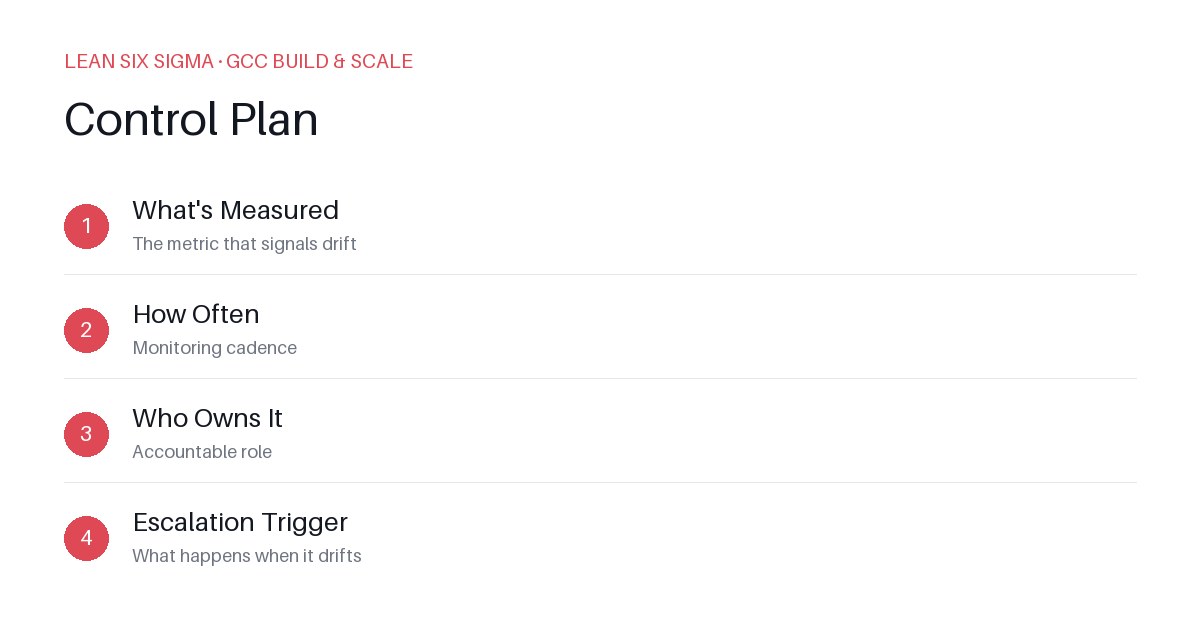
Downloadable templates
Turn your GCC from a cost center into a predictable, high-quality delivery machine with a structured control plan.
Why Your GCC Needs a Control Plan
Most Global Capability Centers (GCCs) fail because they lack a control plan. They build teams, hire talent, and deploy processes, but they don't control the variation. Without a control plan, you're just guessing when something goes wrong.
A control plan is your playbook. It tells you what to do when, so you don't have to improvise under pressure. It's not a document you file away. It's a living system that keeps your GCC stable.
What Goes Into a GCC Control Plan
A control plan has four parts. You need all of them.
- Process Map: Draw your process. Not a flowchart. A map. Show the steps, the handoffs, and the bottlenecks. If you can't map it, you can't control it.
- Critical Quality Characteristics (CQCs): Define what "good" looks like. For a GCC, this might be cycle time, defect rate, or first-pass yield. You need to measure these. If you can't measure it, you can't control it.
- Control Methods: Choose the tools you'll use to monitor your CQCs. These could be control charts, poka-yoke, or automated checks. Pick the tools that fit your process. Don't use a sledgehammer to crack a nut.
- Response Actions: Decide what you'll do when things go wrong. If a defect rate spikes, do you stop the line? Do you retrain? Do you call a root cause analysis? You need a plan. Otherwise, you'll react, not respond.
How to Build a Control Plan in Your GCC
Start with a pilot process. Don't try to control everything at once. Pick a process that's important and has high variation. Then, follow these steps:
- Map the Process: Use a value stream map or a simple flowchart. Show the steps, the handoffs, and the bottlenecks. Get your team involved. They know the process better than you.
- Define CQCs: Identify the metrics that matter. For a GCC, this might be cycle time, defect rate, or first-pass yield. Set targets. Make them realistic. If you set targets that are impossible, your team will give up.
- Choose Control Methods: Pick the tools that fit your process. For example, if you're dealing with defects, use a control chart. If you're dealing with cycle time, use a timer. Pick the tools that are easy to use. If your team won't use them, they're useless.
- Define Response Actions: Decide what you'll do when things go wrong. If a defect rate spikes, do you stop the line? Do you retrain? Do you call a root cause analysis? You need a plan. Otherwise, you'll react, not respond.
Common Mistakes to Avoid
- Too Many CQCs: If you're measuring everything, you're controlling nothing. Pick the metrics that matter. Focus on the few that drive the most value.
- No Response Actions: If you don't have a plan for when things go wrong, you'll improvise. Improvisation is the enemy of stability. You need a plan. Otherwise, you'll react, not respond.
- Ignoring the Team: If your team doesn't buy into the control plan, it won't work. Involve them in the process. They know the process better than you. Make them owners of the control plan. Otherwise, they'll ignore it.
Getting Started
Start small. Pick a pilot process. Build a control plan for it. Test it. Tweak it. Then, scale it. Don't try to control everything at once. Focus on the few processes that drive the most value. Then, build from there. A control plan is not a one-time thing. It's a living system. You need to update it as your GCC grows. Otherwise, it will become obsolete. And then, you'll be back to guessing when something goes wrong.
Comments
Be the first to comment on this post.
Sign in to leave a comment.