Value Stream Mapping a GCC Shared Services Handoff
August 28, 2026
Like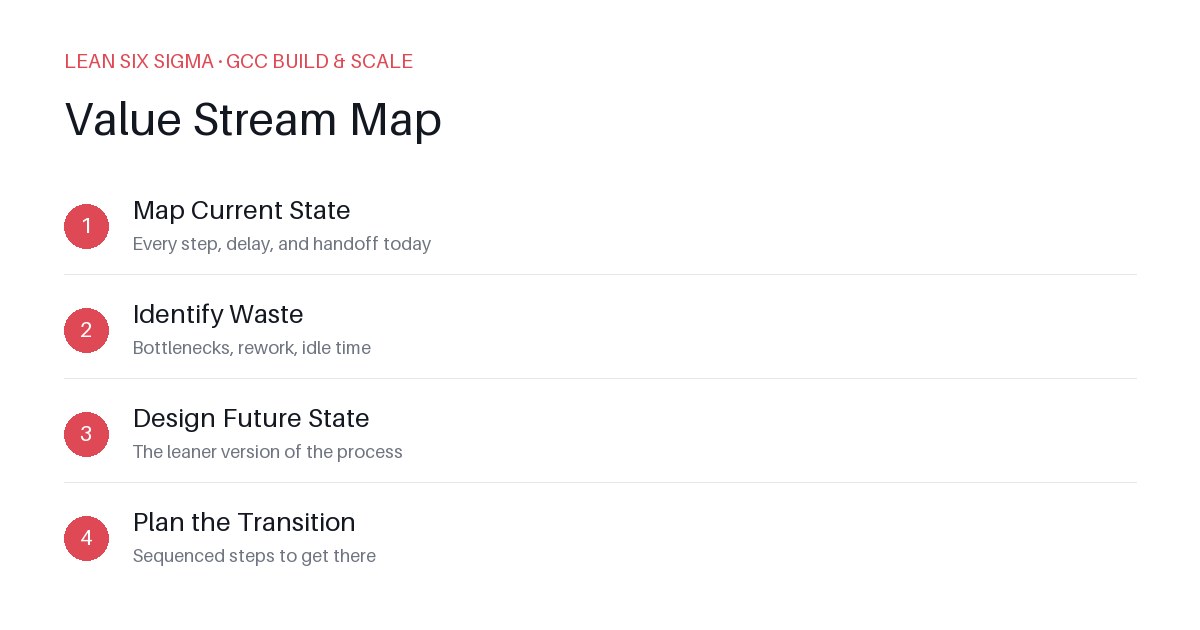
Downloadable templates
A practical walkthrough of applying Value Stream Map to real GCC build-and-scale work.
Why Value Stream Map Matters for GCC Teams
Scaling a Global Capability Center means standardizing work across sites, handoffs, and teams that have never worked together before. Value Stream Mapping gives you a shared vocabulary and a repeatable sequence for doing that. In GCC environments, where work often crosses time zones, legal boundaries, and organizational silos, the invisible friction in handoffs can silently erode delivery velocity. A Value Stream Map makes those handoffs visible. It turns “someone else’s problem” into a documented process step, revealing where work stalls, where approvals loop, and where information is lost in translation.
The Value Stream Map Sequence
-
Map Current State — Every step, delay, and handoff today
Begin by tracing a single end-to-end process — for example, “Request to Provision a New Development Environment” or “Submit a Security Review for a Production Deployment.” Interview subject matter owners at each touchpoint. Capture not just the official steps, but the actual behavior: email chains, Slack pings, status updates, rework loops, and waiting periods. Use swimlanes to show which team or role owns each activity. Mark cycle times and lead times where possible. This raw map becomes your baseline truth. -
Identify Waste — Bottlenecks, rework, idle time
Apply lean principles to your current-state map. Look for the seven wastes: defects, overprocessing, waiting, non-utilized talent, transportation, inventory, and extra-motion. In GCC handoffs, common waste includes: duplicate approvals across regions, manual data re-entry between systems, unclear ownership causing “who’s next?” delays, and handoffs that require physical or digital file transfers instead of system-to-system integration. Quantify impact where possible — e.g., “Security review averages 14 days, with 6 days spent in back-and-forth clarification.” -
Design Future State — The leaner version of the process
Reconstruct the process by eliminating or automating waste. Consolidate approval layers, standardize intake forms, define clear SLAs for each handoff, and assign single points of accountability. Introduce digital handoff triggers where possible — for instance, a ticket status change automatically notifies the next team and attaches required artifacts. Ensure the future state is realistic: don’t eliminate steps that exist for compliance or risk reasons, but streamline how they’re executed. Document the new flow with updated swimlanes, expected cycle times, and success criteria. -
Plan the Transition — Sequenced steps to get there
A future-state map is useless if you can’t get there. Break the transition into phased, low-risk steps. Start with pilot teams or a single process variant. Define change management activities: training, communication, feedback loops, and metrics to track adoption. Assign owners for each transition milestone. Build in review checkpoints to adjust based on real-world usage. Celebrate quick wins to build momentum across the GCC.
Applying It
Start small: pick one recurring pain point your GCC team hits every week, and walk it through these 4 steps before rolling the approach out more broadly. Download the template below to run your first pass. Focus on clarity over perfection in your initial map. Involve cross-functional representatives early — their frontline insights are invaluable. After mapping, schedule a 60-minute workshop to validate findings and co-create the future state. Track baseline metrics before and after implementation to demonstrate ROI. Over time, embed Value Stream Mapping into your GCC’s continuous improvement cadence, reviewing key handoff processes quarterly and updating maps as tools, teams, or compliance requirements evolve.
Comments
Be the first to comment on this post.
Sign in to leave a comment.