RACI Matrices for GCC Cross-Site Ownership
August 25, 2026
Like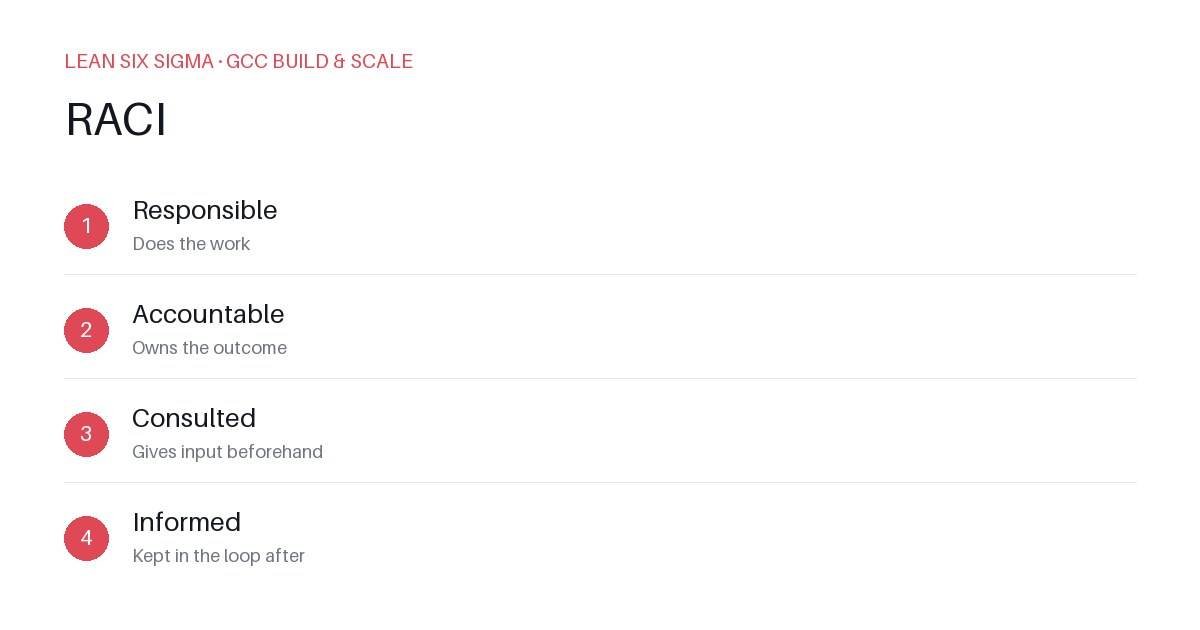
Downloadable templates
Eliminate cross-site handoff friction by assigning clear RACI roles to every process, ensuring accountability without bottlenecks.
Define the Process Boundary
Before you map roles, you need a tight definition of the process. If the scope is vague, the RACI matrix becomes a mess. Start by writing the process in steps. Example: 'Global Risk Assessment Review.' Steps include: Data collection, local analysis, central review, and final approval.
Keep each step atomic. If a step has multiple actions, split it. You can't assign responsibility to a blob.
Assign R, A, C, and I
Now, map each step to a role. Remember: one Accountable, one Responsible, multiple Consulted, multiple Informed.
- R (Responsible): The person who does the work. There can be more than one, but they must coordinate.
- A (Accountable): The person who signs off. There must be exactly one. If you have two, you have no accountability.
- C (Consulted): People whose input is needed before the decision. They don't decide; they advise.
- I (Informed): People who need to know the outcome. They don't influence the decision.
Example: Global Risk Assessment
Step 1: Local Data Collection
- R: Local Risk Analyst
- A: Local Risk Analyst
- C: Local Compliance Officer
- I: Regional Risk Manager
Step 2: Central Review
- R: Central Risk Team
- A: Global Risk Director
- C: Legal Counsel
- I: Local Risk Analysts
Step 3: Final Approval
- R: Global Risk Director
- A: Chief Risk Officer
- C: Board Risk Committee
- I: All Local Risk Analysts
Check for Ambiguity
Look at your matrix. Are there steps with no A? No R? Multiple As? Fix them now. Ambiguity in RACI causes delays and blame games.
If you see a step with no A, assign one. If you see multiple As, pick the final decision-maker.
Communicate the Matrix
A RACI matrix is useless if no one sees it. Post it in the process documentation. Share it in team meetings. Update it when roles change.
If a new person joins the team, show them their RACI roles. If a process changes, update the matrix.
Review Quarterly
RACI matrices aren't set and forget. Review them every quarter. Ask: 'Are these roles still accurate? Are there bottlenecks? Is anyone overloaded?'
If you find a step that's consistently delayed, look at the RACI. Is there a handoff issue? Is there a missing C or I?
Avoid Common Mistakes
- Too many Cs: Consulted people slow down decisions. Only include those whose input is critical.
- No Is: Informed people need to know the outcome. If you miss them, you create surprises.
- R without A: Someone does the work, but no one signs off. This creates risk.
Build Trust Through Clarity
Clear RACI matrices reduce friction. They show everyone who does what and when. This builds trust across sites. When roles are clear, people step up. When they're vague, people step back.
Start small. Pick one process. Map it. Share it. Improve it. Then scale.
Comments
Be the first to comment on this post.
Sign in to leave a comment.