RACI Matrices for GCC Cross-Site Ownership
August 22, 2026
Like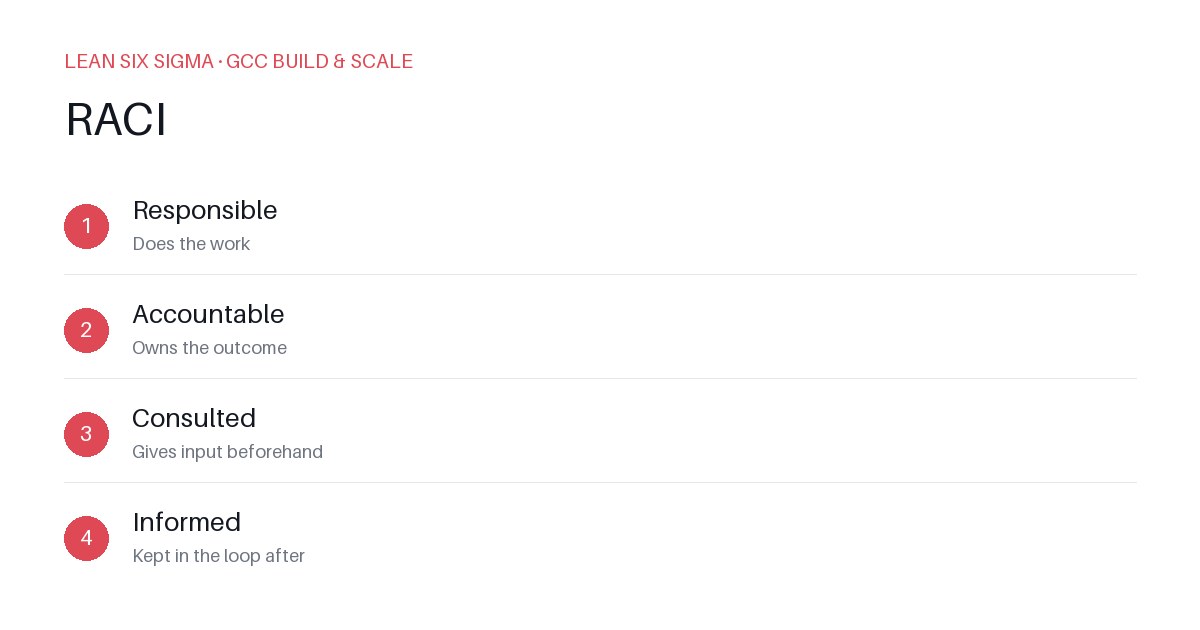
Downloadable templates
Map RACI roles across GCC sites to eliminate overlap, clarify accountability, and scale lean processes without confusion.
The Problem: Multiple Teams, One Process
Global Capability Centers (GCCs) span multiple locations, time zones, and functional silos. Without clear ownership, processes stall. A defect in one region becomes a bottleneck for all. RACI matrices solve this by defining who does what, where.
How RACI Works in GCCs
RACI stands for Responsible, Accountable, Consulted, Informed. Each role has a specific purpose:
- Responsible: The person who completes the task. There can be multiple.
- Accountable: The person who signs off. Only one.
- Consulted: The person whose input is needed before action.
- Informed: The person who receives updates after action.
Building the Matrix
Start with a high-level process map. Identify each step. Assign roles using these rules:
- One Accountable: Never split accountability. Pick the site or role with the final say.
- Clear Responsible: Assign tasks to the site closest to execution.
- Limit Consulted: Too many consultees slow decisions. Keep it to key stakeholders.
- Inform Strategically: Use this for visibility, not action. Avoid notification fatigue.
Real Scenario: Quality Assurance Across GCCs
Consider a GCC in India handling QA for a product team in the US. The process involves:
- Test case creation (India)
- Execution (India)
- Review (US)
- Reporting (US)
RACI assignment:
- Responsible: India QA team
- Accountable: US Quality Lead
- Consulted: US Product Owner
- Informed: US Development Team
This structure ensures India executes without delay, the US owns quality, and relevant parties stay updated.
Common Pitfalls
- Multiple Accountables: Causes delays. Force a single owner.
- No Informed Roles: Leads to surprises. Identify stakeholders early.
- Over-Consulting: Slows work. Limit to critical inputs.
Implementation Steps
- List all process steps across GCC sites.
- Identify stakeholders for each step.
- Assign RACI roles using the rules above.
- Validate with site leads to ensure clarity.
- Document and share the matrix with all teams.
- Review quarterly to adjust as processes evolve.
Tools and Templates
Use simple spreadsheets or process mapping tools. Keep the matrix visible. Update it when roles change. A living RACI matrix prevents drift and confusion.
Conclusion
RACI matrices bring clarity to GCC cross-site ownership. They eliminate ambiguity, streamline workflows, and support lean scalability. Start small. Map one process. Assign roles. Iterate. Scale.
Comments
Be the first to comment on this post.
Sign in to leave a comment.