Cutting GCC Onboarding Time by 40% with DMAIC: A Field Guide
October 3, 2026
Like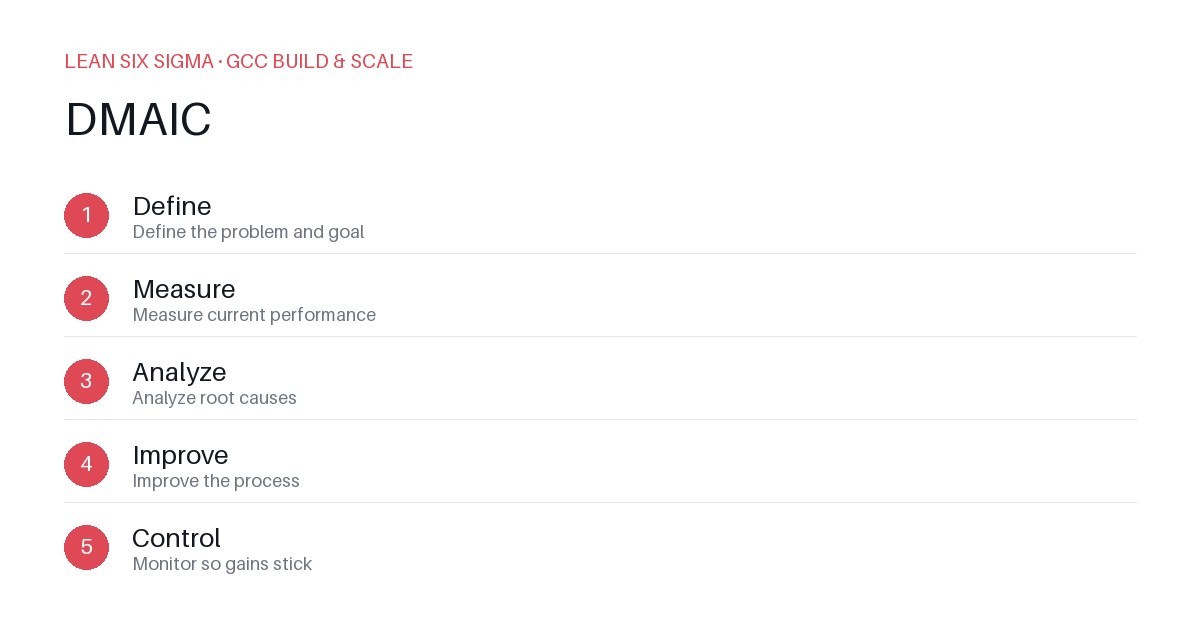
Downloadable templates
A practical DMAIC walkthrough to eliminate bottlenecks in global capability center onboarding and get new hires productive faster.
Defining the Real Problem
Onboarding delays at Global Capability Centers (GCCs) usually stem from fragmented handoffs, not lazy recruiters. Before diving into DMAIC, you need to define the scope precisely. Don't just say "onboarding is slow." Say, "The average time from offer acceptance to first client interaction is 14 days, with 60% of that time spent in IT provisioning and compliance training." That's your baseline. Use value stream mapping to visualize every step from job offer to day one. Identify where the process stalls. Common culprits include manual data entry between HR and IT systems, redundant training modules, and unclear ownership of handoff steps.
Measuring Current Performance
You can't improve what you don't measure. Collect data for at least two weeks. Track lead times for each process step: offer acceptance, background check, IT setup, training completion, and first assignment. Use a simple spreadsheet or lean tool to log timestamps. Look for variance. If some hires take 5 days and others 20, you have process inconsistency. Calculate the cycle time for each step. Identify the longest steps. These are your targets. Set a clear metric: reduce total onboarding time from 14 days to 10 days within 90 days. This gives your team a concrete goal.
Analyzing Root Causes
Now, dig into why the delays happen. Use a 5-Whys analysis on the longest steps. For example, if IT provisioning takes 5 days, ask why. The answer might be manual requests. Ask again. Why manual? Because the system integration isn't automated. You've found a root cause. Map these root causes to each process step. Common issues include:
- Lack of standardized templates for documentation
- Manual data entry between HR and IT systems
- Redundant training modules that don't scale
- Unclear ownership of handoff steps
- Inconsistent IT provisioning timelines
Use a fishbone diagram to categorize these issues into people, process, technology, and environment. This helps you prioritize fixes based on impact and effort. Focus on the high-impact, low-effort items first.
Implementing Lean Solutions
Start with quick wins. Automate data entry between HR and IT using middleware or API integrations. Create standardized templates for documentation and training. Assign clear ownership for each handoff step. For example, designate a GCC coordinator to manage the transition from HR to IT. Train this person on the new process. Run a pilot with a small group of hires. Monitor the results. Adjust as needed. Document the new process. Use visual management boards to track progress. Celebrate small wins to keep momentum.
Controlling and Sustaining Improvements
Once the new process is live, monitor it continuously. Track the same metrics you used in the Measure phase. Compare against your baseline. If delays reappear, investigate immediately. Use control charts to spot trends. Hold weekly reviews with the GCC team to discuss bottlenecks. Update the process as needed. Train new hires on the improved workflow. Incorporate feedback from recent hires into continuous improvement cycles. This ensures the process stays efficient and adapts to changes. Remember, DMAIC isn't a one-time fix. It's a cycle. Keep iterating to maintain gains.
Comments
Be the first to comment on this post.
Sign in to leave a comment.