DMAIC to Fix GCC Onboarding Delays
September 7, 2026
Like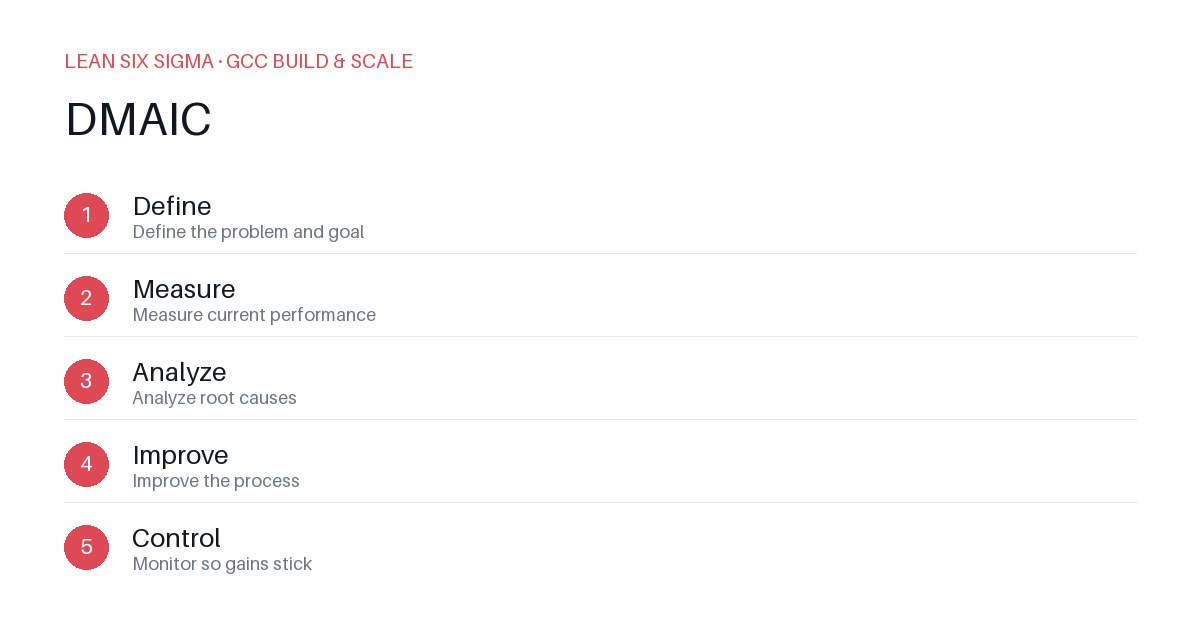
Downloadable templates
Cut onboarding time by mapping bottlenecks with DMAIC instead of guessing where delays hide.
Define the Problem
Onboarding delays in Global Capability Centers (GCCs) usually creep in quietly. New hires spend weeks waiting for access, training materials, or team assignments. The result? Missed ramp-up targets and frustrated managers.
Start by defining what “onboarding” means in your GCC context. Is it the period from hire date to first billable project? From system access to first client meeting? Pick a measurable definition and stick to it.
Next, collect baseline data. Look at the last 20–30 hires. How many days from offer to day one? How many days from day one to first meaningful contribution? Break the process into steps: offer acceptance, IT setup, compliance training, team intro, project assignment.
Map the current state with a simple swimlane diagram. Show who does what and when. You’ll often spot handoffs that create delays — like waiting for HR to approve access before IT can provision it.
Measure the Data
Quantify each step. Time how long IT takes to provision accounts. Track how long compliance training takes to complete. Note how long managers take to assign first tasks.
Use a time log or ticketing system data. If you don’t have that, run a 10-person pilot where each new hire logs their own delays.
Look for the longest steps. Is it IT? Is it legal review? Is it the new hire waiting for their laptop? Don’t assume — measure.
Analyze the Root Causes
Now dig into why the delays happen. Common causes include:
- IT queues without SLAs
- Training materials that require manual updates
- Managers who don’t have clear project pipelines
- No single point of contact for onboarding
Use a root cause analysis. For example, if IT provisioning takes 7 days, ask why. Is it a lack of automated provisioning? Is it a bottleneck in one engineer’s inbox? Is it a policy requiring manual approvals?
Map each delay to its cause. You’ll find that some delays are systemic (process gaps) and some are behavioral (lack of accountability).
Improve the Process
Fix the root causes. Start with the biggest delays.
If IT is the bottleneck, implement automated provisioning where possible. If not, set an SLA with daily updates to new hires.
If training is slow, create a self-paced module with clear completion criteria.
If managers delay project assignment, require them to have a 30-day plan ready before the hire starts.
Assign owners to each fix. Set deadlines. Track progress.
Control and Monitor
After improvements, monitor the new process. Track onboarding time for the next 20 hires.
Compare to baseline. If delays return, investigate early.
Update your standard operating procedure (SOP) to reflect the new process. Train onboarding coordinators.
Review quarterly. Onboarding doesn’t stay fixed — teams change, tools change, and new bottlenecks appear.
Use DMAIC to keep onboarding tight and predictable.
Comments
Be the first to comment on this post.
Sign in to leave a comment.