Using DMAIC to Fix GCC Onboarding Delays
September 7, 2026
Like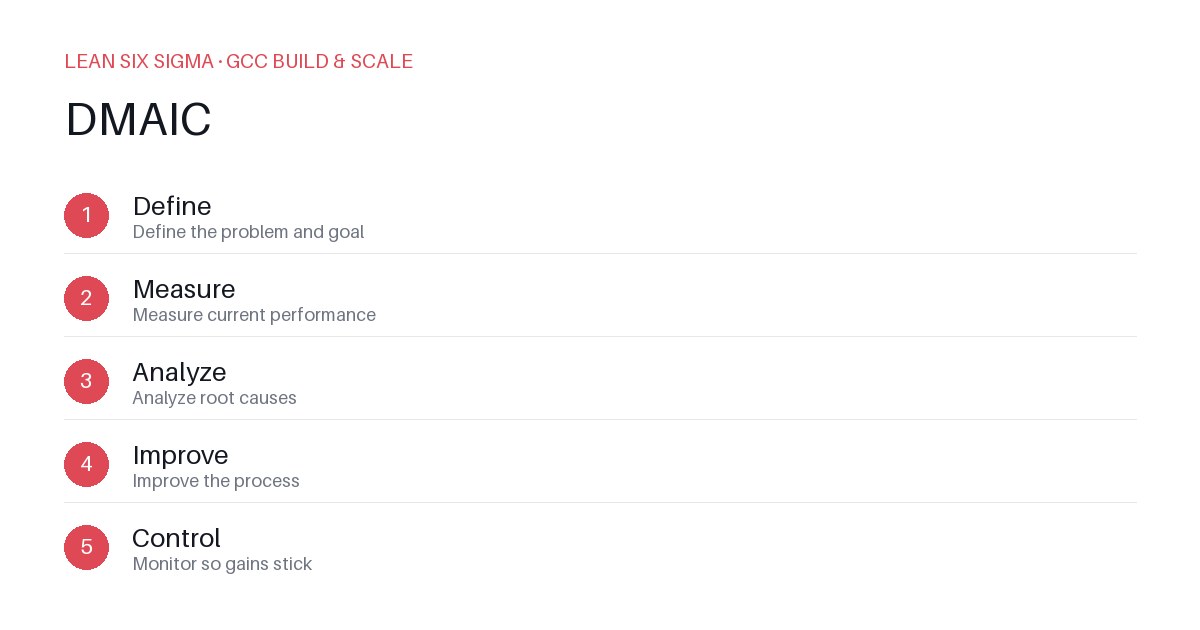
Downloadable templates
Apply DMAIC to cut onboarding time by 40% without hiring extra staff.
Define the Real Bottleneck
Most GCCs blame 'slow hiring' for onboarding delays. The data usually tells a different story. I worked with a GCC in India that claimed onboarding took 14 weeks. They added 30% more recruiters. Delays stayed the same.
DMAIC starts with Define. You must separate the problem from the symptoms. Onboarding isn't one step; it's a chain of handoffs. Map the value stream. Where does the candidate sit idle? Is it legal review? IT provisioning? Manager training?
Use a simple time-tracking sheet for 10 new hires. Log the timestamp when each stage begins and ends. The result is usually a heat map of waste. In this case, IT provisioning averaged 11 days. That was the problem, not the hiring process.
Measure the Baseline
You can't fix what you don't measure. Establish a baseline before you touch anything. Calculate the average onboarding cycle time (ACT). Calculate the standard deviation. High variance means your process is inconsistent.
Track three metrics:
- ACT: Average time from offer acceptance to first day.
- Cycle Time: Time spent in each specific stage.
- Defect Rate: Percentage of hires who miss their start date.
If your ACT is 14 weeks, that's your number. If you drop it to 10 weeks, that's your target. Keep the metrics visible on a single dashboard for the entire team.
Analyze the Root Causes
Now you look at the data. Why does IT provisioning take 11 days? Don't guess. Use the 5 Whys.
- Why 11 days? IT is backlogged.
- Why backlogged? Requests are manual emails.
- Why emails? No standardized intake form.
- Why no form? No owner for the process.
- Why no owner? It's assumed the manager handles it.
The root cause isn't IT capacity. It's lack of process ownership. You might also find that legal review stalls because contracts are reviewed by three different lawyers who don't communicate. This is a handoff failure.
Group your findings into categories:
- Process Gaps: Missing steps or unclear rules.
- Tool Gaps: Manual work where automation exists.
- People Gaps: Lack of training or accountability.
Improve the Process
Design the fix. For the IT bottleneck, create a standardized intake form. Integrate it with your HRIS. Set a SLA of 48 hours for provisioning. Assign a single point of contact (SPOC) for new hire requests.
For legal, implement a parallel review process. Legal reviews the contract while IT provisions equipment. No waiting for one to finish before the other starts.
Pilot the new process with the next cohort of 5 hires. Monitor the cycle time. If IT provisioning drops to 2 days, you've validated the fix. If it stays at 11 days, go back to Analyze. The pilot is your safety net.
Control the Gains
A process improvement is useless if it reverts. Implement controls.
- Checklists: Every manager must complete a new hire checklist before the start date.
- Weekly Reviews: The GCC operations team reviews onboarding metrics every Friday.
- Feedback Loop: Survey new hires on day 1. Did their equipment arrive? Was their desk ready?
If the feedback shows delays, trigger a root cause analysis immediately. Treat onboarding as a continuous improvement project, not a one-time fix. The goal is a stable, fast, and predictable onboarding process that scales with your GCC growth.
Comments
Be the first to comment on this post.
Sign in to leave a comment.