Kaizen Habits for Distributed GCC Teams
September 16, 2026
Like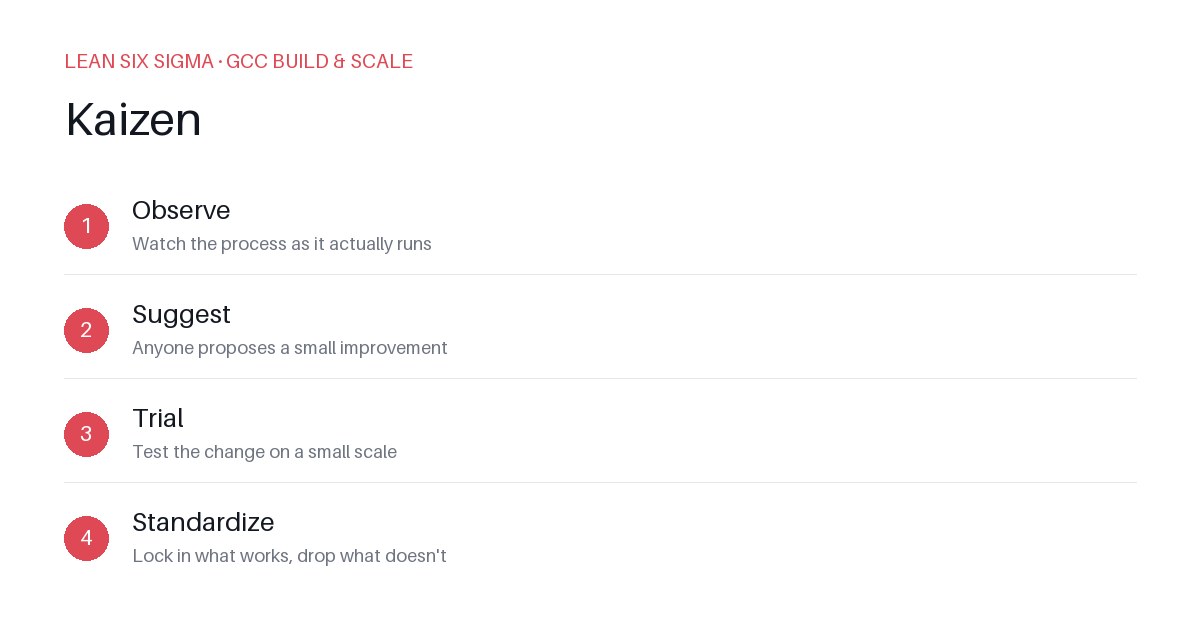
Downloadable templates
A practical walkthrough of applying Kaizen to real GCC build-and-scale work.
Why Kaizen Matters for GCC Teams
Scaling a Global Capability Center means standardizing work across sites, handoffs, and teams that have never worked together before. Kaizen gives you a shared vocabulary and a repeatable sequence for doing that. In distributed environments, where communication latency, time-zone differences, and cultural nuances can amplify small inefficiencies, having a disciplined framework for continuous improvement is not just helpful — it’s essential. Kaizen isn’t about radical transformation; it’s about incremental, sustainable change driven by the people who do the work. For GCC teams, this means turning fragmented local practices into a coherent, scalable operating model without sacrificing agility or morale.
The Kaizen Sequence
- Observe — Watch the process as it actually runs. This isn’t about reviewing documentation or asking “what should happen.” It’s about shadowing real workflows, capturing handoff delays, identifying where work stalls, and noting the friction points that cause rework or bottlenecks. In a distributed GCC, this might mean joining a cross-site sprint retrospective, reviewing ticket aging trends, or mapping the actual steps between discovery and delivery across regions.
- Suggest — Anyone proposes a small improvement. The key here is psychological safety and inclusivity. Encourage team members at all levels to surface ideas, no matter how minor. A suggestion could be as simple as “Let’s add a 15-minute sync before handoff to Region B” or “Use a shared checklist for QA sign-off.” The goal is to generate a backlog of actionable, low-risk changes that address observed pain points.
- Trial — Test the change on a small scale. Don’t roll out improvements globally on day one. Instead, pilot them with one pod, one project, or one week’s worth of work. Measure impact: Did cycle time decrease? Were errors reduced? Was team satisfaction improved? In distributed GCCs, trials should include representatives from each site involved to ensure the change works across contexts and doesn’t create new dependencies.
- Standardize — Lock in what works, drop what doesn’t. Once a trial proves its value, formalize the change into your team’s operating rhythm. This could mean updating runbooks, embedding steps into automation, or adding checkpoints to your cadence. Crucially, document why the change was made and what metrics it improved — this builds institutional knowledge and prevents regression when new team members join.
Applying It
Start small: pick one recurring pain point your GCC team hits every week, and walk it through these 4 steps before rolling the approach out more broadly. For example, if your team consistently misses SLAs due to unclear ownership during cross-region handoffs, observe the handoff process, gather suggestions from engineers, QA, and PMs, trial a simple RACI matrix or handoff checklist, and then standardize it into your project templates. Download the template below to run your first pass. Consistency in applying the Kaizen sequence builds momentum, fosters a culture of ownership, and turns distributed complexity into a competitive advantage.
Comments
Be the first to comment on this post.
Sign in to leave a comment.