RACI Matrices for GCC Cross-Site Ownership
September 14, 2026
Like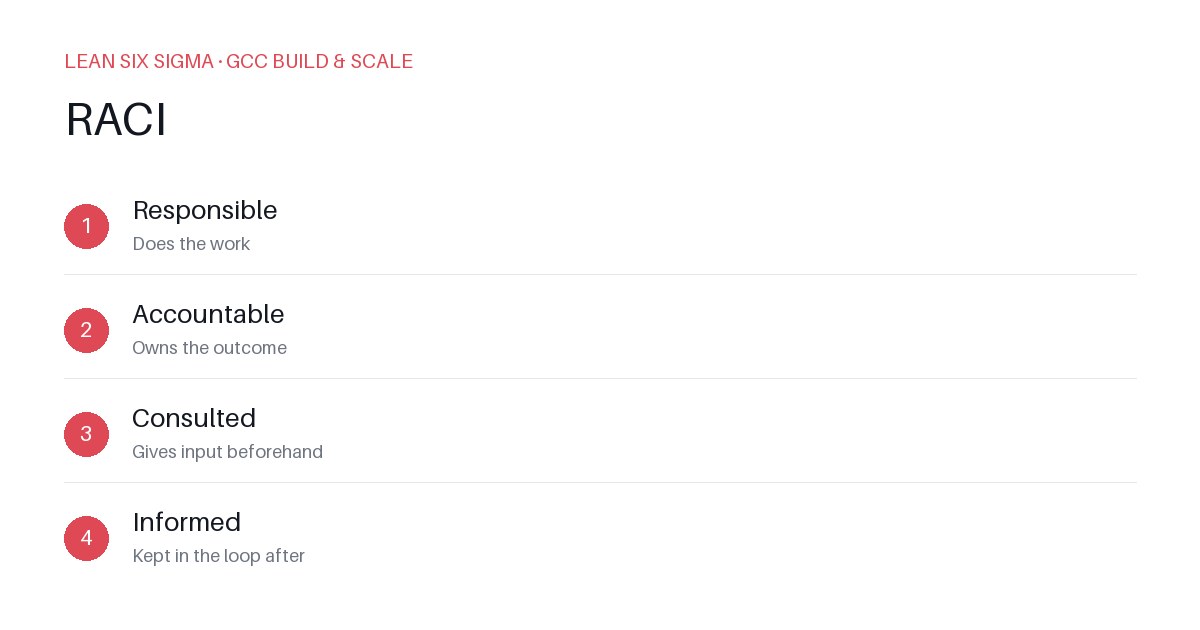
Downloadable templates
Stop guessing who owns what in your GCC. Use a strict RACI framework to eliminate handoff delays across global sites.
The Problem: Shadow Owners and Silent Bottlenecks
You have three GCCs across India, Brazil, and the Netherlands. They all report to the same Center of Excellence (CoE). When a process optimization project starts, everyone assumes the India team owns the documentation while Brazil handles the pilot. Six weeks later, the pilot is stalled because the documentation never arrived. There was no single source of truth. That ambiguity costs you velocity and morale.
Define the Roles Clearly
RACI stands for Responsible, Accountable, Consulted, and Informed. In a GCC environment, you must map these roles for every deliverable, not just the overall project.
- Responsible: The team actually doing the work. This is usually the local GCC staff.
- Accountable: The single person who signs off on the work. This is the GCC Head or CoE lead.
- Consulted: People whose input is needed before the work is done. These are subject matter experts or stakeholders.
- Informed: People who need updates but don't influence the work. These are regional managers or finance.
Build the Matrix for Cross-Site Workflows
Create a simple grid for each project phase. List the phases as rows and the roles as columns. Fill in the letters. For example, in the 'Process Design' phase, the India team might be 'R', the CoE lead is 'A', and the Brazil team is 'C'. This visual map removes guesswork.
Enforce One 'A' Per Task
The biggest mistake teams make is assigning two 'A's. If both the India and Brazil leads are marked as 'A', you get conflict. Always ensure only one person is 'A' for each task. This forces accountability and stops the 'wait for approval' loop.
Use the Matrix for Onboarding
When a new hire joins a GCC, give them the RACI matrix for their first project. They immediately see where they fit. They know who to ask for input and who to report to. This reduces ramp-up time and prevents them from overstepping or underperforming.
Review and Update Quarterly
GCCs evolve. Roles shift. Revisit your RACI matrix every quarter. Ask the team: "Did this work? Was anyone blocked?" Adjust the letters as needed. A static RACI becomes obsolete quickly in a scaling GCC.
Final Tip: Keep it Simple
Don't overcomplicate the matrix. Use it for critical path items only. For small tasks, a quick chat is enough. The goal is clarity, not bureaucracy. Use RACI to streamline, not slow down.
Comments
Be the first to comment on this post.
Sign in to leave a comment.