RACI Matrices for GCC Cross-Site Ownership
September 12, 2026
Like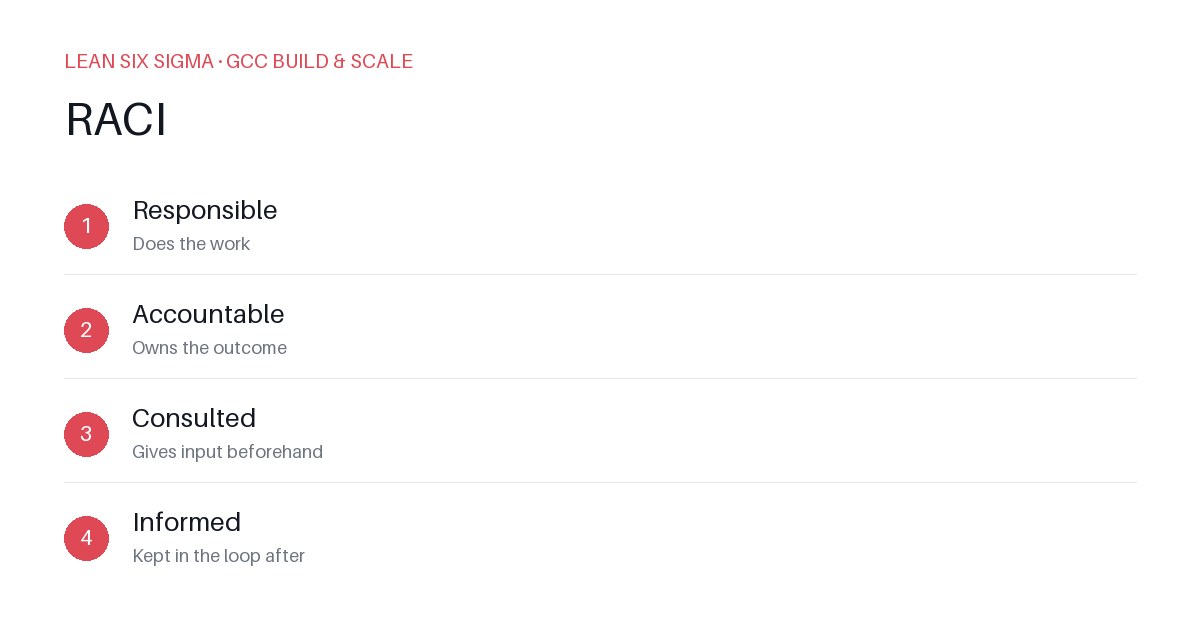
Downloadable templates
Eliminate handoff friction between GCCs using a practical RACI framework to clarify who owns what, where, and when.
The Cross-Site Coordination Problem
When you run multiple Global Capability Centers (GCCs), you quickly hit the same wall: duplicate work, conflicting priorities, and blurred accountability. You have a data analytics GCC in India, a UX research GCC in Brazil, and a process automation GCC in the US. They all touch the same customer journey. Without clear ownership, you end up with three teams building three different dashboards, and no one knows which one is the source of truth.
This isn’t a people problem. It’s a structure problem. The fix is a RACI matrix — but not the generic one you find in a PMP textbook. You need a version that maps to cross-site workflows, not just internal project tasks.
How to Build a GCC-Specific RACI
Start by listing the key processes or deliverables that span multiple GCCs. Examples:
- Customer segmentation model
- Process automation playbook
- UX research insights repository
For each item, assign four roles:
- Responsible: The team that does the work.
- Accountable: The single person who signs off.
- Consulted: Those whose input is needed before decisions.
- Informed: Those who need updates after decisions.
The critical rule: only one A per item. If you have two accountables, you have no accountability.
Mapping RACI to Cross-Site Workflows
Most GCCs fail here because they map RACI to people, not to roles and locations. Instead, map it to:
- Role: e.g., Data Scientist, Product Owner, Quality Lead
- Location: e.g., GCC-India, GCC-Brazil, HQ-US
- Function: e.g., Analytics, UX, Automation
Example: Customer segmentation model
- R: Data Science team (GCC-India)
- A: Head of Customer Analytics (HQ-US)
- C: Product Marketing (GCC-Brazil), UX Research Lead (GCC-India)
- I: Product Owners (all GCCs), Marketing Ops (HQ-US)
This makes it clear who does the work, who owns the outcome, and who needs to be looped in.
Implementing the RACI Matrix
- List all cross-GCC processes: Start with the top 5–10 that cause the most friction.
- Assign R, A, C, I for each: Use the roles and locations above. Avoid assigning to individuals; assign to roles.
- Validate with stakeholders: Run a 30-minute workshop with leads from each GCC. Challenge the A assignments — they’re the most common source of conflict.
- Publish and enforce: Put the RACI in a shared wiki or Confluence. Link it to your process documentation. Update it quarterly.
- Audit and adjust: If a process is delayed, ask: “Who was A? Who was C? Was the right person consulted?” Use the RACI to diagnose, not blame.
Common Pitfalls to Avoid
- Multiple Accountables: If you have two As, you have no accountability. Pick one.
- Too Many Consulted: If you have five Cs, decision-making slows. Limit to 2–3 key voices.
- Static Matrices: GCCs evolve. Update RACIs when roles change or new processes emerge.
- Ignoring the “I”: Informed parties need updates. If you skip them, you create silos.
Next Steps
Start small. Pick one cross-GCC process that’s causing friction. Build a RACI for it. Run it for a month. Measure the impact on cycle time and rework. Then scale to the next process.
A well-built RACI doesn’t just clarify ownership — it accelerates delivery, reduces waste, and builds trust across GCCs. That’s the Lean Six Sigma way: eliminate ambiguity, standardize the process, and measure the result.
Comments
Be the first to comment on this post.
Sign in to leave a comment.