Kaizen Habits for Distributed GCC Teams
September 19, 2026
Like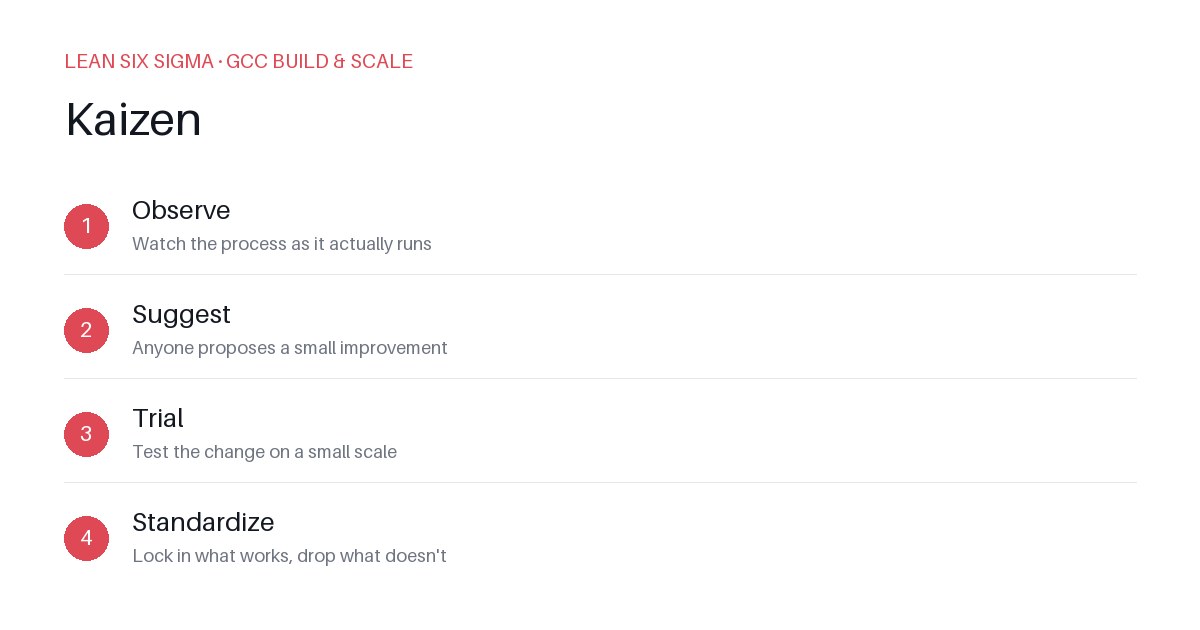
Downloadable templates
Build a continuous improvement culture across distributed GCC teams with practical, daily habits that drive real results.
Start with Visual Management
Distributed teams struggle when work is hidden in emails or Slack threads. Make the work visible.
- Use a shared Kanban board (Trello, Jira, or Miro) for all GCC initiatives.
- Group cards by process, not person.
- Update status daily: To Do, Doing, Done.
- Highlight blockers in red — visibility forces action.
Run Daily 15-Minute Huddles
Replace hour-long meetings with focused stand-ups.
- Each team member shares: What I did yesterday, What I’m doing today, What’s blocking me.
- Keep it to 15 minutes max.
- End with one decision or action item.
- Rotate facilitation to build ownership.
Implement Weekly Kaizen Events
Dedicate one hour every Friday to process improvement.
- Pick one bottleneck from the week.
- Map the current state (value stream map).
- Identify waste (muda) — delays, rework, waiting.
- Propose one small fix.
- Test it the next week. Measure the impact.
Use PDCA for Continuous Improvement
Apply Plan-Do-Check-Act to every process tweak.
- Plan: Define the problem and goal.
- Do: Implement the change.
- Check: Measure results against baseline.
- Act: Standardize if it works, adjust if not.
Example: A GCC team reduced onboarding time from 3 weeks to 10 days by automating document collection.
Encourage Frontline Voice
Frontline staff see waste first.
- Create a suggestion box (digital or physical).
- Review suggestions weekly.
- Reward quick wins — even small ones.
- Share success stories in team channels.
Measure What Matters
Track metrics that reflect real improvement.
- Cycle time (how fast work moves).
- Defect rate (errors per deliverable).
- Employee engagement (survey scores).
- Utilization rate (capacity vs. demand).
Avoid vanity metrics like “hours worked” or “tickets closed.”
Build a Feedback Loop
Continuous improvement needs continuous feedback.
- Hold monthly retrospectives.
- Ask: What worked? What didn’t? What will we change?
- Update SOPs based on learnings.
- Train new hires on the improved process.
Sustain the Culture
Kaizen isn’t a project — it’s a habit.
- Assign a Kaizen champion in each team.
- Celebrate small wins publicly.
- Tie improvements to business outcomes.
- Review and refine your Kaizen practices quarterly.
Next Steps
Start small. Pick one habit — visual management or daily huddles — and run it for two weeks. Measure the impact. Then add another.
Consistency beats intensity. Small, frequent improvements compound into major gains.
Comments
Be the first to comment on this post.
Sign in to leave a comment.