Kaizen Habits for Distributed GCC Teams
October 17, 2026
Like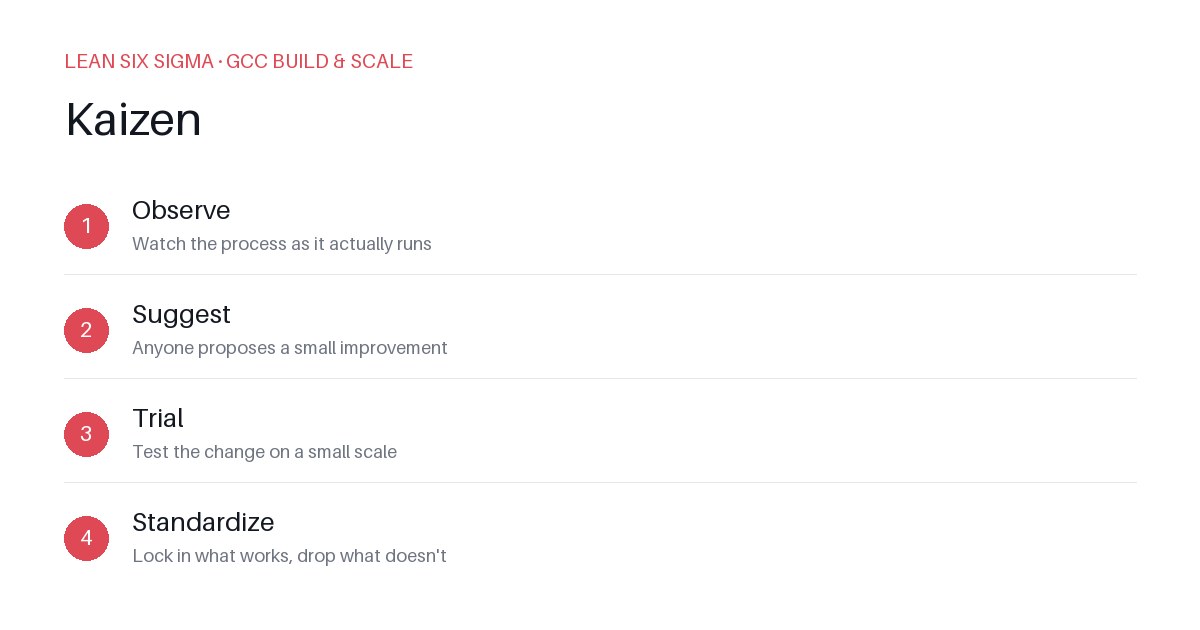
Downloadable templates
Five daily micro-habits that keep distributed GCC teams focused on continuous improvement without burning out.
Start with a 15-Minute Daily Standup
Distributed teams often default to long meetings. Cut that out. Instead, run a 15-minute daily standup focused on three things: what you did yesterday, what you’re doing today, and what’s blocking you. Keep it to the point. No status updates that could be an email. If someone raises a block, assign an owner and move on. This creates a rhythm of accountability without the time tax.
Use Visual Kanban Boards
Digital tools like Jira, Trello, or Asana work, but they only help if everyone follows the same rules. Standardize your board: columns for To Do, In Progress, Review, and Done. Limit work-in-progress (WIP) to two items per person. When someone sees the board full, they know it’s time to stop starting new work and finish what’s there. Visuals reduce ambiguity and keep momentum.
Implement the “Five Whys” for Root Causes
When something breaks—whether it’s a process delay or a quality issue—don’t just patch it. Ask “why” five times until you hit the real cause. Example: A team member missed a deadline. Why? Because they were waiting on approval. Why? Because the approver was out. Why? Because no backup was assigned. Why? Because no one thought to plan for absences. Why? Because onboarding didn’t cover contingency planning. Fix the last one, not the symptom.
Run Weekly Retro with Action Items
every week, hold a 30-minute retro. Use a simple format: what went well, what didn’t, and what we’ll change. The key is to end with one or two actionable items. No vague promises. Example: “We’ll add a checklist to our release process to catch missing test cases.” Assign an owner and a deadline. Track it in your Kanban board.
Encourage Peer Coaching Over Manager Fixes
In a GCC, you want teams to self-correct. Train senior members to coach peers through problems. Instead of jumping in, ask: “What’s your hypothesis?” “What data supports that?” “What’s your plan?” This builds ownership and reduces bottlenecks. Managers should step back and let the team solve it, stepping in only when stuck.
Measure What Matters
Track simple metrics: cycle time, defect rate, and team satisfaction. Don’t overcomplicate it. If cycle time drops, you’re moving faster. If defects rise, you’re cutting corners. If satisfaction falls, you’re burning out. Use these to guide your Kaizen efforts. Adjust, don’t add complexity.
Build a Culture of Small Wins
Kaizen isn’t about big transformations. It’s about tiny improvements that compound. Celebrate small wins. Share them. Make them visible. When a team member suggests a change that saves an hour a week, acknowledge it. Reinforce the behavior. Over time, these small shifts create a culture where improvement is automatic, not optional.
Comments
Be the first to comment on this post.
Sign in to leave a comment.