Kaizen Habits for Distributed GCC Teams
August 19, 2026
Like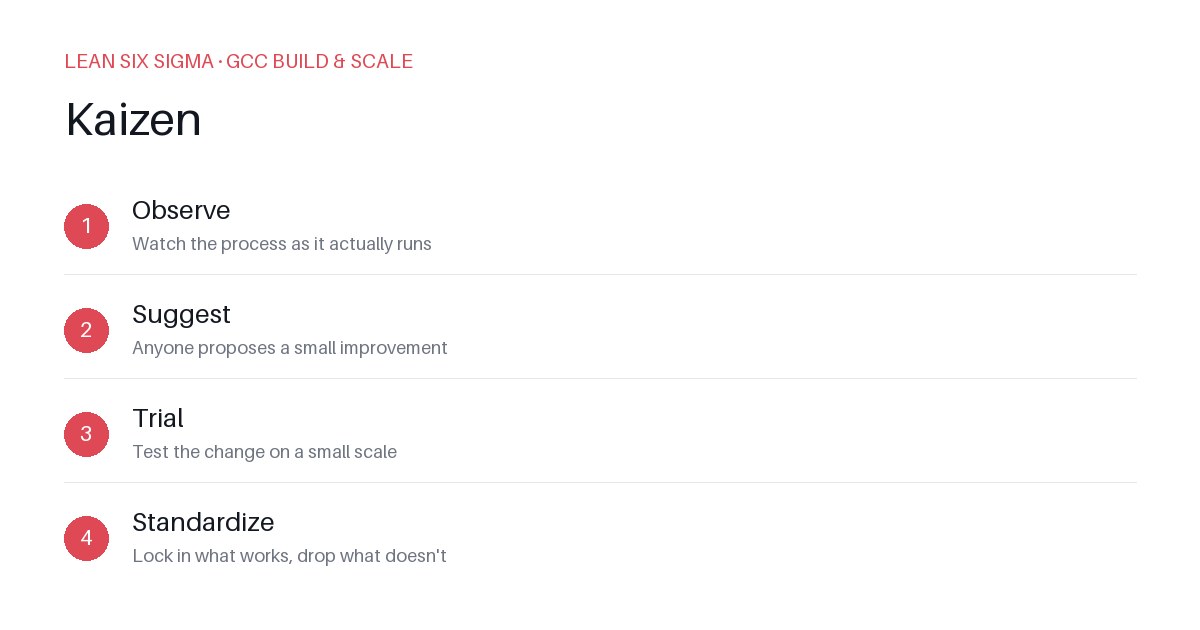
Downloadable templates
Small, repeatable improvements drive sustainable growth in distributed Global Capability Centers.
The Distributed GCC Reality
Global Capability Centers (GCCs) are rarely monolithic. They span time zones, cultures, and legacy systems. Traditional top-down process overhauls fail here because they ignore the ground truth of daily operations. Kaizen, the philosophy of continuous improvement, isn’t a program; it’s a habit. When distributed teams adopt Kaizen habits, they turn friction into fuel for scaling.
Start with the 5 Whys, Not the Spreadsheet
Most GCC leaders reach for dashboards before diagnosing problems. This is backwards. Begin with a specific pain point—say, a 48-hour delay in defect resolution. Ask "Why?" five times.
- Why the delay? QA handoff takes too long.
- Why? Test environments are unstable.
- Why? DevOps pipeline lacks automated provisioning.
- Why? No standard playbook exists.
- Why? Ownership is unclear between teams.
The root cause isn’t the delay; it’s the lack of a standardized, automated handoff. Fix the root, not the symptom.
Implement Daily 15-Minute Kaizen Huddles
Distributed teams often skip daily alignment because of time zone conflicts. Replace lengthy status meetings with 15-minute Kaizen huddles focused on one improvement. Use a rotating facilitator to keep engagement high. The agenda is strict: one problem, one solution, one owner. This creates momentum without burning out teams.
Visualize the Flow, Not Just the Output
GCCs track velocity and utilization, but these metrics hide bottlenecks. Map the value stream for a core capability. Identify where work piles up. Use simple Kanban boards visible to all time zones. When a bottleneck is visible, the team naturally prioritizes clearing it. Visualization turns abstract delays into actionable tasks.
Standardize, Then Improve
A common mistake is chasing perfection before standardization. Document the current best practice, even if it’s imperfect. Once everyone follows the same steps, you can measure the impact of changes. For example, standardize code review checklists before experimenting with AI-assisted reviews. You need a baseline to know if your improvement actually works.
Celebrate Micro-Wins Publicly
distributed teams need recognition to sustain momentum. Highlight small improvements in weekly newsletters or Slack channels. When a team reduces onboarding time by 20%, acknowledge it. Public recognition reinforces the Kaizen mindset and encourages other teams to share their improvements. It turns individual efforts into collective learning.
Build a Kaizen Champion Network
Kaizen doesn’t scale through mandates. It scales through champions. Identify influential members in each region or team and train them in Kaizen techniques. These champions facilitate local improvements and share insights across the GCC. A network of champions creates a self-sustaining improvement culture that outlasts any single initiative.
Measure the Right Metrics
track the number of improvements implemented, not just the number of meetings held. Monitor cycle time reduction, defect escape rates, and team engagement scores. If these metrics plateau, revisit the Kaizen habits. Are the huddles too long? Is the root cause analysis too superficial? Adjust based on data, not intuition.
Close the Loop
Kaizen is a cycle, not a destination. After implementing an improvement, review its impact after 30 days. Did it stick? Did it create new bottlenecks? If not, iterate. This close-the-loop discipline ensures that improvements compound over time, building a resilient, high-performing GCC that scales with the business.
Comments
Be the first to comment on this post.
Sign in to leave a comment.