Lean VSM for GCC Handoffs: Cut Waste, Speed Delivery
September 2, 2026
Like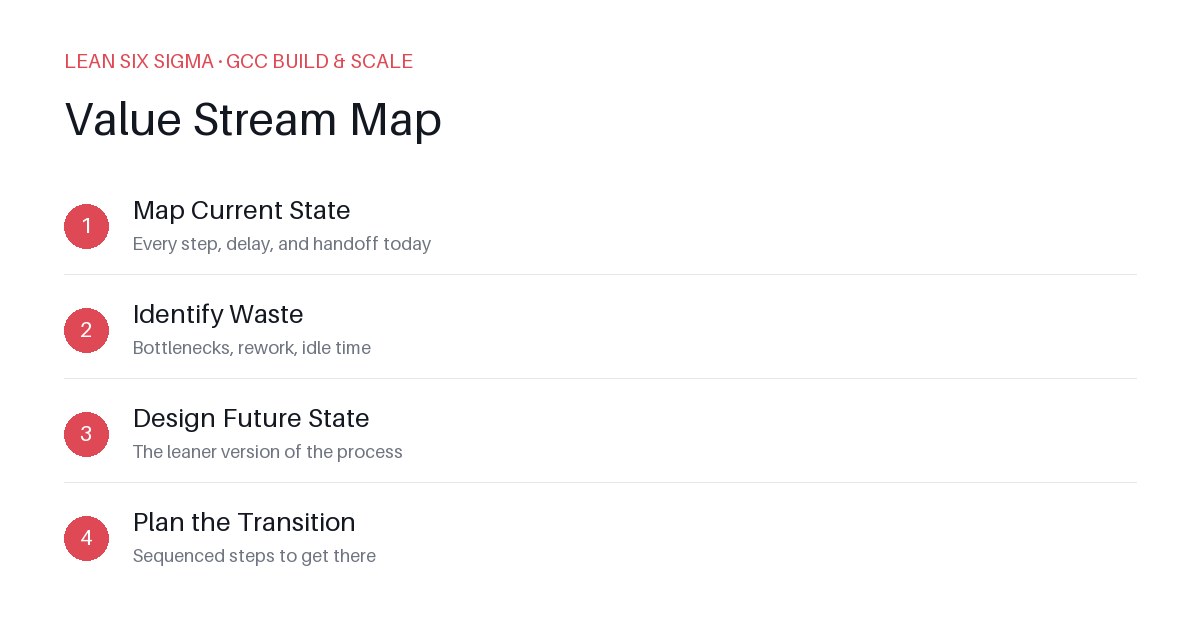
Downloadable templates
Apply Lean VSM to GCC handoffs to expose delays, clarify ownership, and cut cycle time from weeks to days.
Why Handoffs Are Where Value Dies
Shared services transfers between GCCs and business units are notorious for hidden bottlenecks. Documents sit in email threads. Stakeholders wait for approvals that never come. You don’t know who owns what until a deadline breaks. A Value Stream Map (VSM) exposes the actual flow of work, not the assumed one.
Step 1: Define the Scope and Boundaries
Start tight. Pick one recurring handoff — for example, a new reporting dashboard moving from the analytics GCC to the finance business unit. Define what “done” means. Define where the handoff starts and ends. Anything outside those lines is noise for this map.
Step 2: Map the Current State
Gather the people who actually do the work. Not the managers. The analysts, the approvers, the IT support. Walk through the last real handoff. Ask: who does what, when, and for how long. Record each step. Time it. Note delays. Use sticky notes or a whiteboard. Don’t polish yet.
Step 3: Identify Value-Added vs. Non-Value-Added Steps
Value-added steps move the work closer to the customer’s need. Examples: building the report, testing accuracy, final sign-off. Non-value-added steps add no customer value: email approvals, rework loops, waiting for IT, duplicate reviews. Mark each step clearly. You’ll see how much of the process is waiting or rework.
Step 4: Calculate Cycle Time and Lead Time
Cycle time is the time between steps. Lead time is the total time from start to finish. Sum the non-value-added time. You’ll likely find it dwarfs the value-added time. Quantify the waste. This becomes your baseline for improvement.
Step 5: Design the Future State
Now strip the waste. Combine steps where possible. Remove approvals that don’t add value. Automate status updates. Clarify handoff ownership. Define clear entry and exit criteria for each step. Draw the new flow. Keep it simple. Aim for fewer steps, faster flow, less waiting.
Step 6: Implement and Monitor
Roll out the new process. Train the team. Track the same metrics: cycle time, lead time, defect rate. Compare to the baseline. Adjust as needed. VSM is not a one-time exercise. Revisit it quarterly. Update it when the process changes. Continuous improvement starts with seeing the truth.
Real Scenario: From 21 Days to 4
A GCC analytics team used to take 21 days to hand off a monthly sales dashboard to the finance team. The VSM revealed seven approval layers, three rework loops, and 14 days of waiting for IT. They eliminated redundant approvals, automated status tracking, and clarified handoff criteria. The new process took 4 days. Error rates dropped by 60%. The team measured the improvement weekly and refined the process further.
Comments
Be the first to comment on this post.
Sign in to leave a comment.