Value Stream Mapping a GCC Shared Services Handoff
August 31, 2026
Like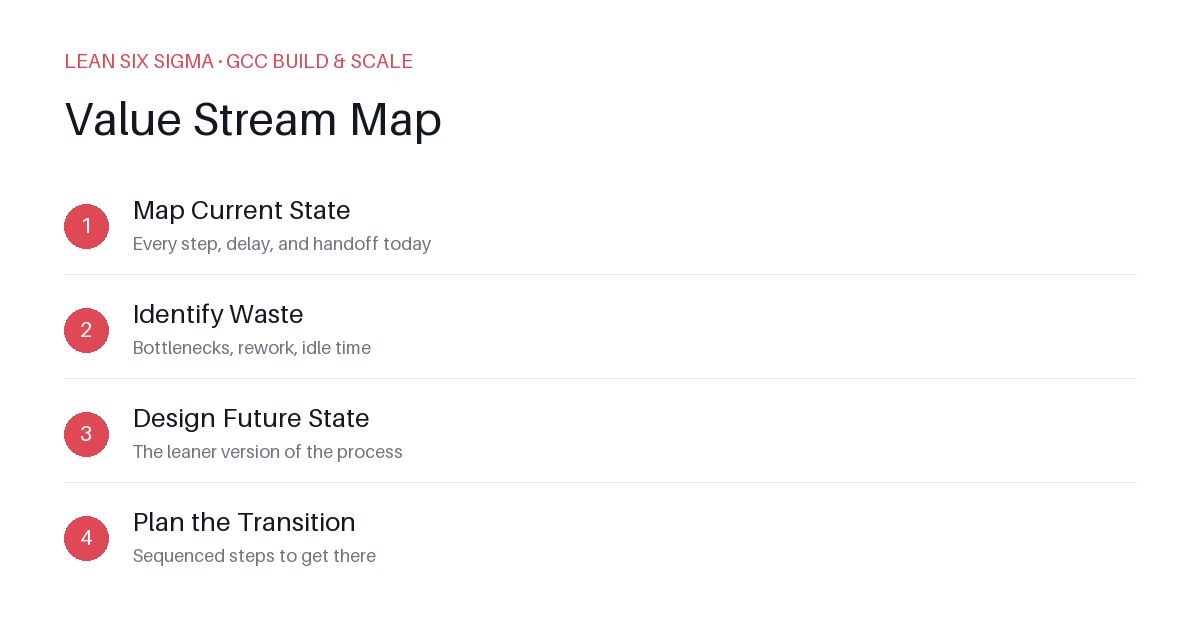
Downloadable templates
Cut handoff waste by mapping the exact flow of work between GCC teams and local operations.
The Handoff Problem
GCCs excel at centralized expertise, but value dies at the handoff. A ticket moves from local ops to the GCC, gets analyzed, then returns with a solution that takes weeks to implement. Meanwhile, local teams idle, rework, or bypass the GCC entirely. You’re paying for expertise that never lands.
Value Stream Mapping (VSM) exposes this. It’s not a pretty diagram. It’s a diagnostic tool that shows where work stalls, where information is lost, and where cycles multiply. Map the handoff as you would a manufacturing line: trace one unit of work from trigger to completion, and you’ll see the friction.
Map the Current State
Start with a single, high-volume handoff. Pick a process like incident resolution, configuration change, or deployment support. Don’t try to map the whole GCC. Pick one flow.
Walk the path with the people who actually do the work. Not managers. Not architects. The people who click, copy, and wait.
Record these fields for every step:
- Who performs the step
- What input they need
- What output they produce
- How long it takes (actual, not estimated)
- What triggers the next step
- Where work sits idle
You’ll quickly see patterns. Information gets re-entered. Status updates require manual follow-ups. Approval gates sit in inboxes. Each of these is a waste of capacity.
Identify the Value-Adding Steps
Not every step creates value. Value means the customer receives something better, faster, or cheaper. Most handoff steps are not value-adding. They’re administrative, redundant, or defensive.
Mark each step:
- Value-adding: Directly improves the solution or accelerates delivery
- Non-value-adding: Administrative, waiting, rework, or handoff overhead
You’ll find that 60–80% of the time in a handoff is non-value-adding. That’s your target.
Design the Future State
Now you redesign. The goal isn’t to add steps. It’s to eliminate waste, standardize flow, and reduce handoff friction.
Apply these tactics:
- Merge steps: Combine adjacent non-value-adding steps into one workflow. Example: Instead of separate steps for ticket triage and root cause analysis, merge them into a single review process.
- Automate status updates: Remove manual follow-ups. Use system triggers to notify stakeholders.
- Standardize handoff templates: Require structured inputs and outputs. No free-form emails. Use forms with required fields.
- Define clear SLAs per step: Not end-to-end. Per step. This exposes bottlenecks and creates accountability.
- Eliminate approval gates where possible: Use checklists and automated validations instead of manual sign-offs.
Implement and Measure
VSM is useless without execution. Pick one process. Redesign it. Run it for 30 days. Measure:
- Cycle time from trigger to completion
- Number of handoffs
- Rework rate
- Local team wait time
You’ll see the impact. Then map the next process. Repeat. Each VSM cycle compounds the gains.
GCCs don’t scale by adding seats. They scale by removing friction. VSM is how you find it.
Comments
Be the first to comment on this post.
Sign in to leave a comment.