SIPOC Blueprint for Launching a New GCC Function
September 18, 2026
Like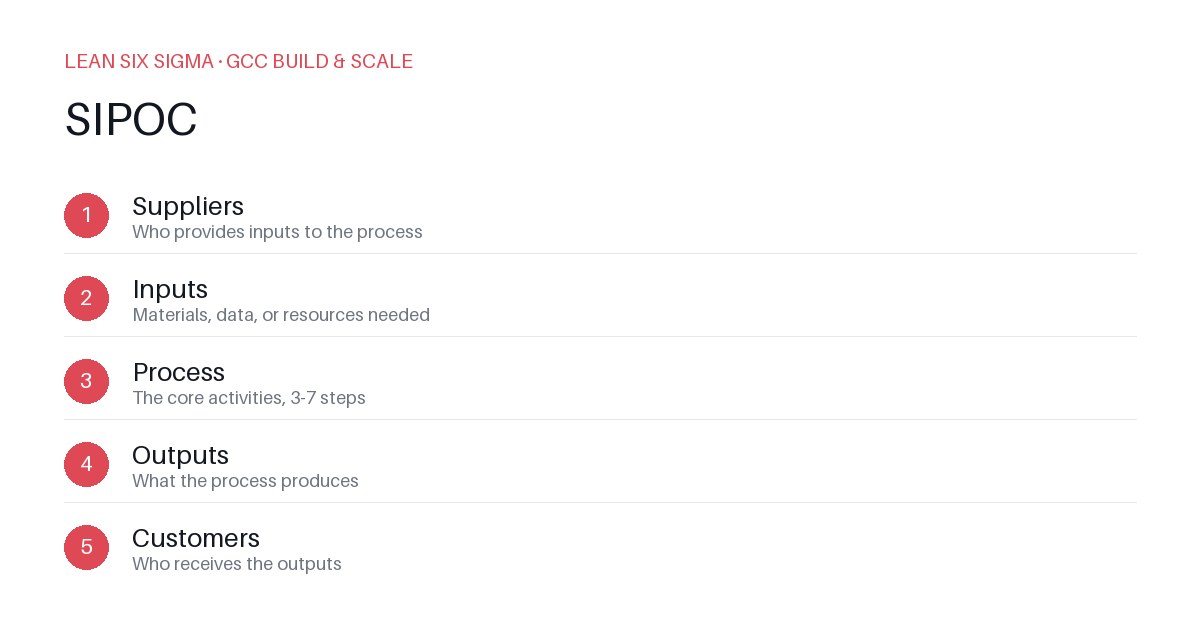
Downloadable templates
Use a SIPOC map to define inputs, processes, and outputs when standing up a new GCC capability, ensuring alignment and reducing launch defects.
Defining the Scope of the New Function
Before writing code or hiring staff, you must define what the new function actually does. A SIPOC map (Suppliers, Inputs, Process, Outputs, Customers) forces clarity on scope. Without it, GCCs often suffer from scope creep or misaligned handoffs.
Start by identifying the business problem this function solves. For example, if you are launching a new data analytics function, the problem might be slow decision-making in the supply chain.
Identifying Suppliers and Inputs
Suppliers are the sources of everything the new function needs. This includes people, systems, and data.
- People Suppliers: HR for hiring, Finance for budget approval, IT for infrastructure access.
- System Suppliers: ERP, CRM, or legacy data warehouses that provide raw data.
- Process Inputs: Standard operating procedures, compliance requirements, and initial training materials.
If a supplier is missing, the process stalls. For instance, if IT does not provide a sandbox environment, your analysts cannot start building models.
Mapping the Core Process Steps
Break the function launch into distinct, measurable steps. Use the 8-D steps or a simplified workflow.
- Step 1: Requirement Gathering: Collect data needs from stakeholders.
- Step 2: Resource Allocation: Hire or assign staff and tools.
- Step 3: Pilot Execution: Run a small-scale test case.
- Step 4: Validation and Feedback: Review results against KPIs.
- Step 5: Full Deployment: Roll out to the broader organization.
Keep steps short. Long steps hide bottlenecks. If a step takes more than two weeks, split it.
Defining Outputs and Customers
Outputs are what the function delivers. Customers are who receives those outputs.
- Tangible Outputs: Reports, dashboards, automated scripts, or trained personnel.
- Intangible Outputs: Improved decision speed, reduced error rates, or cost savings.
- Customers: Internal departments like Operations or Finance that use the outputs.
If you do not define the customer clearly, you risk building something nobody uses. Always ask: "Who will fail if this function does not work?"
Applying Lean Six Sigma to the SIPOC
Use the SIPOC to identify waste and variation.
- Eliminate: Remove redundant approval steps in the supplier chain.
- Reduce: Cut down on non-essential inputs that slow down the pilot.
- Improve: Standardize the feedback loop between customers and the process.
- Maintain: Document the SIPOC for future GCC expansions.
Concrete Steps for Implementation
- Draft the SIPOC: Use a simple table. List suppliers, inputs, process steps, outputs, and customers.
- Validate with Stakeholders: Review the map with HR, IT, and Finance. Fix gaps.
- Set KPIs: Define success metrics for each process step.
- Execute the Pilot: Run the function with the defined inputs and outputs.
- Review and Refine: Analyze results and update the SIPOC as needed.
A well-defined SIPOC prevents chaos during GCC launch. It ensures every team knows their role and how their work connects to the bigger picture.
Comments
Be the first to comment on this post.
Sign in to leave a comment.