PDCA Loops for GCC Vendor Governance
September 27, 2026
Like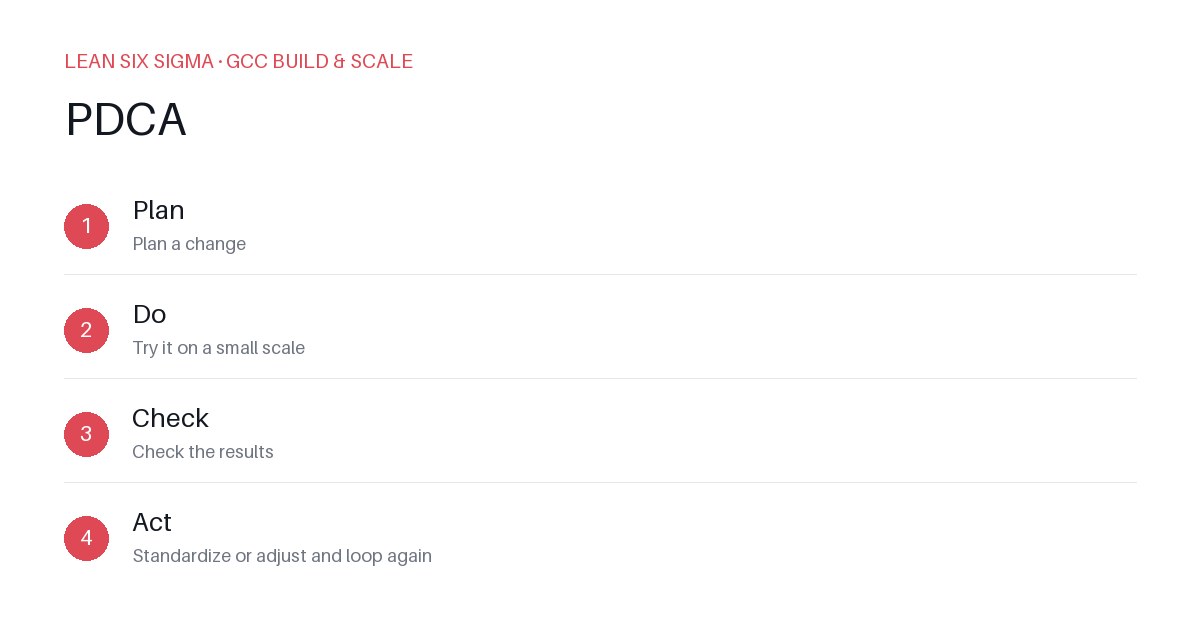
Downloadable templates
Run PDCA cycles to fix vendor performance issues before they break your GCC delivery timeline.
Start with a Concrete Problem
Vendors deliver late, deliver wrong, or deliver nothing. You can't fix what you don't measure. Pick one vendor and one KPI. Examples: On-time delivery rate for a software vendor, first-pass yield for a manufacturing partner, or defect escape rate for a QA team.
Plan the Loop
Write the loop on a single page. Define the current state, the target, and the test.
- Current state: Vendor X delivers 78% of work packages on time.
- Target: 95% on-time delivery.
- Test: Run a 30-day pilot with a specific subset of work packages.
Identify the root cause. Use 5 Whys. Example: Late delivery happens because the vendor's internal approval queue takes four days. The queue exists because the vendor lacks a dedicated resource for your account.
Execute the Pilot
Change one variable. Don't change everything.
- Add a dedicated vendor account manager.
- Move approval to a shared Slack channel.
- Set a daily stand-up for the first two weeks.
Track the KPI daily. Record every delay and every delay reason. Do not guess. Log it.
Check and Act
Compare the pilot data to the target. Did you hit 95%? If yes, standardize the change. If no, adjust the plan and run another loop.
Example: The dedicated resource helped, but the approval still took two days. You moved to an automated approval tool. The next loop targets 98%.
Repeat. Each loop takes 30 to 60 days. Each loop builds a case for contract renegotiation or vendor replacement.
Common Mistakes
- Running loops without a single KPI. You get noise, not signal.
- Blaming the vendor without data. You get pushback, not fixes.
- Stopping at Check. You never improve.
- Ignoring the human side. Vendors need clear feedback and support to change.
Real Scenario
A GCC in India used PDCA to fix a software vendor's defect escape rate. The current state was 12% defects found in production. The target was 2%.
Plan: Add a shared test environment and a daily defect triage call. Execute: Ran the pilot for 30 days. Check: Defects dropped to 5%. Act: Added automated test scripts. Next loop targets 2%.
After three loops, the vendor's defect rate was 1.8%. The GCC negotiated a performance bonus clause into the contract.
Next Steps
Pick one vendor. Pick one KPI. Write the loop. Run it. Repeat. Your GCC will be leaner and your vendors will be more accountable.
Comments
Be the first to comment on this post.
Sign in to leave a comment.