PDCA Loops for GCC Vendor Governance
October 6, 2026
Like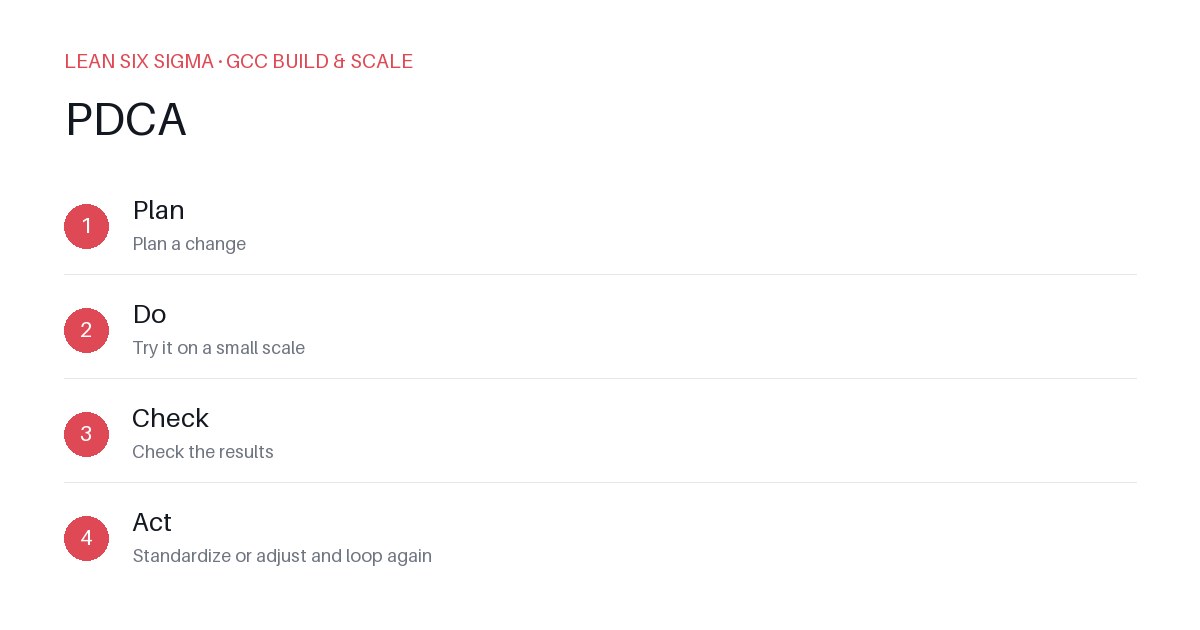
Downloadable templates
Run tight PDCA cycles to govern your GCC vendors, cut waste, and lock in performance without micromanaging.
Why Vendor Governance Fails
Most GCC teams treat vendor governance as a compliance exercise. You sign a contract, set quarterly business reviews (QBRs), and hope the vendor delivers. In practice, you get delayed SLA reports, scope creep, and surprise costs.
The root cause is usually static governance. You define metrics once and never adapt them as the GCC evolves. PDCA (Plan-Do-Check-Act) fixes this by turning governance into a continuous feedback loop.
Plan: Define the Right Levers
Start by mapping your GCC’s critical outcomes to vendor responsibilities. Don’t list every activity. Pick three to five metrics that actually move the needle.
Examples:
- Cycle time for defect resolution in QA automation
- First-pass yield for process mapping deliverables
- Utilization rate of vendor resources on your priority backlog
For each metric, define:
- Target: What does “good” look like? (e.g., 90% of defects resolved within 48 hours)
- Owner: Who on the vendor team owns it? Not the account manager.
- Frequency: How often will you measure it? Daily, weekly, or per sprint?
Document this in a one-page governance charter. Share it with the vendor. Make it part of the contract renewal criteria.
Do: Embed Monitoring into Workflows
Don’t build a separate governance dashboard. Embed tracking into the vendor’s daily operations.
- Daily standups: Vendor leads share metric status. No deep dives, just red/yellow/green.
- Weekly syncs: Review trends. If cycle time slipped, ask “why?” and log the root cause.
- Monthly deep dives: Analyze the data. Look for systemic issues, not just outliers.
Use your existing tools. If you use Jira, create a dashboard that pulls vendor performance data. If you use ServiceNow, automate SLA tracking. The goal is visibility without extra effort.
Check: Measure, Don’t Guess
At the end of each cycle, compare actual performance against targets. Ask three questions:
- Did we hit the target? If not, what’s the gap?
- Why? Was it a resource issue, a process flaw, or a scope change?
- What’s the impact? How does this affect the GCC’s overall delivery?
Document the findings. Don’t just report numbers. Tell the story behind them. For example:
“Defect resolution cycle time increased by 15% in week 3. Root cause: two senior testers were reassigned to a new release. Impact: QA automation backlog grew by 20%.”
This turns data into actionable insights.
Act: Adjust and Scale
Use the insights from the Check phase to drive change.
- If the vendor is underperforming: Provide specific feedback. Co-create a remediation plan. Tie it to incentives or penalties.
- If the vendor is overperforming: Celebrate. Ask if they can take on more scope or suggest improvements.
- If the metrics are wrong: Revise them. Governance should evolve with the GCC.
Close the loop by updating your Plan. Adjust targets, owners, or frequencies as needed. Then start the next cycle.
Real-World Example
A GCC in healthcare used PDCA to govern its QA vendor. They started with a single metric: defect resolution cycle time. The target was 48 hours. After two months, they saw consistent misses.
In the Check phase, they found the root cause: the vendor’s testers were waiting on environment access from the GCC’s IT team. In the Act phase, they co-created a process with IT to automate environment provisioning. Cycle time dropped to 32 hours in the next quarter.
They then added a second metric: first-pass yield for test cases. The same PDCA loop applied. Governance became a collaborative process, not a policing exercise.
Key Takeaways
- Start small: Pick one or two metrics. Master the loop before adding more.
- Embed, don’t add: Use existing tools and workflows. Governance should feel natural.
- Focus on root causes: Don’t just track numbers. Understand why they move.
- Iterate: PDCA isn’t a one-time fix. It’s a continuous improvement engine.
Vendor governance doesn’t have to be bureaucratic. With PDCA, it becomes a partnership that drives value, reduces waste, and keeps your GCC moving forward.
Comments
Be the first to comment on this post.
Sign in to leave a comment.