PDCA Loops for GCC Vendor Governance
October 19, 2026
Like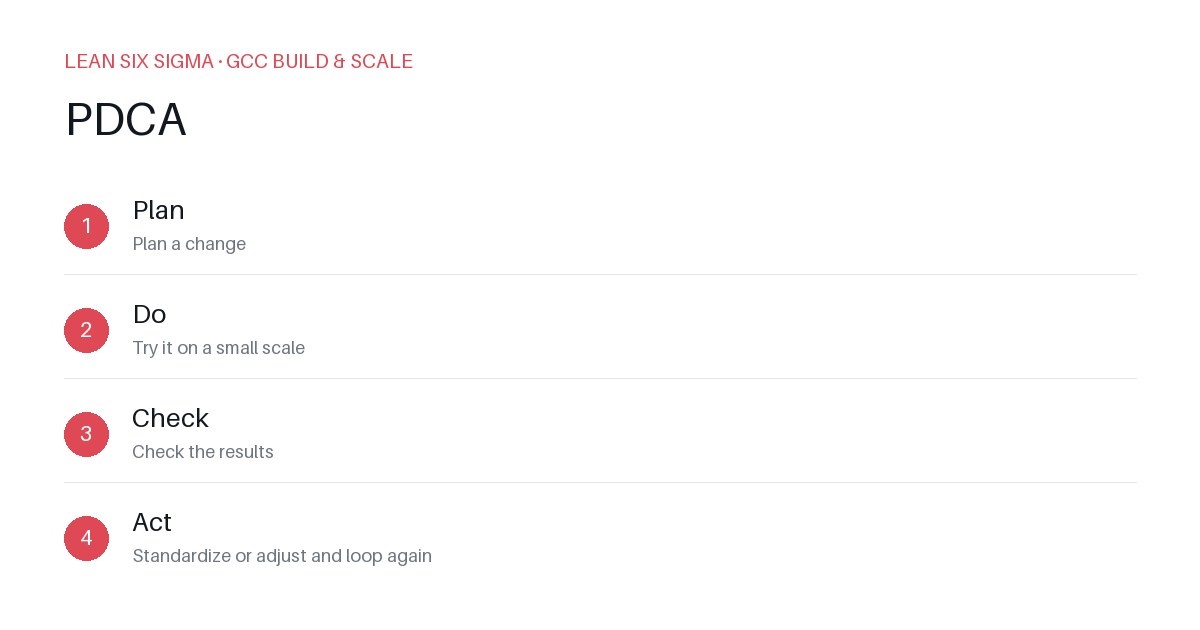
Downloadable templates
Run a PDCA cycle to cut vendor waste, fix SLA gaps, and lock in performance gains across your GCC.
Plan: Map the Vendor Pain Points
Start with a concrete problem. Don't start with 'optimize governance.' Start with 'Vendor B missed three deadlines last quarter, causing a 10% delay in our AI model training.'
Gather data. Pull SLA reports, ticket logs, and cost-per-deliverable metrics. Identify the top three pain points: late delivery, scope creep, or quality issues. Define the baseline metrics. If current on-time delivery is 72%, that's your baseline. Set a target of 90% for the next 60 days. Define what 'good' looks like in numbers, not adjectives.
Do: Run a Controlled Pilot
Don't roll out new governance rules to all vendors. Pick one vendor and one process. Introduce a lightweight control mechanism. For example, implement a daily stand-up for the top three deliverables. Or require a pre-approval checklist for any scope change. Keep the change small and measurable. Track the impact on cycle time, defect rate, and cost.
Document everything. Note what worked, what didn't, and where friction appeared. If the stand-up slows down the vendor team, adjust the cadence. If the checklist catches errors early, measure the reduction in rework tickets. This phase is about learning, not perfection.
Check: Measure Against the Baseline
Compare the pilot results to your baseline. Did on-time delivery improve? Did defect rates drop? Calculate the delta. If you hit 85% on-time delivery, you're 5% away from the 90% target. If you're at 70%, you need to adjust. Don't guess. Use the data.
Identify root causes for any gaps. Use a simple 5-Whys or a fishbone diagram to trace delays back to their source. Is it unclear requirements? Poor communication? Resource constraints? The 'Check' phase is where you separate symptoms from causes.
Act: Standardize and Scale
Once the pilot works, document the process. Create a one-page run sheet that captures the steps, roles, and metrics. Train the vendor team and your internal GCC managers. Then, scale the approach to other vendors or processes. If the daily stand-up reduced delays by 20%, apply it to the next vendor. If the checklist caught 80% of errors early, mandate it for all new contracts.
Close the loop. Schedule a review in 30 days. Set new targets based on the current performance. The cycle repeats. Vendor governance isn't a one-time fix. It's a continuous improvement engine. Run the PDCA loop, measure the results, and scale what works. That's how you turn vendor chaos into predictable, high-performance delivery.
Comments
Be the first to comment on this post.
Sign in to leave a comment.