PDCA Loops for GCC Vendor Governance
October 31, 2026
Like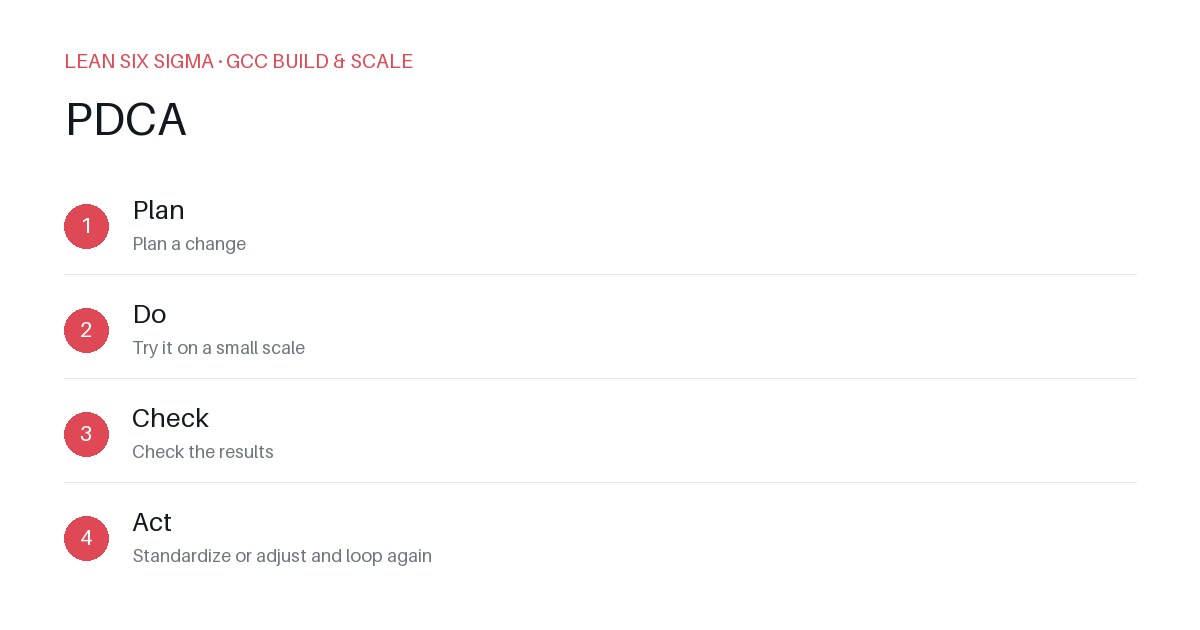
Downloadable templates
A practical walkthrough of applying PDCA to real GCC build-and-scale work.
PDCA Loops for GCC Vendor Governance
Why PDCA Matters for GCC Teams
Scaling a Global Capability Center (GCC) means standardizing work across sites, handoffs, and teams that have never worked together before. In this environment, vendor governance is no longer a back-office concern — it’s a strategic lever that can make or break delivery velocity, cost predictability, and quality consistency. PDCA gives you a shared vocabulary and a repeatable sequence for tackling the friction points that emerge when multiple vendors, regions, and internal stakeholders interact. Without a disciplined cycle like PDCA, teams default to ad-hoc fixes, inconsistent SLAs, and reactive firefighting. With it, you build a governance rhythm that evolves with your program.
The PDCA Sequence
-
Plan — Plan a change
Define the specific vendor governance gap, gather baseline metrics (e.g., on-time delivery rate, defect density, response times), identify stakeholders, and set measurable objectives. Clarify what “success” looks like before you begin. -
Do — Try it on a small scale
Pilot the change with one vendor, one project, or one region. Implement the new process — whether it’s a revised intake form, a new escalation path, or a standardized RACI matrix — and collect real-world feedback without over-engineering. -
Check — Check the results
Compare outcomes against your baseline. Did cycle times improve? Were misunderstandings reduced? Use both quantitative data and qualitative input from vendors and internal users. Identify what worked, what didn’t, and why. -
Act — Standardize or adjust and loop again
If the pilot succeeded, formalize the change: update templates, train teams, embed checks into governance reviews, and communicate the new standard. If it fell short, refine the approach and run another PDCA cycle. Governance is never “done” — it’s continuously optimized.
Applying It to Vendor Governance
Start small: pick one recurring pain point your GCC team hits every week — such as inconsistent vendor onboarding, delayed issue resolution, or misaligned expectations around scope changes — and walk it through these four steps before rolling the approach out more broadly.
For example, if your team struggles with slow vendor response times during critical incidents:
- Plan: Define a target response window (e.g., 2 hours), map current escalation paths, and identify bottlenecks.
- Do: Test a new escalation protocol with one vendor and one internal team for two weeks.
- Check: Measure response times, resolution rates, and stakeholder satisfaction. Note where delays still occur.
- Act: If the protocol works, document it, add it to your vendor handbook, and schedule a training session. If not, adjust the escalation triggers or assign a dedicated liaison and repeat.
Download the template below to run your first pass. It includes fields for baseline metrics, pilot scope, success criteria, and post-check actions — designed to keep your PDCA loop tight, traceable, and actionable.
Why This Approach Scales
PDCA loops turn vendor governance from a static policy into a living system. By cycling through Plan-Do-Check-Act, you create feedback loops that surface hidden inefficiencies, align cross-site practices, and build vendor partnerships grounded in continuous improvement. Over time, this discipline reduces risk, accelerates time-to-value, and empowers your GCC team to govern with confidence — not just compliance.
Comments
Be the first to comment on this post.
Sign in to leave a comment.