PDCA Loops for GCC Vendor Governance
November 2, 2026
Like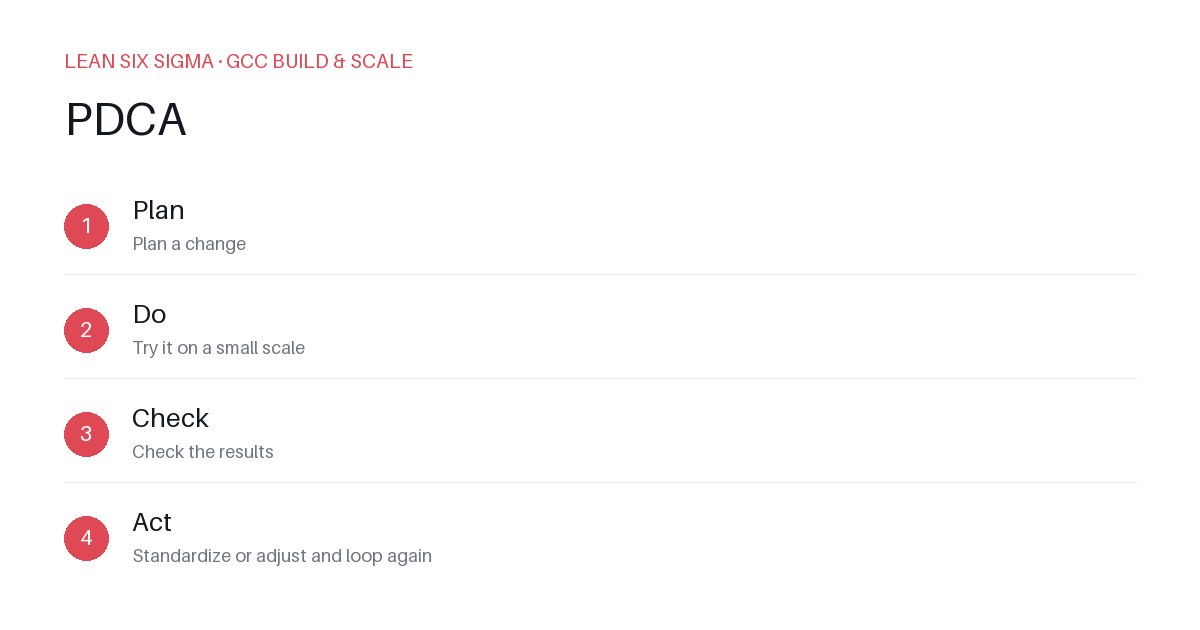
Downloadable templates
Run PDCA cycles to tighten vendor governance, cut waste, and keep your GCC delivery predictable.
Vendor governance is not a one-time audit. It is a continuous loop. If you treat it as a compliance checkbox, your Global Capability Center (GCC) will bleed on scope creep, missed SLAs, and misaligned priorities. Apply PDCA (Plan-Do-Check-Act) to vendor governance. The result is a lean, repeatable process that keeps costs in check and delivery predictable.
Plan: Define governance scope and metrics
Start with clarity. List every vendor tied to your GCC. For each, define:
- Role: Is the vendor a core partner, a spot-for-hire pool, or a specialized tool provider?
- Risk level: High, medium, low based on data sensitivity, dependency, and cost.
- Key metrics: Cycle time, defect rate, utilization, cost variance, SLA adherence.
Set baseline targets. Example: vendor delivery cycle time under 48 hours, defect rate below 5%, cost variance within ±5%. Document these in a single governance dashboard.
Do: Run the governance loop
Execute the plan. For each vendor:
- Assign an owner: A GCC manager or program lead, not a committee.
- Schedule touchpoints: Weekly ops reviews for high-risk vendors, monthly for medium, quarterly for low.
- Collect data: Pull metrics from your PM tool, time tracking, and quality logs.
- Run a review meeting: 30 minutes max. Focus on deviations, not status updates.
Keep the rhythm. Consistency beats intensity. A vendor governance loop that runs monthly will outperform a quarterly deep dive.
Check: Measure against targets
Compare actuals to baselines. Ask three questions:
- Are we meeting targets? If not, by how much?
- What is the root cause? Look for process gaps, skill mismatches, or unclear requirements.
- Is the data reliable? Garbage in, garbage out. Clean up tracking before drawing conclusions.
Example: A vendor misses cycle time targets. Investigation reveals that requirement handoffs take three days because the GCC team lacks a standard intake form. The issue is process, not performance.
Act: Adjust and standardize
Close the loop. Options include:
- Retrain or reassign: If skill gaps exist, pair the vendor with a GCC SME or adjust the work mix.
- Update SOPs: Create or refine intake forms, review checklists, and escalation paths.
- Renegotiate SLAs: If targets are unrealistic, adjust them with data, not emotion.
- Exit or replace: If a vendor consistently fails and shows no improvement, initiate an offboarding plan.
Document the change. Update your governance dashboard. Communicate the update to the vendor and internal stakeholders.
Make it repeatable
After one PDCA cycle, you have a baseline. After ten, you have a system. Automate data pulls where possible. Use a simple scoring model to flag at-risk vendors. Review the loop quarterly to refine metrics and thresholds.
Vendor governance is not about control. It is about predictability. PDCA gives you the rhythm to keep it tight without micromanaging. Start small. Pick one vendor. Run the loop. Measure. Adjust. Scale.
Comments
Be the first to comment on this post.
Sign in to leave a comment.