PDCA Loops for GCC Vendor Governance
September 4, 2026
Like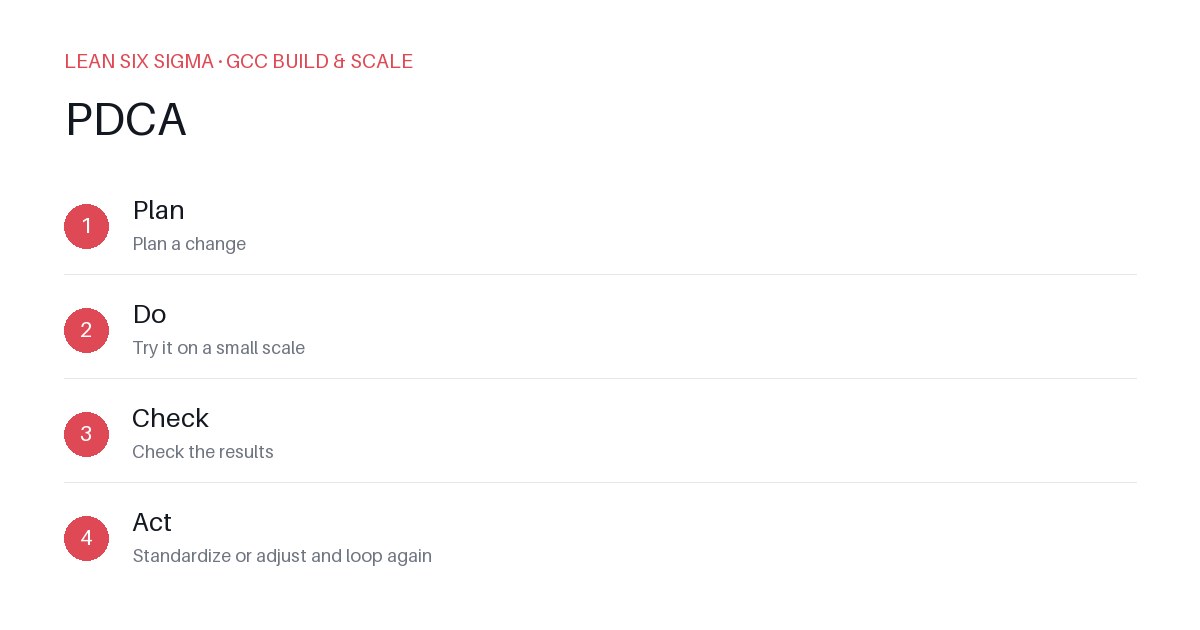
Downloadable templates
Run PDCA cycles to govern GCC vendors, reduce waste, and stabilize delivery quality across global operations.
Plan: Define Vendor Governance Metrics
Start by mapping vendor responsibilities to GCC outcomes. Identify where waste shows up: delays, defects, rework, or unclear handoffs. Set measurable targets before you launch the cycle.
- Define KPIs: on-time delivery, defect rate, first-pass yield, escalation resolution time.
- Map current workflow: document who does what, when, and how data flows.
- Identify bottlenecks: use value stream mapping to spot wait times and handoff errors.
- Set baseline metrics: record current performance for each KPI.
- Align stakeholders: get sign-off on goals, roles, and review cadence.
Do: Implement and Collect Data
Run the first iteration of your vendor governance process. Keep it lean and focused on the chosen metrics.
- Pilot with one vendor or process area to limit scope.
- Assign clear ownership: who collects data, who analyzes it, who acts.
- Use simple tools: shared dashboards, weekly check-ins, defect logs.
- Record actual performance against the baseline.
- Document deviations: note where the plan diverged from reality.
Check: Analyze Results
Review the data to understand what worked and what didn’t. Don’t guess—let the metrics drive decisions.
- Compare actual vs. target KPIs.
- Identify root causes for missed targets using 5 Whys or fishbone diagrams.
- Separate signal from noise: focus on repeatable issues, not one-off events.
- Assess process stability: is performance consistent or highly variable?
- Gather vendor feedback: ask what’s working and what’s blocking progress.
Act: Standardize and Improve
Close the loop by updating your governance process. Make improvements permanent.
- Update SOPs: document changes to workflows, roles, and handoffs.
- Train teams: ensure everyone follows the revised process.
- Adjust KPIs if needed: refine targets based on new baselines.
- Schedule the next PDCA cycle: set a date to revisit and iterate.
- Communicate wins: share improvements with leadership and vendors.
Real-World Example
A GCC in India struggled with delayed code reviews from a US-based vendor. Using PDCA:
- Plan: Defined target review time as 24 hours. Mapped current workflow.
- Do: Piloted a new review queue with SLA tracking.
- Check: Found 60% of delays came from unclear requirements.
- Act: Updated intake forms to require detailed specs. Reduced delays by 40%.
Repeat the cycle quarterly. Each loop tightens governance, cuts waste, and builds trust with vendors.
Key Takeaways
- PDCA keeps vendor governance practical and measurable.
- Start small, measure rigorously, and iterate fast.
- Link every action back to GCC outcomes: speed, quality, cost.
- Treat vendors as partners in the loop, not just vendors.
Governance isn’t a one-time setup. It’s a continuous cycle of improvement. Run PDCA, track results, and keep refining your GCC vendor model.
Comments
Be the first to comment on this post.
Sign in to leave a comment.