PDCA Loops for GCC Vendor Governance
September 7, 2026
Like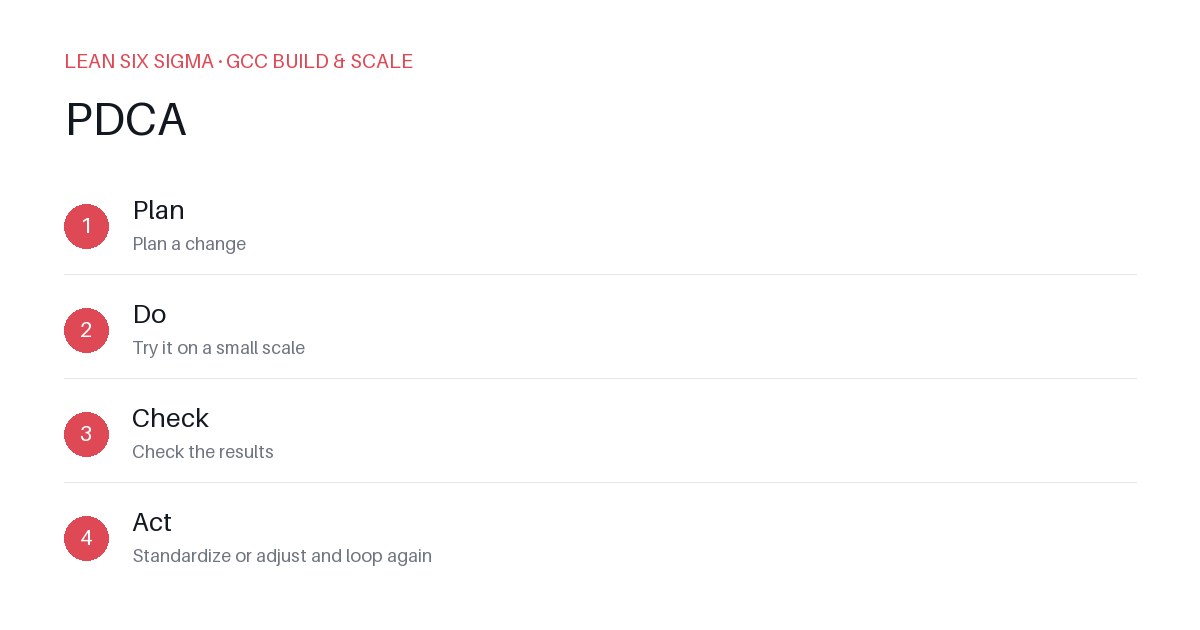
Downloadable templates
Run tight PDCA cycles to fix vendor performance gaps before they derail your GCC scaling goals.
The Vendor Governance Trap
GCCs often outsource to vendors to fill skill gaps or scale capacity. Without a disciplined governance loop, these relationships become black boxes. You pay for capacity, but quality drifts, SLAs erode, and your center stalls.
PDCA (Plan-Do-Check-Act) is the operational engine to keep vendor performance aligned with GCC outcomes. It turns governance from a quarterly audit into a continuous correction system.
Plan: Define Vendor Success Metrics
Start with what matters to the GCC, not what the vendor claims to deliver. Define 3–5 measurable outcomes:
- Defect rate per sprint
- Time to resolve critical bugs
- Utilization efficiency (billable vs. actual productive hours)
- Compliance pass rate for security reviews
Set thresholds. Example: defect rate must stay below 2%. If it breaches, trigger a review. Document this in a one-page vendor scorecard.
Do: Implement and Monitor
Assign a GCC owner to the vendor relationship. They are accountable, not just the procurement team.
- Run weekly syncs focused on metric trends, not status updates.
- Use a shared dashboard with real-time data feeds where possible.
- Log exceptions immediately. Do not wait for monthly reports.
Example: A GCC in India uses a vendor for QA automation. The owner tracks test case coverage and escape defects weekly. When coverage drops below 85%, the owner flags it for the next PDCA cycle.
Check: Analyze Deviations
Compare actual performance against thresholds. Ask why deviations occurred.
- Is it a skill gap? A tooling issue? A misaligned process?
- Gather root cause data, not opinions.
If defect rate hits 2.5%, investigate:
- Are test cases outdated?
- Is the vendor team understaffed?
- Are requirements changing too fast?
Document findings. No fix without a clear cause.
Act: Correct and Standardize
Implement changes based on root cause.
- Retrain vendor staff on new test frameworks.
- Adjust sprint planning to account for requirement volatility.
- Escalate to vendor management if performance does not improve after two cycles.
Close the loop by updating the Plan metrics if needed. Example: If defects are driven by tooling, add tooling stability to the scorecard.
Scaling PDCA Across Multiple Vendors
GCCs often use multiple vendors. Apply PDCA uniformly:
- Use the same scorecard structure.
- Hold monthly vendor review meetings with all stakeholders.
- Share best practices across vendors. If Vendor A solves a defect issue faster, document and roll it out.
Avoid siloed governance. Centralize oversight in the GCC leadership team.
Common Pitfalls
- Treating PDCA as a monthly report instead of a weekly rhythm.
- Ignoring small deviations until they become crises.
- Blaming the vendor for process gaps in the GCC.
Fix the system, not just the supplier. PDCA works when ownership is clear and data is transparent.
Final Thought
Vendor governance is not a contract exercise. It is a performance loop. Run PDCA tightly, and your GCC scales with quality, not risk.
Comments
Be the first to comment on this post.
Sign in to leave a comment.