PDCA Loops for GCC Vendor Governance: A Practical Guide
September 10, 2026
Like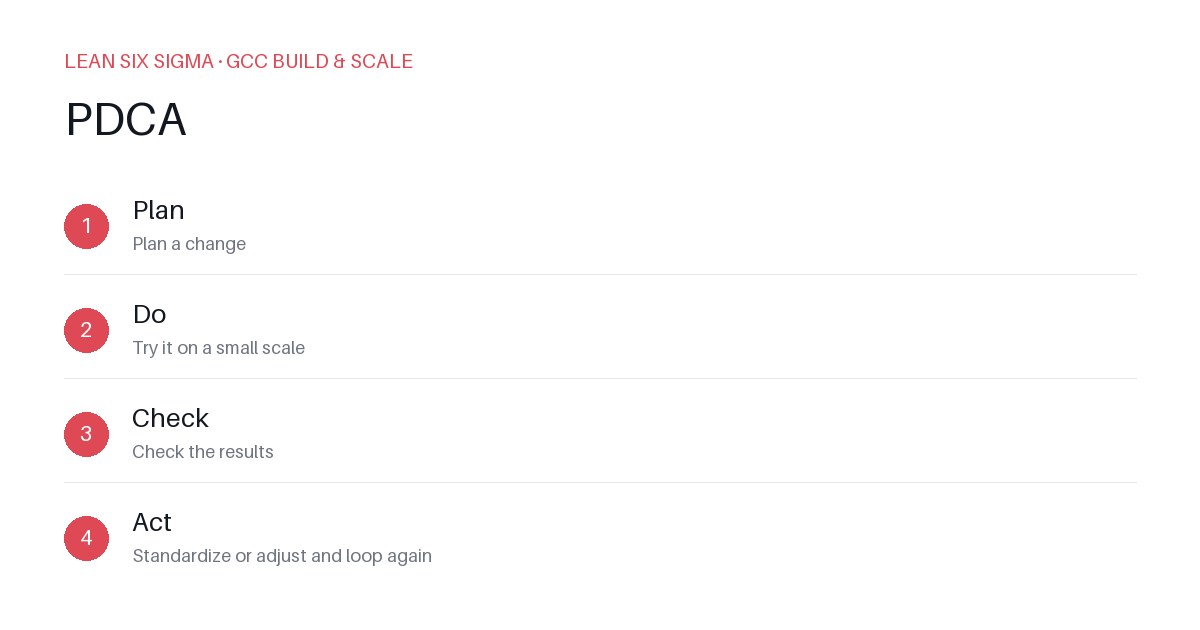
Downloadable templates
Apply PDCA to vendor governance for faster cycle times and fewer errors in your GCC operations.
PDCA Loops for GCC Vendor Governance: A Practical Guide
Start with a Clear Plan
Define your vendor governance scope with surgical precision. Rather than attempting to overhaul all vendor-related activities at once, pick one high-impact process like onboarding, timesheet approval, or offboarding. Map the current state using a value stream mapping technique, visually documenting every handoff, approval gate, and data entry step. Identify the root cause of delays or errors by asking “why?” at least five times until you reach systemic issues rather than symptoms. Set measurable, time-bound goals such as reducing approval time from five days to two, or cutting error rates by 30%. Document the plan with clear roles and responsibilities for each team member involved, including vendor relations, finance, IT security, and legal. Assign a single owner for the PDCA cycle to ensure accountability.
Execute with Precision
Implement the new process using a controlled pilot group of three to five vendors to minimize disruption while maximizing learning. Track each step meticulously using standardized checklists and digital tools like Jira, Trello, or Microsoft Power Automate to monitor progress in real time. Ensure all stakeholders follow the updated workflow by conducting brief training sessions and sharing visual process maps. Collect quantitative data on cycle times, error rates, rework frequency, and customer satisfaction scores through automated dashboards and post-process surveys. Address any immediate issues that arise during the pilot phase by convening rapid response huddles within 24 hours. Keep a living log of deviations and workarounds to understand where the process breaks down under real-world conditions.
Check for Gaps
Review the pilot results against your predefined goals using a structured comparison framework. Analyze the data to identify where the process is failing by calculating variance from targets and pinpointing specific steps with the highest failure rates. Look for bottlenecks such as manual data transfers, duplicate approvals, or lack of automated notifications. Identify inconsistencies in how different teams interpret governance requirements. Discuss findings with the team to gain diverse perspectives, including input from vendors who experienced the new workflow firsthand. Document lessons learned in a shared repository, categorizing them as process, people, or technology issues. Decide whether to adjust the process based on evidence rather than assumptions, ensuring that changes are proportional to the impact of the identified gaps.
Act on Insights
Make necessary adjustments to the process based on your findings. If the pilot was successful and met or exceeded goals, prepare a scaled rollout plan with communication templates, updated SOPs, and support resources for all vendors. If not, refine the approach by addressing the top three root causes identified during the check phase, then run a second, smaller pilot to validate improvements. Continuously monitor the process after implementation by establishing key performance indicators (KPIs) and reviewing them monthly. Share success stories and recognition with teams and vendors to encourage adoption and maintain momentum. Embed the PDCA cycle into your governance calendar to ensure continuous improvement becomes a cultural norm rather than a one-time initiative.
Real-World Example
A GCC team reduced onboarding time by 40% using PDCA. They started by mapping the current process and identified redundant approvals as a bottleneck. After removing unnecessary steps, they saw a significant improvement in cycle time. The team then scaled the solution across multiple vendors, maintaining high satisfaction scores.
Comments
Be the first to comment on this post.
Sign in to leave a comment.