Value Stream Mapping a GCC Shared Services Handoff
September 8, 2026
Like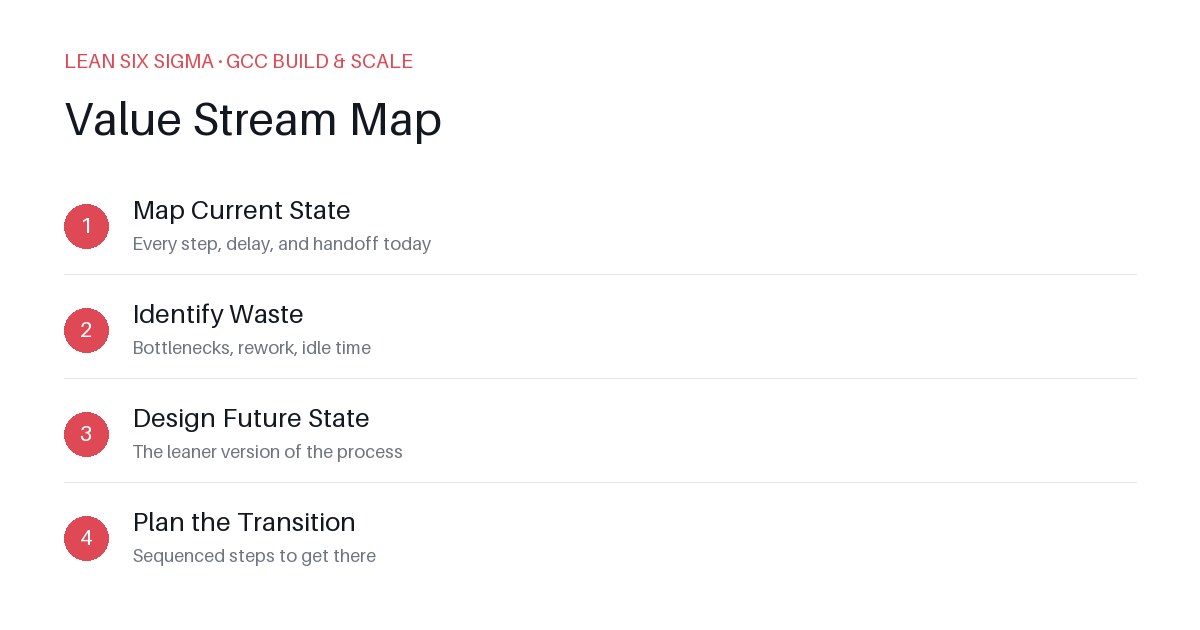
Downloadable templates
A practical walkthrough of applying Value Stream Map to real GCC build-and-scale work.
Value Stream Mapping a GCC Shared Services Handoff
Why Value Stream Map Matters for GCC Teams
Scaling a Global Capability Center means standardizing work across sites, handoffs, and teams that have never worked together before. Value Stream Map gives you a shared vocabulary and a repeatable sequence for doing that. When multiple regions rely on a single shared service, ambiguity in ownership, unclear SLAs, and inconsistent handoff criteria become the primary drivers of delays and frustration. A Value Stream Map exposes these hidden friction points before they become systemic bottlenecks.
The Value Stream Map Sequence
-
Map Current State — Every step, delay, and handoff today
Begin by capturing the end-to-end flow from request initiation to final delivery. Include not just the active work steps, but also waiting periods, approval gates, and rework loops. Document who is responsible at each stage, what tools are used, and where information is lost or duplicated. -
Identify Waste — Bottlenecks, rework, idle time
Apply lean principles to categorize non-value-adding activities. Common wastes in GCC handoffs include:- Waiting: Teams idle while awaiting approvals or data from other regions.
- Overprocessing: Redundant reviews or documentation requests that add no value.
- Defects: Incomplete or inaccurate handoffs requiring rework.
- Excess Motion: Manual data transfers between systems or platforms.
-
Design Future State — The leaner version of the process
Reconfigure the flow to eliminate identified waste. This may involve consolidating approval steps, automating status updates, standardizing handoff templates, or clarifying RACI matrices. The goal is a process that is predictable, transparent, and scalable across all participating teams. -
Plan the Transition — Sequenced steps to get there
Roll out changes incrementally. Pilot the new process with a small group, gather feedback, refine, and then expand. Include training, communication plans, and metrics to track improvement over time.
Applying It
Start small: pick one recurring pain point your GCC team hits every week, and walk it through these 4 steps before rolling the approach out more broadly. Download the template below to run your first pass.
Concrete Example: Incident Escalation Handoff
Consider a GCC team managing security incident response across three regions. Currently, when an incident is detected in Region A, it’s manually logged in a shared spreadsheet, then emailed to the on-call responder in Region B, who must cross-reference the log, verify ownership, and then escalate to the global SOC. This process averages 45 minutes from detection to response.
By mapping this flow, the team discovers that 20 minutes are spent waiting for email responses, 10 minutes on duplicate data entry, and 15 minutes on clarifying ambiguous incident codes. The future state introduces an automated ticketing system with standardized incident codes, automated routing based on severity, and real-time status updates. The transition plan includes a two-week pilot with the on-call team, followed by full rollout and monthly performance reviews.
Measuring Success
Track key metrics before and after the process redesign:
- Cycle Time: Total time from request to completion.
- First-Pass Yield: Percentage of handoffs completed without rework.
- Handoff Accuracy: Error rate in transferred information.
- Team Satisfaction: Survey results on process clarity and support.
These metrics provide objective evidence of improvement and help sustain momentum for continuous refinement.
Comments
Be the first to comment on this post.
Sign in to leave a comment.