PDCA Loops for GCC Vendor Governance
October 26, 2026
Like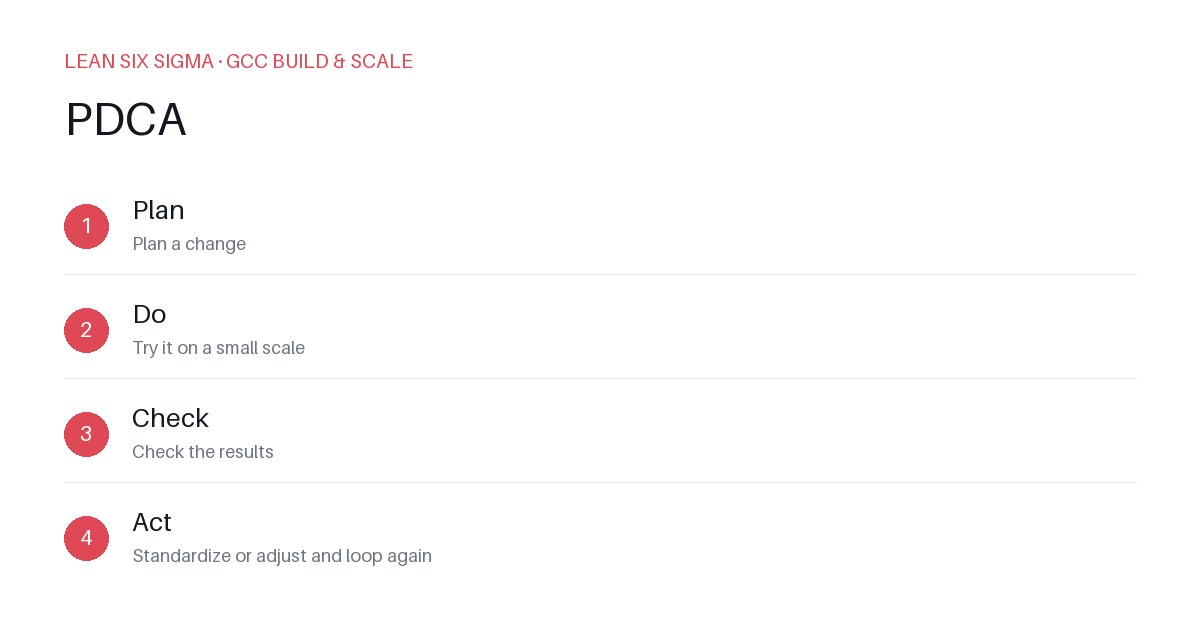
Downloadable templates
Apply PDCA to vendor governance to turn static SLAs into living capability engines that adapt to scale and change.
Most GCCs treat vendor governance like a compliance exercise. You sign a contract, define an SLA, and hope the vendor delivers. When scale hits, that model breaks. Vendors get siloed, capabilities fragment, and your GCC loses control of the delivery engine.
PDCA (Plan-Do-Check-Act) isn’t just a quality tool. It’s a governance operating system. Here’s how to wire it into your vendor management process so it actually moves the needle.
Plan: Map Capabilities, Not Just Services
Stop planning around vendor deliverables. Plan around GCC capabilities. For example, if your GCC owns 'Incident Response,' don’t plan around '24/7 monitoring.' Plan around the capability: mean time to resolution (MTTR), escalation accuracy, and post-incident learning.
Create a capability-to-vendor mapping matrix. Each cell shows:
- Which vendor owns which capability
- The current maturity level (1-5)
- The PDCA cycle frequency (weekly, monthly, quarterly)
This exposes gaps. You’ll see, for example, that Vendor A owns monitoring but Vendor B owns analysis. That’s a handoff risk. Fix it in the plan phase.
Do: Run Lightweight Experiments
Don’t wait for annual reviews to test improvements. Run 30-day experiments.
Example: Vendor C has a 45-minute MTTR for P1 incidents. Plan a Do cycle: implement a shared runbook with your GCC’s L1 team. Track MTTR over 30 days. If it drops to 30, you’ve validated the change. If not, adjust.
Key rules:
- Keep experiments small. One metric, one change.
- Document everything. No experiment is worth repeating without a record.
- Involve the vendor in the Do phase. They own the execution; you own the design.
Check: Measure Capability, Not Just Compliance
Check phase is where most GCCs fail. They check SLA adherence. You need to check capability health.
Track these metrics per vendor:
- Capability maturity trend (is it improving?)
- Handoff error rate (between vendors or internal teams)
- Time to resolve capability gaps
- Vendor innovation contribution (new tools, processes, or ideas)
Review these in a monthly capability governance meeting. No vendor performance reviews. Just capability data. If a vendor’s capability maturity is flat for two cycles, trigger a corrective action plan. Not a penalty. A plan.
Act: Institutionalize or Pivot
Every Check must lead to an Act. Options:
- Scale: If the experiment worked, embed the change into the vendor’s operating model. Update the SLA. Retrain the team.
- Pivot: If it failed, document why. Try a different approach next cycle.
- Exit: If a vendor consistently fails to improve, start the transition process. Don’t wait for contract renewal.
The Act phase closes the loop. It’s where governance becomes adaptive. Without it, PDCA is just a checklist.
Wire It Into Your Rhythm
- Weekly: Vendor capability huddles. 30 minutes. One metric. One action.
- Monthly: Capability review. PDCA outcomes. Adjust plans.
- Quarterly: Capability maturity assessment. Update the matrix.
- Annually: Vendor capability strategy. Align with GCC roadmap.
PDCA turns vendor governance from a static contract into a dynamic capability engine. Your GCC doesn’t just manage vendors. It evolves with them.
Comments
Be the first to comment on this post.
Sign in to leave a comment.