PDCA Loops: Continuous Vendor Governance for GCCs
October 14, 2026
Like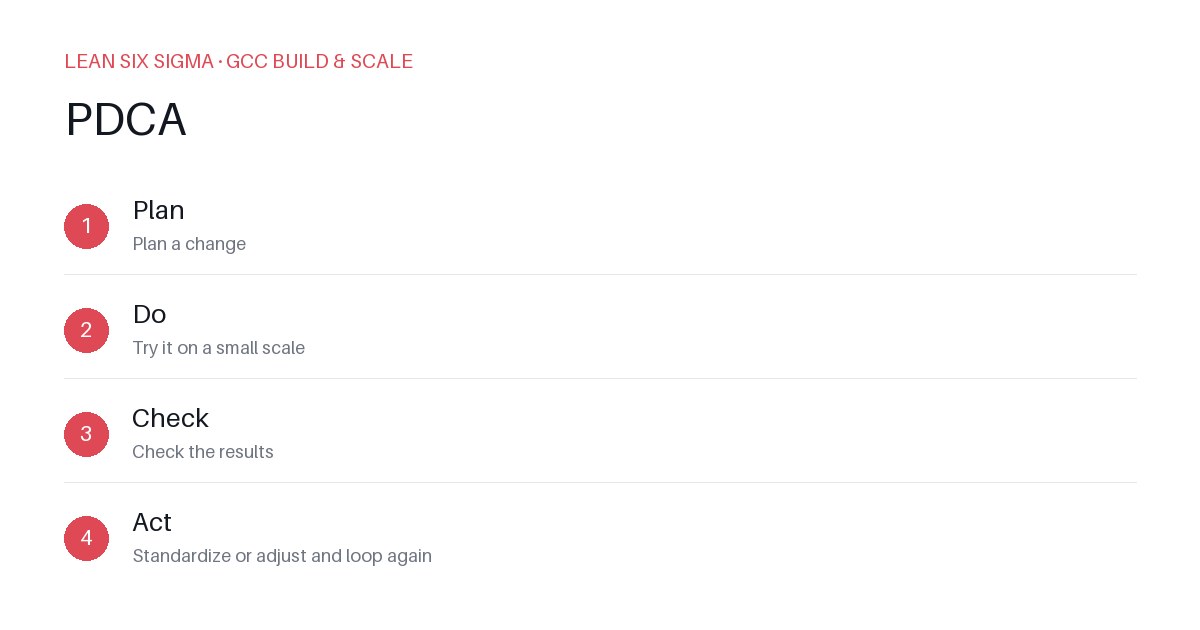
Downloadable templates
Use PDCA to turn static vendor governance into a continuous improvement engine that cuts costs and boosts quality.
Most GCCs treat vendor governance like a compliance checklist. You sign off, you file, you repeat. This approach is brittle. When a vendor slips, you react. When costs creep, you panic. PDCA (Plan-Do-Check-Act) flips this. It turns governance from a static report into a living system that adapts to real performance data.
Plan: Define What 'Good' Looks Like
Start with specific metrics, not vague promises. A 'good' vendor isn't one who 'meets expectations.' It's one that consistently delivers under defined parameters.
- Define SLAs with precision: Instead of '99% uptime,' use '99.9% uptime with automatic failover within 5 minutes.'
- Set baseline metrics: Establish current performance levels for delivery time, defect rate, and cost per unit.
- Identify improvement targets: Decide where you want to be in 6 months. If current defect rate is 5%, target 2%.
Do: Implement and Test
Don't overhaul everything at once. Pick one vendor and one metric. Test changes in a controlled environment.
- Pilot a new process: Introduce a weekly quality review with a specific vendor. Track the impact on defect rates.
- Adjust onboarding: Test a stricter technical assessment for new hires at a partner. Measure time-to-productivity.
- Monitor closely: Keep detailed logs of the pilot. Note what works, what doesn't, and where friction occurs.
Check: Measure Against Plan
Data is your reality check. If you're not measuring, you're guessing.
- Compare to baseline: Did the pilot reduce defects by 30%? If yes, scale. If no, analyze why.
- Identify root causes: Use a simple 5-Why analysis if metrics miss targets. Was it poor training? Unclear requirements? Tooling issues?
- Review with the vendor: Share results transparently. This builds trust and aligns both teams on the problem.
Act: Standardize and Scale
If the test works, make it permanent. If it doesn't, adjust and try again.
- Update governance documents: Embed successful practices into your standard operating procedures. If weekly reviews cut defects, make them mandatory.
- Train the team: Ensure your GCC staff and the vendor know the new standard. Knowledge gaps kill consistency.
- Repeat the loop: Governance isn't a one-time fix. Schedule the next PDCA cycle. Maybe now you target cost reduction. Or perhaps you focus on innovation speed.
Real-World Example
A GCC in India faced rising costs from a software testing vendor. Instead of renegotiating the contract, they ran a PDCA loop.
- Plan: They identified that 60% of defects were due to unclear test cases.
- Do: They piloted a collaborative test case design session with the vendor.
- Check: Defect rates dropped by 40%, but the pilot took 20% longer.
- Act: They standardized the design session but added a time limit. They then applied this to all vendors.
The result? A 15% cost reduction and higher quality, without firing anyone or rewriting contracts.
PDCA for vendor governance isn't about perfection. It's about progress. Start small, measure ruthlessly, and scale what works. Your GCC will thank you.
Comments
Be the first to comment on this post.
Sign in to leave a comment.