PDCA Loops for GCC Vendor Governance
October 9, 2026
Like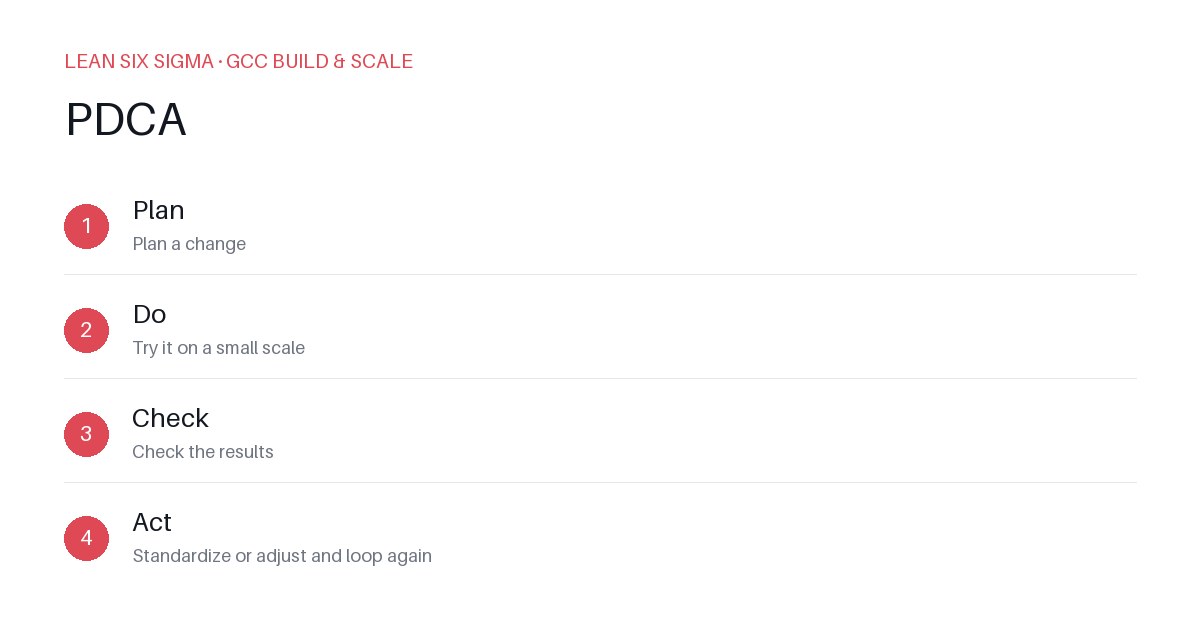
Downloadable templates
Stop patching vendor issues. Use PDCA to build self-correcting governance that scales with your GCC operations.
Why Most Vendor Governance Fails
Most GCC teams treat vendor governance like a compliance checklist. You audit, you flag, you re-audit. The problem isn’t the audit — it’s that you never close the loop. You track issues without fixing the root cause, so the same vendor misses SLAs again next quarter.
PDCA (Plan-Do-Check-Act) isn’t just a quality tool. It’s a governance operating system. When you apply it to vendor management, you shift from reactive firefighting to proactive control.
The Plan: Define Vendor Success with Measurable Outcomes
Start with what you actually need from a vendor. Not vague promises. Specific, measurable outcomes.
- Define KPIs: Response time, first-contact resolution, defect escape rate, cost per ticket, vendor satisfaction score.
- Set baselines: What’s acceptable? What’s critical? Document thresholds.
- Create a PDCA charter: One page. Who owns what? How will you measure progress? When do you review?
Example: A GCC in India uses a shared services vendor for IT support. They set a baseline: 95% of P1 tickets resolved in 2 hours. Current data: 78%. That’s your starting point.
The Do: Implement Targeted Interventions
Don’t overhaul everything at once. Pick one leverage point.
- Run a focused experiment: Maybe the vendor lacks proper escalation paths. Implement a daily stand-up with their team.
- Adjust resources: Add a dedicated GCC account manager. Provide better tooling.
- Pilot changes: Test the new process with one service line before rolling out.
Keep it small. Track what you change. If nothing changes, you can’t measure the impact.
The Check: Measure Against Baselines
Data is your truth. Not opinions. Not vendor reports.
- Collect metrics weekly: Use automated dashboards. No manual spreadsheets.
- Compare to baselines: Are you moving toward the target? If not, why?
- Identify deviations: Which vendor? Which process? Which team?
Example: After the daily stand-up, P1 resolution improves to 85%. Good. But defect escape rate increases. That’s a new problem. You don’t ignore it. You loop back.
The Act: Standardize and Scale
If the experiment works, lock it in.
- Update SOPs: Document the new process. Train the vendor.
- Share wins: Show the GCC leadership what worked. Build buy-in for scaling.
- Scale the fix: Roll out the daily stand-up to other vendors. Or adjust the KPIs if you’re ahead of schedule.
Then start the next PDCA loop. Different vendor. Different problem.
Make It Stick
PDCA isn’t a one-time project. It’s a rhythm.
- Run monthly PDCA reviews: Review all vendor experiments. Kill what’s not working. Double down on what is.
- Assign owners: Every PDCA loop has a GCC owner. Not the vendor. Your team.
- Tie to incentives: Reward vendors who improve. Not just those who meet minimums.
GCCs don’t scale by adding headcount. They scale by removing friction. Vendor governance is friction. PDCA removes it.
Start small. Measure everything. Loop fast. The results compound.
Comments
Be the first to comment on this post.
Sign in to leave a comment.