RACI Matrices for GCC Cross-Site Ownership
September 30, 2026
Like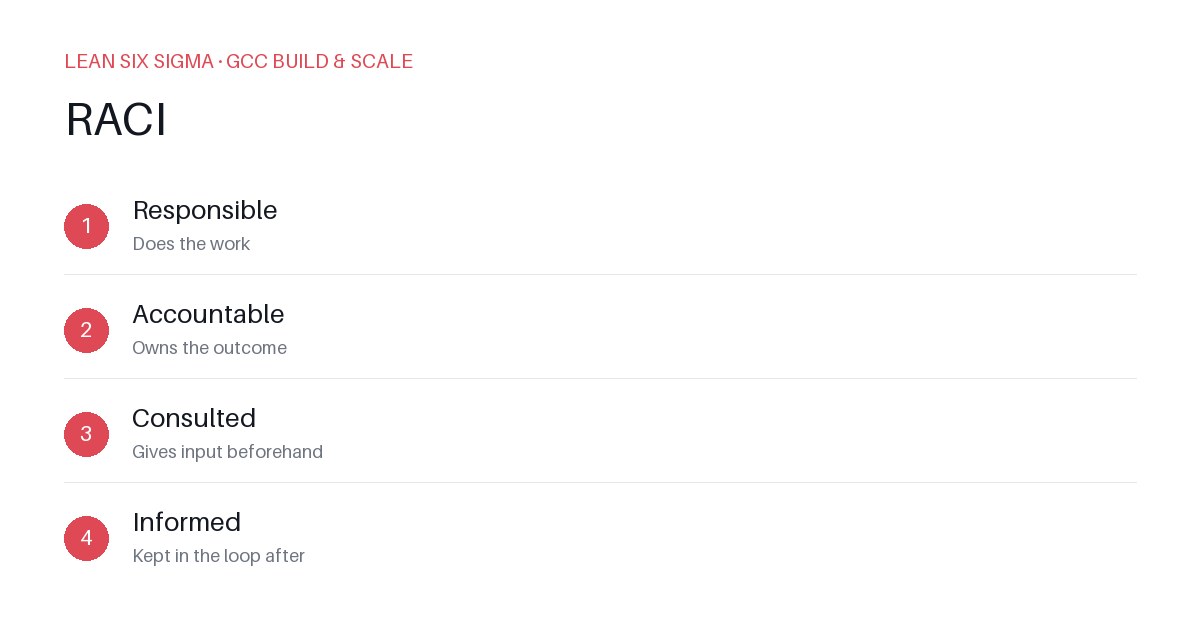
Downloadable templates
Eliminate overlap and gaps in global GCC operations by defining clear RACI roles across sites with a practical framework.
The Problem with Vague Ownership
Cross-site GCCs often fail because responsibilities drift. When Site A owns a process and Site B owns the data, who fixes the broken integration? Without explicit RACI definitions, you get duplicated work, missed deadlines, and leadership frustration. RACI matrices force clarity by assigning one single owner for every critical activity.
Define the Activity First
Before assigning roles, list every repeatable activity in your GCC. Examples include: requirements gathering, code review, test execution, deployment, and incident response. Each activity needs a clear description. Ambiguity in the activity definition leads to ambiguity in ownership. Write the activity as a verb phrase, such as "Execute UAT for release candidate."
Assign Roles Using the RACI Framework
Apply the RACI model to each activity. Remember the rules: only one Responsible person per task, but multiple Accountable, Consulted, and Informed roles are allowed. Use the following guidelines:
- Responsible: The person who does the work. This is always a single individual or a small team. For example, the QA lead at Site A might be Responsible for test execution.
- Accountable: The person who signs off on the work. This role cannot be shared. If the project manager at Site B is Accountable, they must ensure the work meets standards.
- Consulted: People whose input is needed before the work is done. These roles provide expertise. For example, the DevOps engineer at Site C might be Consulted on deployment scripts.
- Informed: People who need updates after the work is done. These roles do not influence the work. For example, the Finance team at Site D might be Informed about budget changes.
Implement the Matrix in Practice
Create a simple table with activities as rows and roles as columns. Use the letters R, A, C, I to mark each cell. Review the matrix with all site leads. Look for common errors:
- Multiple Responsible roles per task. This causes confusion about who actually does the work.
- No Accountable role. This means no one owns the outcome.
- Too many Consulted roles. This slows down decision-making.
Edit the matrix until each cell has exactly one letter, except for I, which can have multiple entries. Share the final version with all stakeholders. Post it in your team's wiki or project management tool. Update it whenever processes change.
Avoid Common Pitfalls
Don't use RACI for one-time events. It works best for recurring processes. Don't assign roles based on title alone. Focus on the actual work needed. Don't forget to revisit the matrix quarterly. GCC structures evolve, and so must ownership. If you skip these steps, you risk returning to the same overlap and gaps you started with.
Next Steps
Start with your most critical GCC activity. Build a draft RACI matrix. Run it by your site leads. Make the necessary adjustments. Once approved, put it into practice. Track the results. You will see faster decisions, fewer conflicts, and clearer accountability across your global GCC.
Comments
Be the first to comment on this post.
Sign in to leave a comment.