Running PDCA Loops for GCC Vendor Governance
August 29, 2026
Like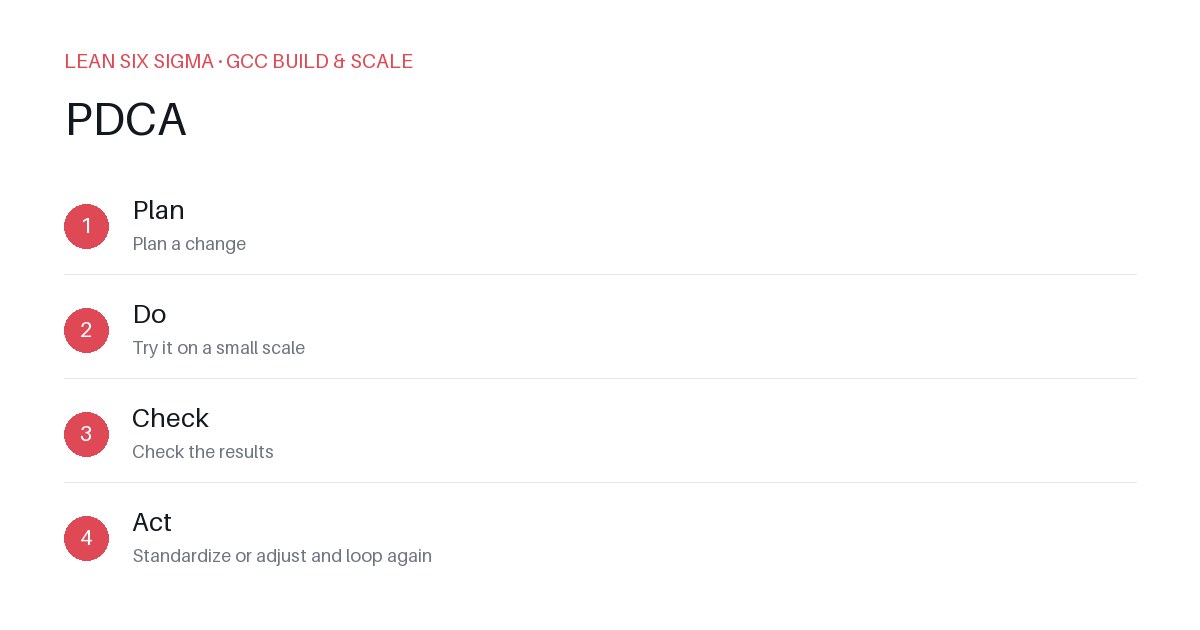
Downloadable templates
Stop treating vendor governance as a compliance checklist. Use PDCA loops to continuously improve vendor performance and reduce risk.
Why Traditional Vendor Governance Fails
Most GCCs treat vendor governance as an annual audit. You sign SLAs, collect reports, and hope for the best. This reactive approach misses problems until they cause delays or quality drops.
PDCA (Plan-Do-Check-Act) turns vendor governance into a continuous improvement engine. It’s not about paperwork; it’s about data-driven adjustments.
Plan: Define Clear Vendor Metrics
Start by aligning vendor KPIs with GCC outcomes. Don’t track vague metrics like “good service.” Use specific, measurable targets:
- Delivery accuracy: % of tasks completed on time
- Quality score: Defect rate or rework hours
- Cost efficiency: Actual vs. budgeted cost per task
- Risk indicators: Number of escalations or compliance flags
Document these in a vendor scorecard. Review with the vendor quarterly to set baselines.
Do: Implement and Track
Deploy the metrics into your vendor management tool. Automate data collection where possible:
- Integrate Jira or ServiceNow with your vendor portal
- Set up weekly automated reports
- Assign a GCC owner to review data every Monday
Keep a log of actions taken. If a vendor misses a target, record the root cause and corrective step.
Check: Analyze and Adjust
Review the data weekly, not yearly. Look for trends:
- Is a vendor consistently underdelivering on quality?
- Are costs creeping above budget?
- Are there recurring delays in critical tasks?
Use the data to trigger conversations. If a vendor’s defect rate spikes, schedule a joint review session. Ask: “What’s causing this, and how do we fix it?”
Act: Improve and Standardize
Based on findings, make changes:
- Retrain vendor staff on best practices
- Adjust SLAs if targets are unrealistic
- Consider replacing underperforming vendors
Document lessons learned and update your governance playbook. Share wins and failures across the GCC to build a culture of continuous improvement.
Example: Fixing a Delivery Delay Problem
A GCC noticed a vendor missing 30% of deadlines. Using PDCA:
- Plan: Set a 95% on-time delivery target
- Do: Implement daily standups and task prioritization
- Check: Track weekly delivery rates; find bottlenecks in testing
- Act: Add automated testing tools and adjust workload distribution
Within two months, on-time delivery hit 97%.
Key Takeaways
- Automate data collection to reduce manual effort
- Review weekly to catch issues early
- Involve vendors in problem-solving, not just reporting
- Update processes based on real results, not assumptions
PDCA loops turn vendor governance from a checkbox exercise into a strategic advantage. Start small, iterate fast, and let data drive your decisions.
Comments
Be the first to comment on this post.
Sign in to leave a comment.