SIPOC Map for Standing Up a New GCC Function
August 28, 2026
Like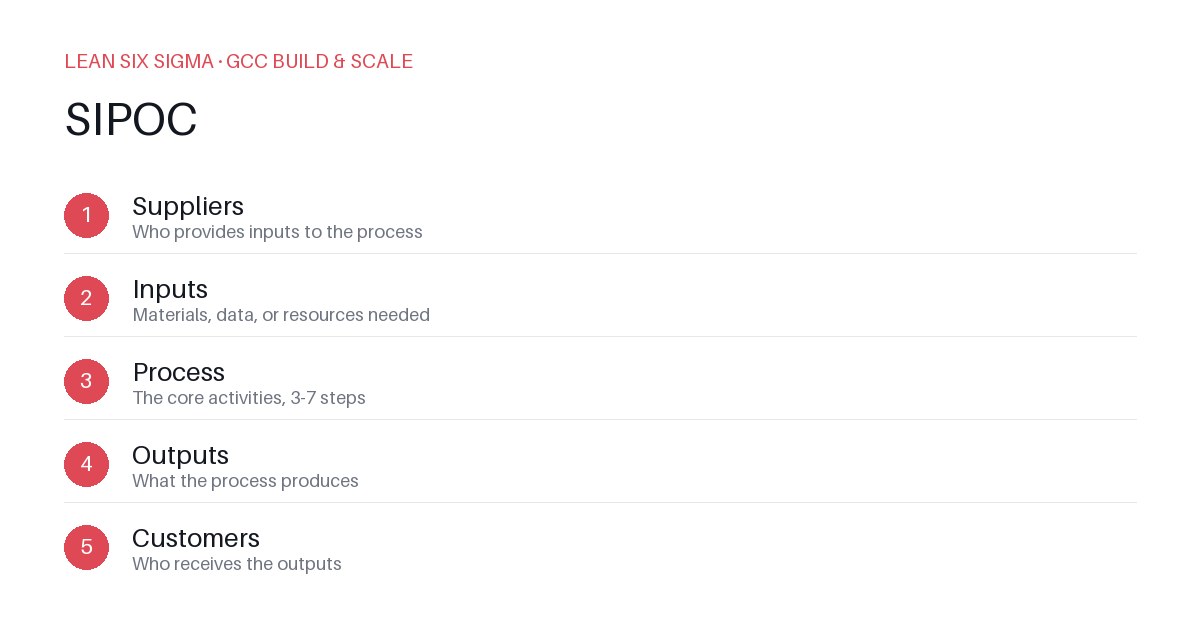
Downloadable templates
Map inputs, processes, outputs, and control variables to avoid scope creep when launching a new GCC capability.
Define the Function Scope First
Before you hire, you need a boundary. A new GCC function often starts as a vague request like 'Improve our testing' or 'Handle customer support for APAC.' Without a SIPOC map, teams default to doing everything. You end up with a bloated, under-resourced team that misses SLAs.
Start by naming the function precisely. Use the format: [Role] + [Action] + [Target]. Example: 'Senior QA Engineer for Regression Automation.' This forces specificity.
Identify Suppliers (Inputs)
Suppliers are what you depend on to start. If you ignore these, your team will stall waiting for handoffs.
- Process Owners: Who currently owns the manual steps you're automating? They must document current workflows.
- Product Teams: They provide the requirements. If they don't, your GCC builds the wrong thing.
- IT Infrastructure: You need access to environments, CI/CD pipelines, and tooling. List the exact tools (e.g., Selenium, Jira, AWS) and who owns them.
- Budget Approvers: Who signs off on headcount and software licenses? Identify them early to avoid approval delays.
Map the Core Processes
Break the function into discrete steps. Use active verbs. Avoid nouns.
- Step 1: Review requirements with product owners.
- Step 2: Design test cases or automation scripts.
- Step 3: Execute tests and log defects.
- Step 4: Report results to stakeholders.
Keep each step under 30 minutes if possible. If a step takes longer, split it. This reveals bottlenecks. For example, if 'Review requirements' takes two days, you need a better intake form or a template.
Define Outputs and Customers
Outputs must be tangible. Vague outputs like 'better quality' mean nothing.
- Direct Outputs: Automated test suites, defect reports, coverage metrics.
- Indirect Outputs: Faster release cycles, reduced hotfixes.
Customers are who consumes these outputs.
- Primary: Development teams, release managers.
- Secondary: QA managers, product owners.
If you don't know who the customer is, you don't know what they value. Ask them: 'What metric would make your job easier?'
Control Variables and Constraints
What affects your process? List them.
- Tool Availability: If the CI/CD pipeline is down, your tests can't run.
- Staffing Levels: One person can't maintain 500 automated tests.
- Quality of Requirements: Bad inputs lead to bad tests.
- Budget Constraints: License costs may limit tool choices.
Document these constraints. They will shape your rollout plan.
Validate with a Pilot
Don't launch the full function at once. Pick one process, one supplier, one customer. Run a 30-day pilot.
- Goal: Test the SIPOC map against reality.
- Measure: Cycle time, defect escape rate, supplier satisfaction.
- Adjust: Fix gaps before scaling.
SIPOC is not a one-time exercise. Update it monthly as the GCC evolves. This keeps the function aligned with business needs.
Comments
Be the first to comment on this post.
Sign in to leave a comment.