SIPOC Map for Standing Up a New GCC Function
September 24, 2026
Like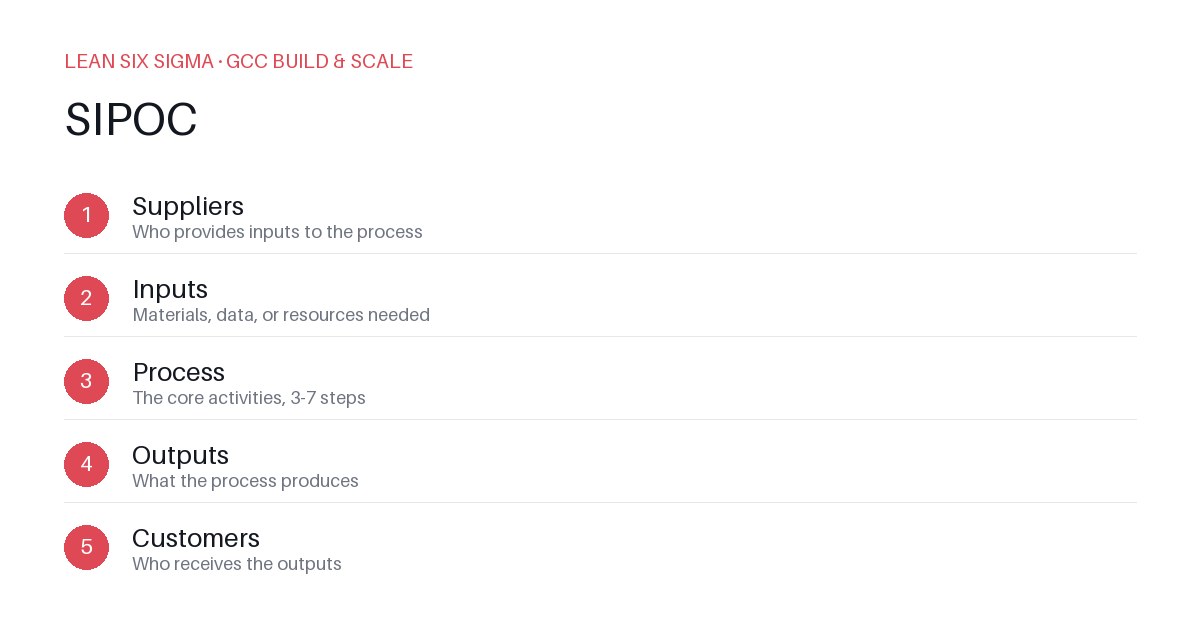
Downloadable templates
Map the SIPOC for launching a new GCC capability to avoid scope creep and ensure clear handoffs.
Define the Scope First
Before hiring or building tools, you need a SIPOC map for the new GCC function. This is not a nice-to-have. It is a risk mitigation tool. A poorly defined GCC function fails because the team builds the wrong thing, or the handoff to the business unit is broken.
Use the SIPOC framework to force clarity. It forces you to define what is inside the GCC's responsibility and what is not. This prevents the classic GCC trap: the GCC team becomes a second line of support for the business unit instead of owning a capability.
Identify Suppliers and Customers
Your suppliers are the sources of work and data. Your customers are the recipients of the value.
In a new GCC function, suppliers are often vague. Are they the IT ticketing system? The product owners? The legacy systems? You must list them explicitly.
- Suppliers: IT Service Management tools, Product Management backlog, Legacy ERP data exports.
- Customers: Regional Finance managers, Product Development teams, Compliance auditors.
If you cannot name the supplier, you do not have a process. You have a guess. A guess kills scalability.
Map the Process Steps
List the steps in the process flow. Keep it high-level. This is not a SOP. This is the skeleton.
- Steps: Ingest data, Validate inputs, Run analysis, Generate report, Distribute output.
- Use active verbs. Avoid noun-heavy titles like "Data Processing." Use "Run analysis" instead.
This list helps you spot bottlenecks before they happen. If you have ten steps in the first month, you are over-engineering. Start with five core steps.
Define Outputs and Inputs
Define what you give to the customer and what you need from the supplier.
- Outputs: Monthly variance report, Dashboard link, Data quality scorecard.
- Inputs: Raw transaction logs, Requirement spec, Access credentials.
Be specific. "Report" is not an output. "PDF report with variance analysis and recommendations" is an output.
Use the Map to Drive Execution
Once you have the SIPOC, use it to drive your rollout.
- Hire based on the steps. If the process requires data engineering, hire a data engineer, not a process consultant.
- Train based on the inputs. Ensure the supplier knows what they need to provide.
- Measure based on the outputs. Define KPIs for each output.
This map becomes your single source of truth. When scope creep hits, you refer back to the SIPOC. If it is not in the map, it is not in scope.
Final Check
Review the SIPOC with your business partner. Ask one question: "Does this map clearly show who owns what?"
If the answer is no, you are not ready to launch. Refine the map until the ownership is unambiguous. Then, build.
Comments
Be the first to comment on this post.
Sign in to leave a comment.