Using DMAIC to Fix GCC Onboarding Delays
September 12, 2026
Like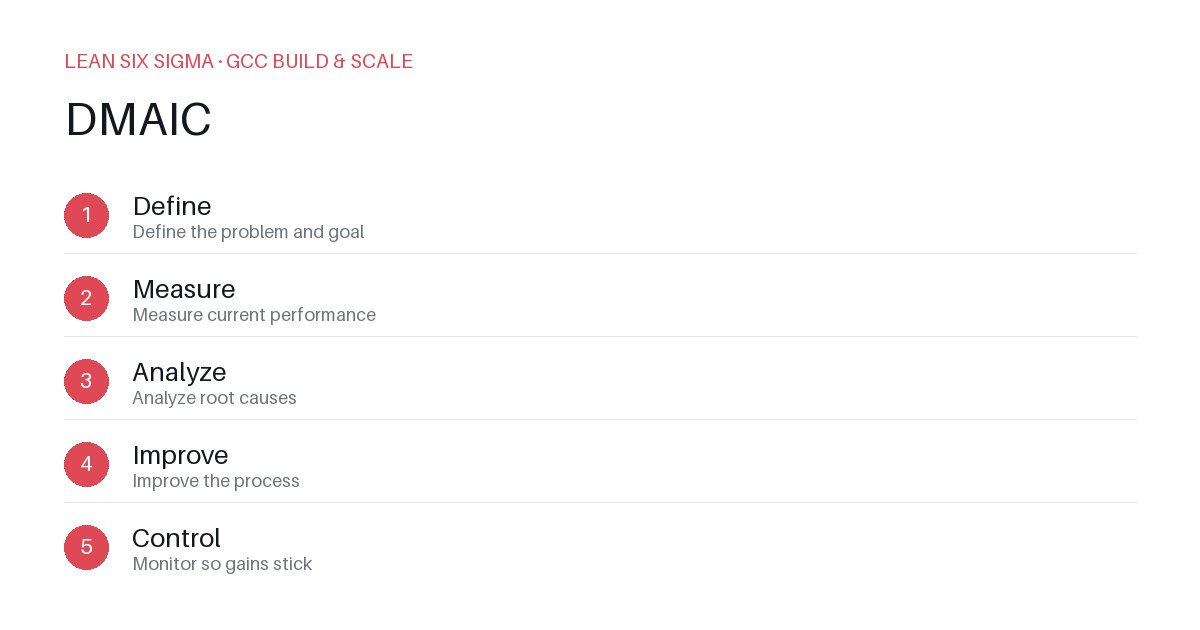
Downloadable templates
Apply DMAIC to cut new hire ramp-up time by 40% with a structured, data-driven approach.
Define the Real Bottleneck
Onboarding delays in Global Capability Centers (GCCs) rarely stem from a single failure. They’re usually a chain of handoffs: incomplete documentation, mismatched tool access, or inconsistent mentor expectations.
Start by mapping the current process. Track one cohort of 20 new hires from day one to first independent task. Log timestamps at each step: access provisioning, training completion, first deliverable.
You’ll likely find 60–70% of delay comes from 2–3 repeatable friction points. Name them clearly: “Access delay,” “training gap,” “unclear first task.”
Measure Baseline and Variability
Don’t guess. Measure.
Record:
- Average days to full system access
- Training completion rate within week one
- Time from last training to first assigned task
- Rework rate on first deliverable
Calculate the mean and standard deviation. If average ramp is 28 days with ±6 days variance, you have a problem. Variance kills predictability.
Use a simple time-and-motion log. Have the GCC operations manager shadow onboarding for one week. Capture where people wait, ask for help, or restart.
Analyze Root Causes
Run a 5-Whys on each bottleneck.
Example: “Access takes 5 days.”
- Why? Security team queues requests.
- Why? No standardized role template.
- Why? Roles changed quarterly without updating provisioning.
Root cause: fragmented ownership, not slow IT.
Map causes to process steps. Classify as people, process, or tool issues. Prioritize by impact and effort. Fix the 20% that drives 80% of delays.
Improve with Lean Six Sigma Tactics
Apply standardization, not customization.
Create a role-based access matrix. Define 5 core roles with pre-approved tool sets. Automate provisioning via service catalog.
Build a “first week checklist” with sign-off gates. Mentor reviews checklist daily. No open loops.
Define “first task” as a repeatable micro-deliverable with rubric. Example: “Document 3 process exceptions.” Graded by manager. Reduces ambiguity.
Pilot with next cohort. Track same metrics. Expect 15–25% improvement.
Control and Sustain Gains
Embed checks into GCC operating rhythm.
Add onboarding KPI to monthly GCC review: access time, training completion, first-task quality.
Assign an Onboarding Owner. They own the process, not the people.
Run quarterly process audits. If variance creeps back, trigger DMAIC again.
Use a control chart. Set upper control limit at 20 days. Alert when breached. Fix before it becomes normal.
Onboarding isn’t a program. It’s a system. Treat it like production: measure, standardize, control.
Comments
Be the first to comment on this post.
Sign in to leave a comment.