Using DMAIC to Fix GCC Onboarding Delays
October 27, 2026
Like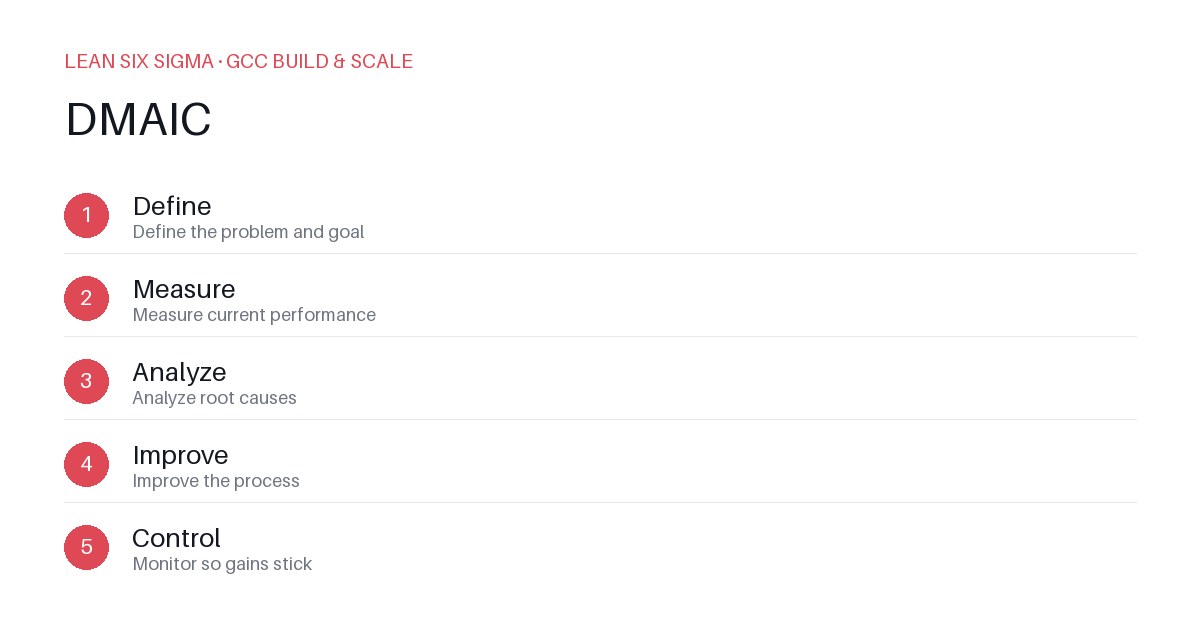
Downloadable templates
Apply DMAIC to eliminate bottlenecks in GCC onboarding, reducing time-to-productivity from 90 to 45 days.
New hires at a Global Capability Center (GCC) often stall for months before hitting full productivity. If your onboarding process is ad hoc, you're leaking talent and money. DMAIC is the practical framework to diagnose and fix these delays without adding bureaucracy. Here’s how to apply it to your GCC onboarding pipeline.
Define: Map the Current Failure
Start by defining the problem with data, not assumptions. Track the 'time-to-first-impact' metric for the last 20 hires. You’ll likely find specific stages where delays occur.
Common bottlenecks in GCC onboarding:
- IT provisioning taking 5+ days due to fragmented ticket systems.
- Lack of role-specific training materials, forcing managers to build content on the fly.
- No clear 'go-live' checklist, leaving new hires guessing what's required to be productive.
Create a value stream map of the current process. Identify where work-in-progress (WIP) piles up. If 60% of hires wait for access permissions, that's your primary defect.
Measure: Quantify the Gap
Establish baseline metrics to understand the severity. Measure:
- Average days from offer acceptance to first code review.
- Number of support tickets per new hire in the first 30 days.
- Retention rate of hires in their first 90 days.
Example: Your baseline shows an average onboarding duration of 85 days, with 40% of hires failing their first project milestone. The cost of this delay is roughly $12,000 per hire in lost productivity.
Analyze: Root Cause Analysis
Use the 5 Whys technique to dig into the bottlenecks. Don't stop at 'IT is slow.' Ask why. Why is IT slow? Because requests are manual. Why manual? Because the ticketing system isn't integrated with HRIS.
Common root causes in GCC onboarding:
- Siloed ownership: HR, IT, and business units operate independently.
- Over-reliance on tribal knowledge: Onboarding steps aren't documented.
- No feedback loop: New hires don't report delays until it's too late.
Perform a Pareto analysis to prioritize fixes. Address the 20% of causes driving 80% of the delays first.
Improve: Implement Targeted Fixes
Design solutions that address the root causes. Focus on automation and standardization.
Concrete improvements:
- Automate IT provisioning via API integration between HRIS and ITSM tools.
- Create a 'Day 1' playbook with checklists, video tutorials, and access pre-approvals.
- Assign an onboarding buddy system to reduce dependency on managers.
Run a pilot with the next 10 hires. Track the new baseline metrics. Expect to see a 30% reduction in onboarding time within the first cycle.
Control: Sustain the Gains
Monitor the process to prevent regression. Implement a monthly review of onboarding metrics.
Key controls:
- Automated dashboards tracking time-to-productivity.
- Quarterly audits of the onboarding playbook for relevance.
- Feedback surveys sent to new hires at 30, 60, and 90 days.
If metrics slip, trigger a corrective action plan. Continuous improvement keeps the GCC lean and responsive.
By applying DMAIC, you turn onboarding from a chaotic experience into a repeatable, efficient process. Your GCC hires become productive faster, and you retain top talent longer.
Comments
Be the first to comment on this post.
Sign in to leave a comment.