Using DMAIC to Fix GCC Onboarding Delays
November 4, 2026
Like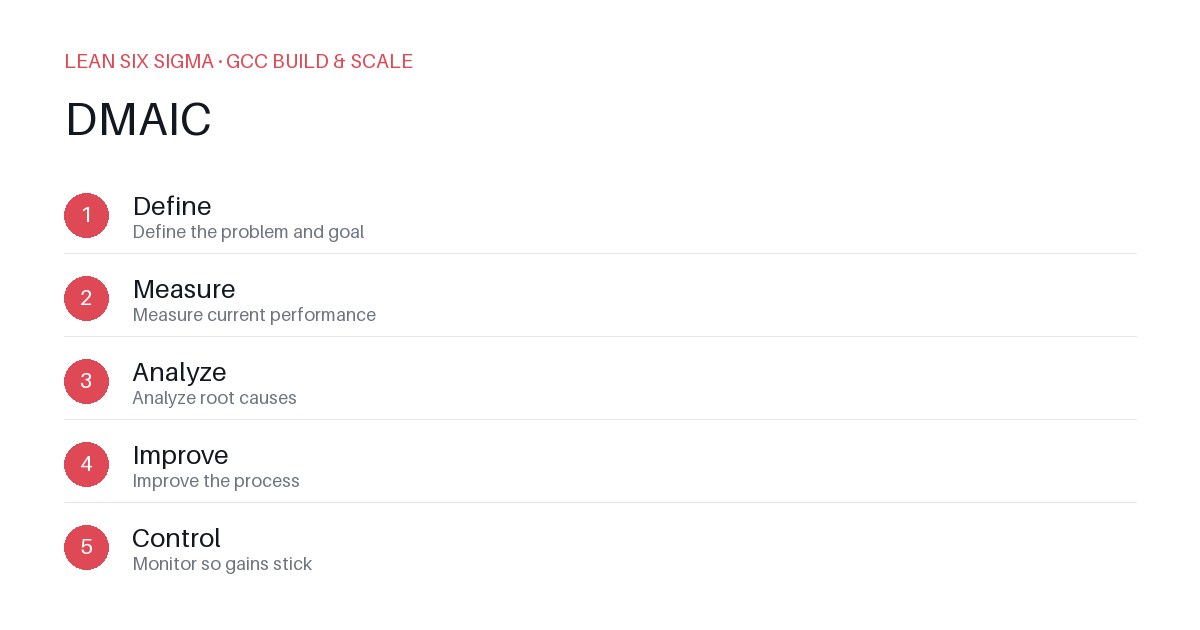
Downloadable templates
A practical walkthrough of applying DMAIC to real GCC build-and-scale work.
Using DMAIC to Fix GCC Onboarding Delays
Why DMAIC Matters for GCC Teams
Scaling a Global Capability Center (GCC) means standardizing work across sites, handoffs, and teams that have never worked together before. In such environments, onboarding delays often stem from fragmented processes, inconsistent expectations, and unclear ownership. DMAIC gives you a shared vocabulary and a repeatable sequence for diagnosing and resolving these issues systematically. Unlike ad-hoc fixes, DMAIC ensures that improvements are grounded in data, aligned with business goals, and sustainable over time.
The DMAIC Sequence
-
Define — Define the problem and goal
Clearly articulate what “onboarding delay” means in your GCC context. Is it the time from hire to first client interaction? The duration until an associate can independently handle tickets? Define success metrics upfront: for example, reducing average onboarding time from 14 days to 7 days within 90 days. -
Measure — Measure current performance
Collect baseline data across all GCC sites. Track metrics like time-to-productivity, training completion rates, manager satisfaction scores, and rework frequency. Use time-stamped logs, survey tools, and workflow analytics to quantify where delays occur — whether in HR setup, IT provisioning, mentor pairing, or technical certification. -
Analyze — Analyze root causes
Use techniques like the 5 Whys, fishbone diagrams, or value stream mapping to identify why delays happen. Common root causes in GCCs include:- Inconsistent training materials across regions
- Manual approval bottlenecks in compliance or security clearances
- Lack of dedicated onboarding coordinators
- Poor cross-team communication during handoffs
Prioritize causes by impact and effort to focus improvement efforts where they’ll yield the most value.
-
Improve — Improve the process
Design targeted interventions based on your analysis. Examples include:- Implementing a centralized onboarding playbook with version control
- Automating IT and access provisioning via workflow tools
- Assigning “onboarding champions” at each site to monitor progress
- Creating a feedback loop for new hires to flag friction points weekly
Pilot changes in one region before scaling, and track leading indicators like task completion time and error rates.
-
Control — Monitor so gains stick
Establish dashboards and regular reviews to sustain improvements. Assign ownership for monitoring key metrics, schedule monthly cross-site syncs to share lessons learned, and embed onboarding KPIs into team performance reviews. Use control charts or statistical process control to detect drift early and trigger corrective actions before delays re-emerge.
Applying It
Start small: pick one recurring pain point your GCC team hits every week, and walk it through these 5 steps before rolling the approach out more broadly. For instance, focus specifically on the “IT access provisioning” phase, which often causes 3–5 day delays. Document the workflow, measure cycle times, identify bottlenecks, test a simplified approval chain, and monitor results over two sprints.
Download the template below to run your first pass. It includes guided prompts for each DMAIC phase, space for data collection, and a simple scoring matrix to prioritize root causes. Consistent use of this framework will not only accelerate onboarding but also build a culture of continuous improvement across your GCC.
Comments
Be the first to comment on this post.
Sign in to leave a comment.