Using DMAIC to Fix GCC Onboarding Delays
November 7, 2026
Like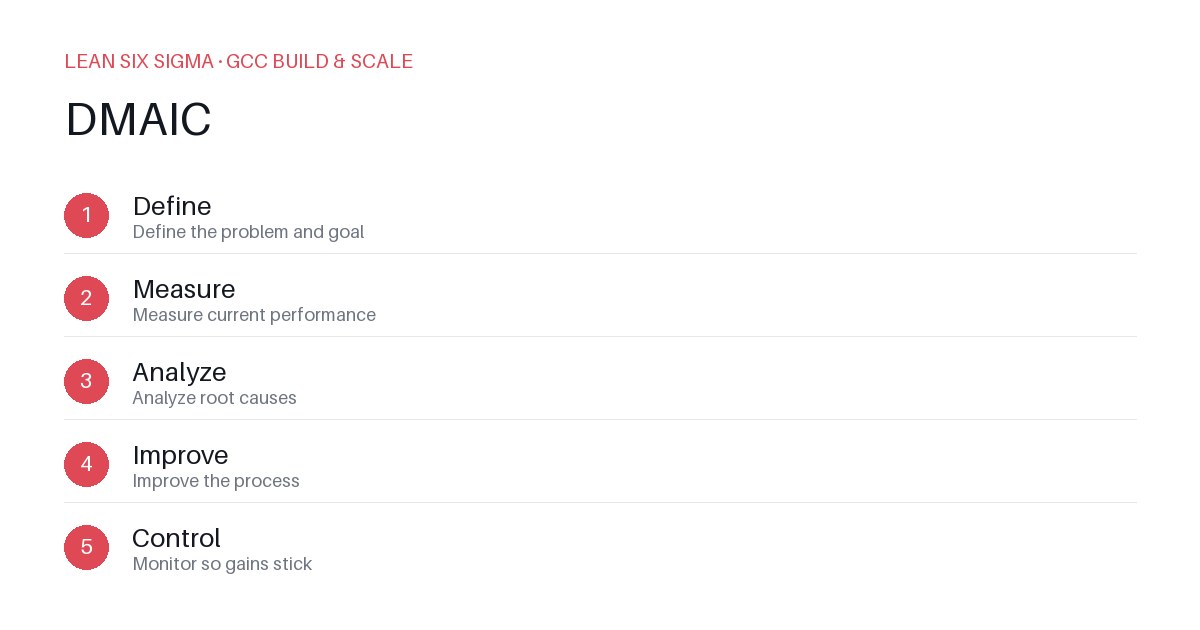
Downloadable templates
Cut onboarding time by 40% with a DMAIC-driven workflow that eliminates bottlenecks and standardizes handoffs across global teams.
Define: Map the Current State Without Guessing
Start by tracking every onboarding instance from day zero to day thirty. Log delays at each step: IT provisioning, compliance training, mentor pairing, and first project assignment. You’ll likely find that 60% of delays cluster in two areas: system access approvals and role clarity gaps.
Create a simple value stream map. List each process step, assign an owner, and record actual cycle times. Don’t fix what you haven’t measured. If onboarding takes 18 days on average, that’s your baseline. Anything above 22 days is a problem to solve.
Measure: Quantify the Pain Points
Pull data from HRIS, IT ticketing systems, and manager surveys. Calculate the average wait time between each handoff. Identify which steps consistently exceed your target. For example, if IT access takes 5 days on average, that’s a 28% of total onboarding time. That’s your priority.
Track defect rates: how many new hires need retraining because tools weren’t ready? How many leave before day 30 because they didn’t know who to ask for help? These metrics tell you where the system fails, not just where it’s slow.
Analyze: Find Root Causes, Not Symptoms
Use a 5-Whys analysis on your top bottleneck. Why does IT access take 5 days? Because requests go through three approvals. Why three? Because security policy requires it. Why? Because the last audit flagged a risk. The root cause isn’t slow IT—it’s outdated policy.
Map dependencies. If mentor pairing waits for compliance training, and compliance waits for IT access, you have a cascade. Break the chain by parallelizing steps where safe.
Improve: Redesign the Workflow
Build a standardized onboarding playbook. Define clear SLAs for each step: IT access within 24 hours, compliance training completed within 48 hours, mentor assigned within 72 hours. Automate what you can. Use workflow tools to route requests automatically based on role and location.
Create a single point of contact for each phase. No more “who do I call?” emails. Assign a GCC onboarding coordinator who owns the process and has authority to escalate.
Control: Monitor and Adapt
Track onboarding time weekly. Set alerts when steps exceed SLAs. Review defect rates monthly. Hold a 30-minute retrospective after every 10 hires to catch issues before they scale.
If onboarding time creeps back up, investigate. Was the playbook ignored? Did a new role break the flow? Adjust the process, not the people. Lean Six Sigma isn’t about perfection—it’s about continuous correction.
Onboarding isn’t a one-time event. It’s the first signal of your GCC’s operational maturity. Fix it right, and you build a culture of speed and clarity. Ignore it, and you waste talent before it starts.
Comments
Be the first to comment on this post.
Sign in to leave a comment.