Using DMAIC to Fix GCC Onboarding Delays
August 23, 2026
Like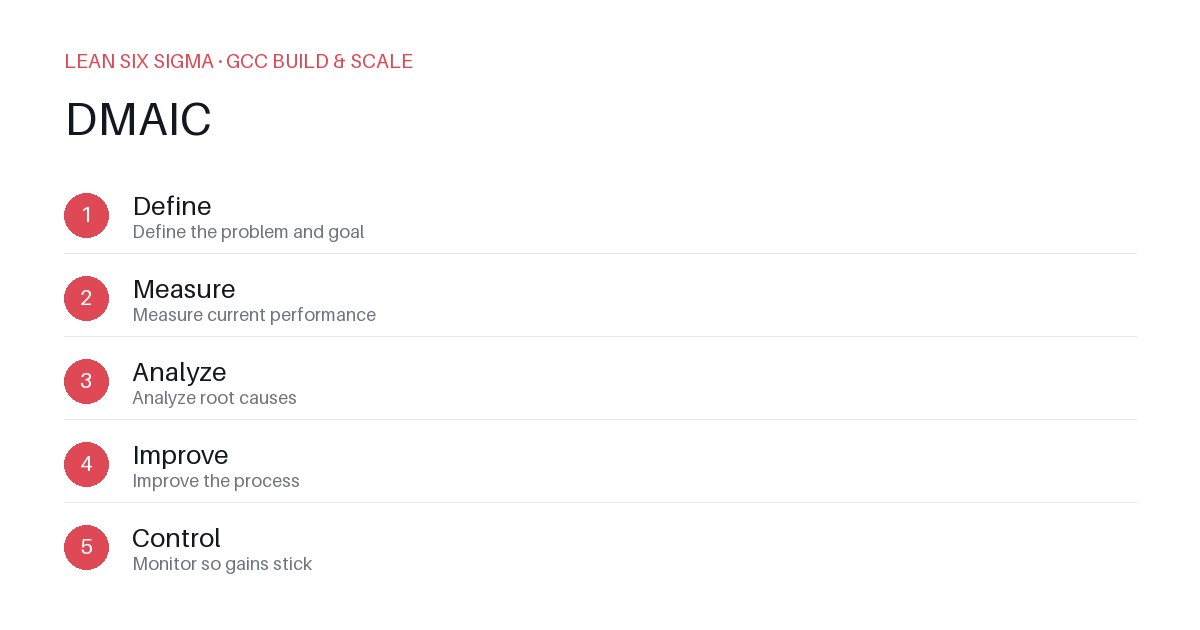
Downloadable templates
A practical walkthrough of applying DMAIC to real GCC build-and-scale work.
Using DMAIC to Fix GCC Onboarding Delays
Why DMAIC Matters for GCC Teams
Scaling a Global Capability Center (GCC) means standardizing work across sites, handoffs, and teams that have never worked together before. Without a structured methodology, onboarding becomes a patchwork of tribal knowledge, inconsistent expectations, and unpredictable timelines. DMAIC gives you a shared vocabulary and a repeatable sequence for diagnosing and fixing those systemic gaps. It transforms onboarding from an ad-hoc activity into a measurable, improvable process.
The DMAIC Sequence
- Define — Define the problem and goal
- Measure — Measure current performance
- Analyze — Analyze root causes
- Improve — Improve the process
- Control — Monitor so gains stick
Applying It
Start small: pick one recurring pain point your GCC team hits every week, and walk it through these 5 steps before rolling the approach out more broadly. Download the template below to run your first pass.
Deep Dive: Each Phase in Action
Define: Pinpoint the Exact Onboarding Failure
Begin by clearly articulating what “onboarding delay” means in your context. Are new hires taking 14 days instead of 10 to reach productivity? Are critical tools not provisioned on Day 1? Are managers spending excessive time repeating the same setup instructions? Write a problem statement using the “5 Ws”: Who is affected? What is failing? When does it happen? Where does it occur? Why does it matter?
Example: “New analysts in the GCC take an average of 12 days to complete their first client deliverable, compared to the 7-day target. This delays project timelines and increases manager overhead.”
Measure: Quantify the Current State
You can’t improve what you don’t measure. Collect baseline data before making changes. Track metrics like time-to-productivity, number of support tickets during onboarding, completion rates of training modules, and manager-reported readiness scores. Use time-stamped logs from HRIS, LMS, and IT provisioning systems to build an accurate picture.
Example: Survey 20 recent hires. Analyze ticketing data for the first 30 days. Map the actual onboarding timeline against the ideal process. You might discover that 60% of delays occur during system access approvals, not training.
Analyze: Uncover Root Causes, Not Symptoms
Avoid jumping to solutions. Use tools like the 5 Whys, fishbone diagrams, or value stream mapping to trace delays back to their source. Common root causes in GCC onboarding include:
- Siloed ownership (HR, IT, and business units all “assume” someone else handles a step)
- Manual handoffs with no SLAs or tracking
- Overloaded managers who lack time to mentor
- Outdated documentation that doesn’t reflect current tools or workflows
Example: You discover that 70% of delays stem from delayed IT provisioning because requests are submitted via email with no priority routing or status visibility.
Improve: Design and Test Targeted Solutions
Develop interventions that directly address the root causes identified. Pilot them with a small group before scaling. Examples:
- Implement an automated onboarding workflow in your HRIS that triggers IT ticket creation upon hire date confirmation
- Create a “Day 1 Checklist” co-owned by HR, IT, and the hiring manager
- Assign an onboarding buddy for the first two weeks
- Standardize training paths by role, with self-paced modules and milestone assessments
Track the impact of each change. Did time-to-productivity drop? Did support tickets decrease? Refine based on feedback.
Control: Embed Gains into the System
Improvements fade without oversight. Establish monitoring mechanisms:
- Add onboarding KPIs to your GCC’s monthly performance dashboard
- Schedule quarterly process audits to catch drift
- Assign an Onboarding Owner accountable for continuous improvement
- Incorporate lessons learned into your standard operating procedures (SOPs)
Example: Run a biweekly “Onboarding Retro” with HR, IT, and hiring managers to review metrics, discuss bottlenecks, and adjust workflows in real time.
Start Small, Scale Smart
Don’t try to fix every onboarding pain point at once. Use DMAIC to solve one high-impact issue first—like delayed system access or inconsistent training completion. Once you see measurable results, replicate the framework across other areas. Over time, you’ll build a culture of continuous process improvement that accelerates GCC onboarding and boosts overall capability delivery.
Download the template below to run your first pass.
Comments
Be the first to comment on this post.
Sign in to leave a comment.