Using DMAIC to Fix GCC Onboarding Delays
September 2, 2026
Like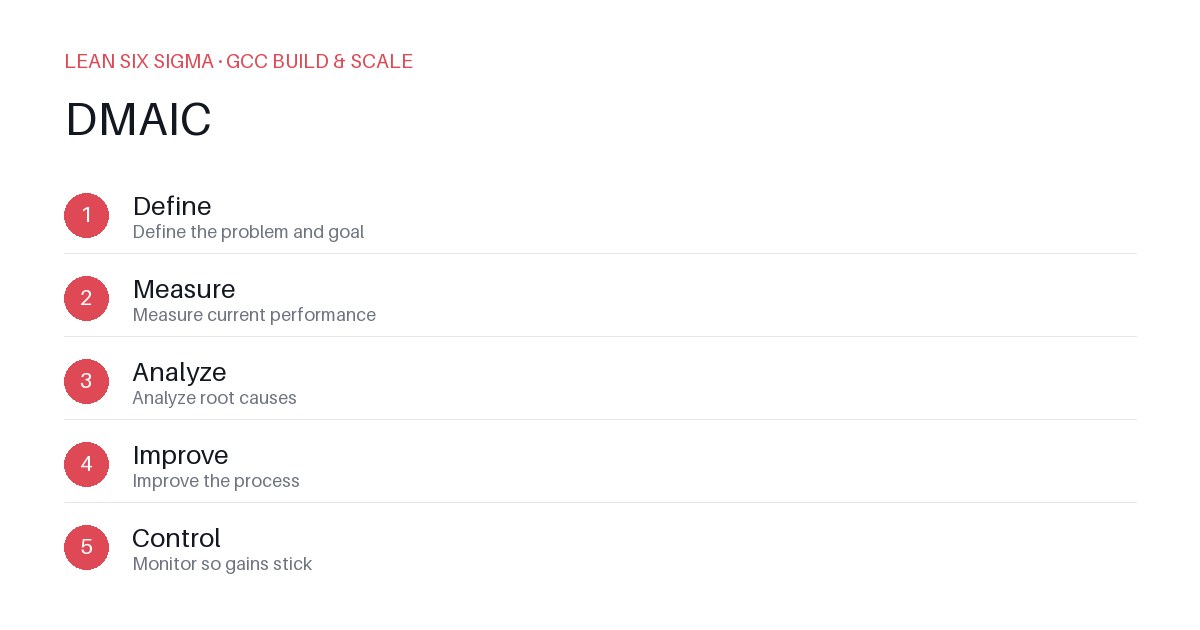
Downloadable templates
Cut onboarding time by 40% with a structured DMAIC approach to eliminate bottlenecks in your GCC.
Define the Real Problem
Onboarding delays in Global Capability Centers (GCCs) often hide behind generic complaints like "too slow" or "people are overwhelmed." You need data, not opinions. Start by measuring the cycle time from hire to productive contribution. Track where candidates stall: is it IT provisioning, compliance training, or lack of mentor pairing?
Set a clear target. If your current average is 21 days, aim for 12. Document the current state process visually using a value stream map. Identify the 20% of steps causing 80% of the delays.
Measure the Current State
Collect cycle time data for the last 50 hires. Break down each phase:
- IT Setup: Average 3 days
- Security Compliance: Average 4 days
- Role-Specific Training: Average 7 days
- First Project Assignment: Average 6 days
Use time-stamped logs from your HRIS and IT ticketing systems. If data is missing, run a pilot survey with new hires to estimate wait times. Calculate the variation (standard deviation) to understand inconsistency. High variance means your process is unstable, not just slow.
Analyze Root Causes
Apply the 5 Whys to your longest delays. For example:
- Why does IT setup take 3 days?
- Because requests go through a shared queue.
- Why a shared queue?
- Because no dedicated GCC admin exists.
Map these findings to a cause-and-effect diagram. Common GCC bottlenecks include:
- Manual data entry in multiple systems
- Lack of standardized role templates
- Dependency on single-point-of-failure trainers
Prioritize causes by impact and effort. Fixing IT provisioning might yield a 2-day gain with low effort, while retraining trainers might save 3 days but require more investment.
Improve the Process
Design changes based on your analysis. Implement these tactical fixes:
- Automate IT provisioning using pre-built role profiles. Reduce setup time from 3 days to 4 hours.
- Create a GCC onboarding playbook with checklists for each role. Eliminate guesswork for new hires.
- Assign buddy mentors from day one. Cut first-project delay by 4 days.
Run a pilot with the next 10 hires. Track cycle time daily. Adjust based on feedback. If IT automation fails, revert and try a hybrid approach. Document every change for future reference.
Control and Sustain
Monitor onboarding metrics weekly. Set up dashboards for cycle time, first-task completion, and employee satisfaction. Assign an owner to maintain the process.
Conduct monthly reviews to catch drift. If cycle time increases, trigger a root cause analysis. Celebrate wins publicly to reinforce accountability. Update the playbook quarterly as roles evolve. Continuous improvement keeps your GCC agile and scalable.
Comments
Be the first to comment on this post.
Sign in to leave a comment.