Value Stream Mapping a GCC Shared Services Handoff
September 13, 2026
Like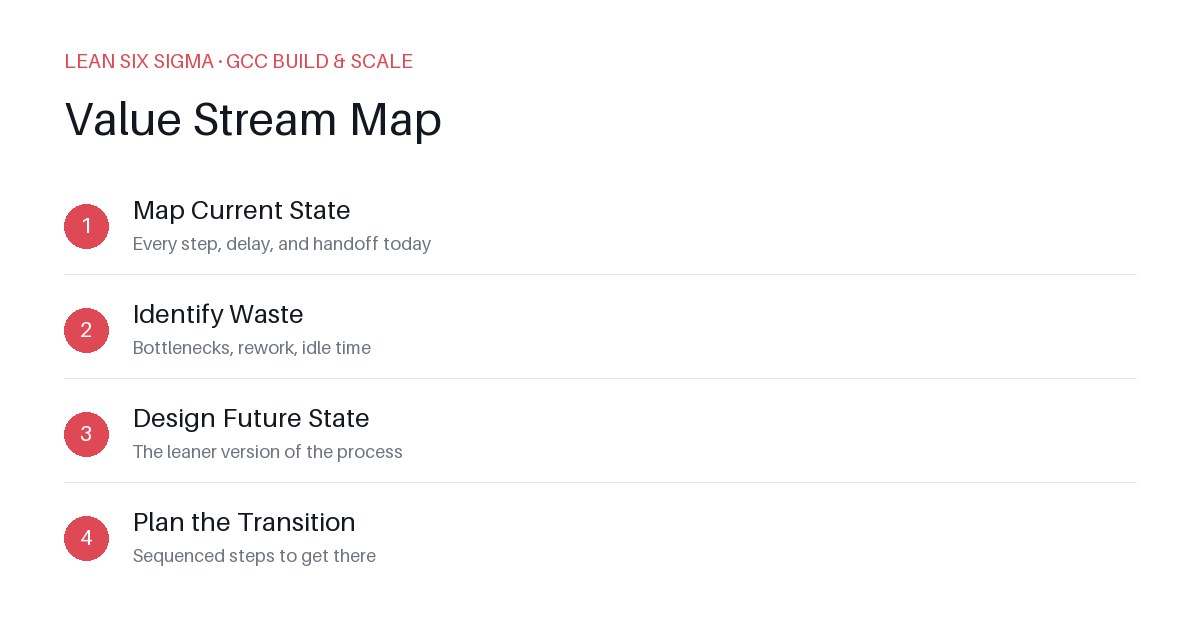
Downloadable templates
Map the handoff process to expose delays, rework, and handoff friction in your GCC shared services workflow.
Start with the Handoff, Not the Whole System
A GCC shared services handoff is a process. It has a start, an end, and multiple steps in between. Most GCCs treat it as a black box. That’s why errors pile up. A Value Stream Map (VSM) forces you to draw the handoff on paper, not in your head.
Capture the Current State
Begin by walking the handoff with a real case. Use a recent ticket, request, or case file. Sit with the people who actually do the work. Ask:
- Where does the work enter the handoff?
- Who touches it, and in what order?
- Where does it wait?
- What information is added, removed, or lost?
Draw what you see. Use boxes for processes, arrows for flow, and clocks for wait times. Label each step with the owner and the output.
Identify Value-Adding vs. Non-Value-Adding Steps
Not all steps create value. A step is value-adding only if the customer or end user benefits directly. Examples:
- Value-adding: Quality check, routing to the right team, final approval.
- Non-value-adding: Re-entry of data, waiting for a manager, reformatting for another system.
Label each step. This shows you where to cut or combine.
Measure Cycle Time and Wait Time
time is the enemy of GCC handoffs. Measure:
- Cycle time: Total time from start to finish.
- Wait time: Time the work sits idle.
- Processing time: Time actively worked on.
Use a stopwatch. Track five to ten real cases. Average the results. This gives you a baseline to beat.
Spot the Bottlenecks and Handoff Friction
Look for:
- Steps where work piles up.
- Re-entry or reformatting steps.
- Steps with high error rates or rework.
- Handoffs between systems or teams that cause delays.
These are your targets. Fix them first.
Design the Future State
Redraw the handoff. Apply these rules:
- Eliminate non-value-adding steps.
- Combine small steps where possible.
- Move work closer to the source when feasible.
- Add standard work or templates to reduce variation.
- Ensure each step has a clear owner and output.
Implement and Monitor
Pilot the new handoff with a small team. Track cycle time, wait time, and error rate. Compare to the baseline. Adjust based on real data. Then scale.
A VSM isn’t a one-time exercise. It’s a living map. Update it as the handoff changes. Keep it visible. Keep it simple.
Comments
Be the first to comment on this post.
Sign in to leave a comment.