Value Stream Mapping a GCC Shared Services Handoff
October 16, 2026
Like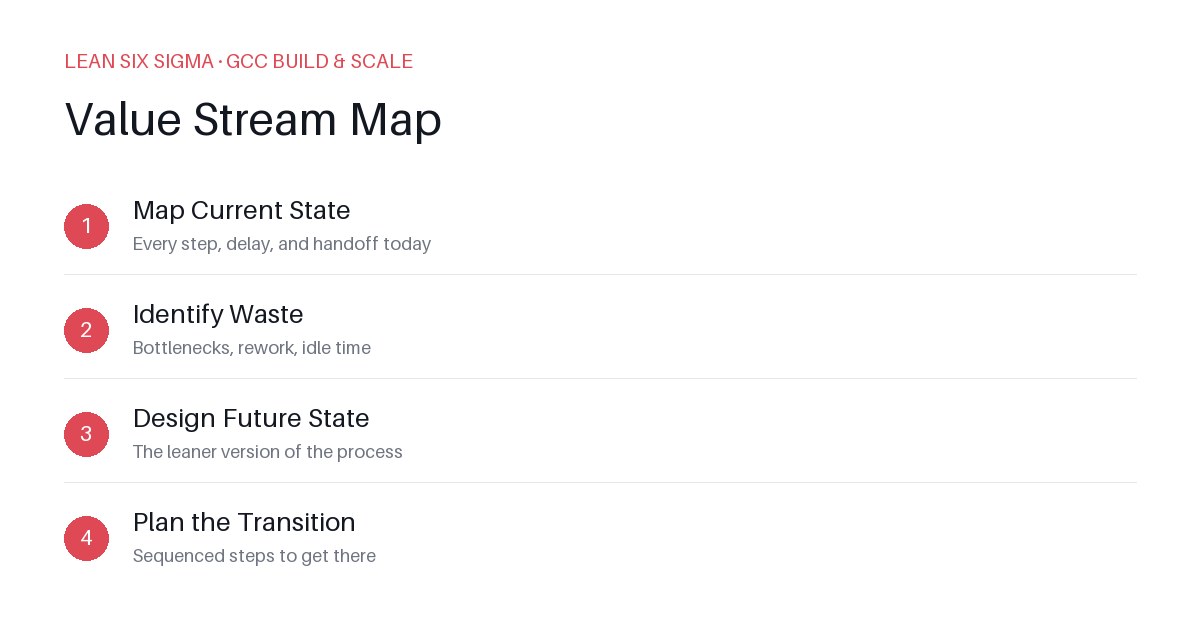
Downloadable templates
Cut cycle time and defects by mapping the exact handoff points between GCC teams using a practical VSM approach.
Why the Handoff is the Real Bottleneck
Most Global Capability Centers (GCCs) fail not because of skill gaps, but because of broken handoffs. Work moves from one pod to another, and it gets stuck in queues, reworked, or misinterpreted. A Value Stream Map (VSM) exposes these hidden delays. You see where value stops flowing and where waste accumulates. The goal is simple: make the handoff transparent, measurable, and fast.
Step 1: Define the Process Boundaries
Start by drawing the current state. Pick one recurring handoff, like a QA defect ticket moving from Development to Testing. Set clear start and end points. Don’t map the whole GCC. Map the handoff. Identify every step, role, and system involved. Include approvals, escalations, and rejections. Write down what each step is supposed to achieve.
Step 2: Capture Cycle Time and Wait Time
For each step, record two numbers: cycle time and wait time. Cycle time is how long the step takes when it’s active. Wait time is how long the work sits idle. Use real data from your ticketing system, not estimates. You’ll likely find that wait time dwarfs cycle time. That’s where your waste lives. Example: A code review might take 30 minutes, but sit in a queue for 48 hours. The VSM shows this clearly.
Step 3: Identify Value-Added vs. Non-Value-Added Steps
Classify each step. Value-added steps directly move the work toward the customer. Non-value-added steps are delays, approvals, or rework. Mark rejections as a waste source. If a ticket gets sent back three times, that’s a process failure, not a person failure. The VSM makes this visible. You can’t fix what you don’t see.
Step 4: Map the Future State
Design a leaner handoff. Reduce steps. Eliminate approvals that add no value. Set clear SLAs for each step. Add visual management, like a Kanban board, so everyone sees the status. Define handoff criteria so work is never ambiguous. Example: A test case is ready for QA only when it includes expected results, steps, and environment details. No guesswork.
Step 5: Implement and Measure
Roll out the new process. Track cycle time, wait time, and defect rates. Compare to the current state. Expect resistance. People protect their workflows. Use data to drive change, not opinion. Celebrate small wins. Adjust the map as needed. The VSM is a living tool, not a one-time exercise. Update it quarterly. Keep it simple. Keep it real.
Real-World Example
A GCC in India mapped a handoff from Product to Engineering. They found 72% of delays came from unclear requirements. They added a mandatory checklist and a 15-minute sync before handoff. Cycle time dropped by 40%. Defects dropped by 25%. The map was updated monthly. The process became a habit.
Final Tip
Start small. Pick one handoff. Map it. Fix it. Repeat. The VSM is your compass. Use it to navigate waste, not just document it. Value flows where clarity exists. Build that clarity.
Comments
Be the first to comment on this post.
Sign in to leave a comment.