Value Stream Mapping a GCC Shared Services Handoff
October 20, 2026
Like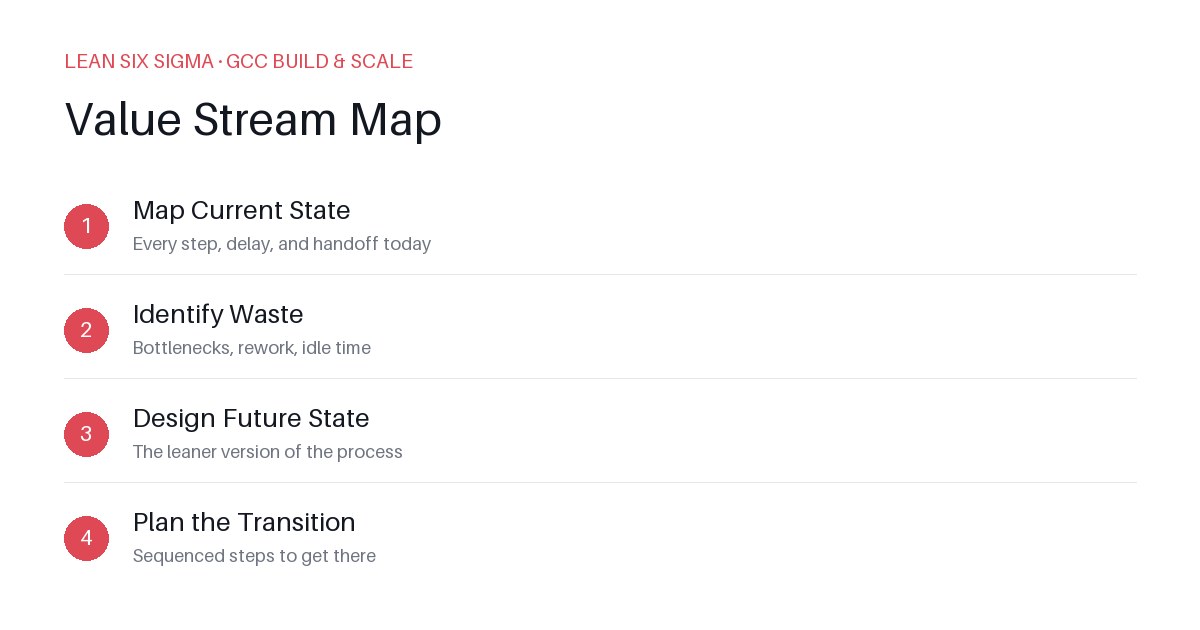
Downloadable templates
Map the handoff between GCC and shared services to find where value leaks in delays, rework, and unclear ownership.
Why Handoffs Break Value Flow
GCCs often outperform when they treat shared services as a single value stream, not separate silos. Most organizations map their GCC end-to-end but stop at the boundary. The handoff to shared services—IT, HR, finance, or legal—is where value leaks. Requests sit in queues. Data gets re-entered. Errors surface late.
A value stream map (VSM) of this handoff makes invisible work visible. It shows every step, wait time, handoff point, and decision gate between the GCC and the shared service function.
Step 1: Define the Process Boundary
Start with a concrete example: a new employee onboarding request.
- The GCC receives the request from a business unit.
- It validates eligibility, assigns resources, and triggers provisioning.
- The handoff occurs when the GCC transfers ownership to shared services for IT setup, HR paperwork, and payroll integration.
Draw the boundary clearly. Mark where the GCC hands off responsibility and where shared services takes it. This is your starting point for the VSM.
Step 2: List Every Value-Adding and Non-Value-Adding Step
Walk through the handoff with a real request.
Value-adding steps:
- Validating employee data
- Assigning system access
- Confirming payroll details
Non-value-adding steps:
- Waiting for approval from multiple managers
- Re-entering data into a shared service portal
- Chasing missing documents
- Status checks via email or chat
Log each step, its owner, and the time it takes. Use a stopwatch for actuals, not estimates.
Step 3: Map the Flow and Identify Waste
Draw the VSM using standard symbols:
- Process boxes for each step
- Queue icons for waits
- Arrows for flow direction
- Decision diamonds for approvals
Look for:
- Long queues: Where do requests pile up? Is it waiting for data, approval, or capacity?
- Rework loops: How often does a request go back to the GCC for corrections?
- Handoff friction: Are there mismatched formats, missing fields, or unclear ownership?
- Decision delays: Who approves what, and how long does it take?
Step 4: Quantify Cycle Time and Lead Time
Calculate:
- Cycle time: Time to complete one request from handoff start to finish.
- Lead time: Time from request creation to final completion.
- Wait time: Total time requests sit in queues.
- Rework rate: Percentage of requests requiring corrections.
Example: A handoff might take 5 days lead time but only 12 hours of actual work. That’s a 97% wait time. That’s your problem.
Step 5: Fix the Bottlenecks
Use the VSM to prioritize fixes:
- Standardize handoff formats: Use a single template or API payload.
- Assign clear ownership: One person owns the handoff, not the whole team.
- Reduce approvals: Move from serial to parallel where possible.
- Automate data transfer: Eliminate manual re-entry.
- Add feedback loops: Let the GCC know when shared services is delayed.
Step 6: Monitor and Iterate
Update the VSM quarterly. Track:
- Cycle time reduction
- Rework rate decline
- Handoff error rate
- Employee satisfaction with the process
A VSM isn’t a one-time exercise. It’s a living map that shows you where value is stuck and how to move it.
Comments
Be the first to comment on this post.
Sign in to leave a comment.