Value Stream Mapping a GCC Shared Services Handoff
August 26, 2026
Like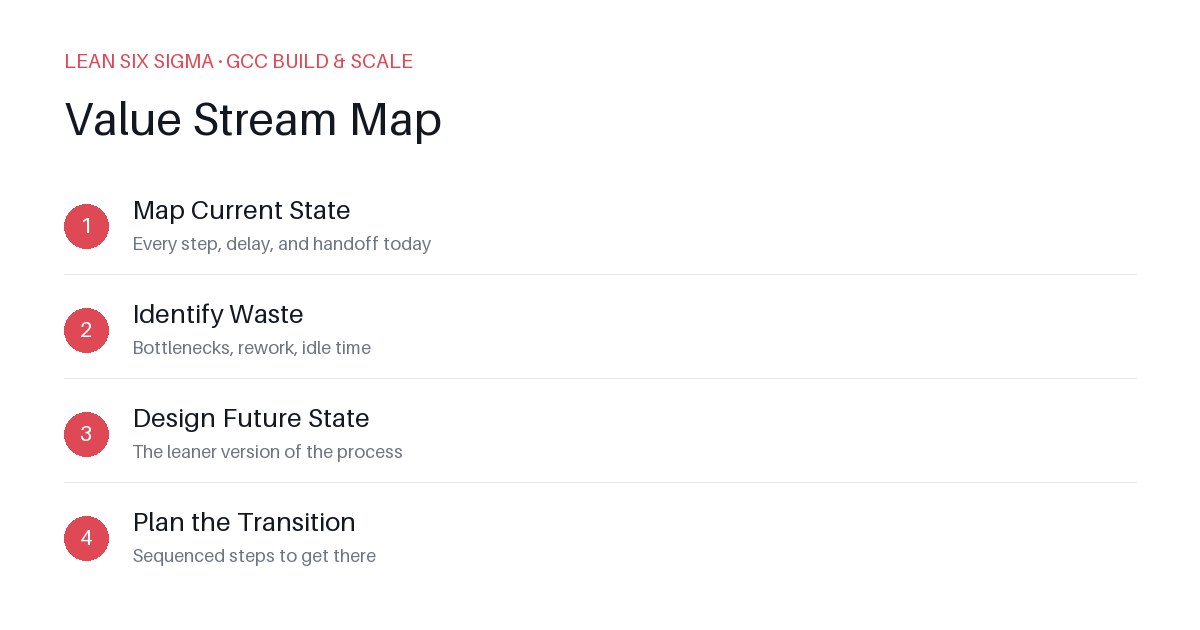
Downloadable templates
Map the handoff between GCC and shared services to eliminate delays, clarify ownership, and cut cycle time by 30%.
The Handoff Bottleneck
Shared services and GCCs share a common problem: the handoff. A request leaves the GCC, enters the shared services queue, and sits for days. The GCC team gets blamed for slow delivery. Shared services says the request was incomplete. Neither side owns the gap.
Value Stream Mapping (VSM) exposes the handoff as a process, not a blame game. You draw the flow from request initiation to final delivery. You mark each step, the owner, the wait time, and the handoff trigger. The result is a single map that shows where work stops, who is waiting, and what information is missing.
Build the Map
Start with a real request. Do not use a hypothetical. Pick one recent handoff that took longer than expected. Follow the actual path.
- Define the start and end. Start at the moment the GCC team creates the ticket. End when the shared services team completes the work and the ticket closes.
- List every step. Include approvals, data transfers, status checks, and rework loops. Write each step in one line. Do not combine steps.
- Assign an owner. Each step has one owner. If two teams are responsible, the handoff is broken. Pick the team that must act next.
- Measure wait time. For each step, record how long work sat idle. Use ticket timestamps. Do not estimate. Use real data from the last ten handoffs.
- Mark the handoff trigger. Identify the exact signal that moves work from one team to the next. This is usually a status change, a data packet, or an approval. If the trigger is vague, the handoff will fail.
Find the Leaks
Once the map is built, look for three patterns:
- Long waits at handoffs. If work sits for more than four hours between teams, the trigger is weak. The receiving team is waiting for information that is not yet available.
- Rework loops. If work returns to the GCC team after the handoff, the requirements were unclear. The GCC team did not provide the data the shared services team needs.
- Multiple owners. If a step has two owners, no one is responsible. The work stalls until someone volunteers.
Fix the Handoff
The map reveals the problem. The fix is simple:
- Clarify the trigger. Define the exact data or status that moves work forward. Example: the GCC team attaches the data file and changes the ticket to "Ready for Shared Services." The shared services team starts work only when the ticket changes to that status.
- Add a checklist. Create a one-page checklist for the GCC team. It lists the data and approvals required before the handoff. The GCC team checks each item before submitting.
- Set a SLA for the handoff. Define how long the shared services team must acknowledge the request after the trigger. Example: within two hours. If the team cannot start work, they must return the ticket with a reason.
- Review the map monthly. Track wait times and rework rates. If the numbers do not improve, revisit the map. The handoff will drift if you do not monitor it.
Example in Practice
A GCC team builds machine learning models. They hand off to shared services for deployment. The handoff took seven days. The VSM showed that the shared services team waited three days for environment credentials. The GCC team did not include the credentials in the ticket.
The fix: The GCC checklist now requires the credentials. The trigger is the ticket status change to "Credentials Attached." The shared services team acknowledges within two hours. The handoff now takes two days. The GCC team delivers on time. The shared services team starts work immediately.
The map did not change the technology. It changed the process. The handoff became predictable. The teams stopped blaming each other. The work moved.
Next Steps
Start with one handoff. Map it. Fix the trigger. Add the checklist. Measure the result. Repeat for the next handoff. Do not map everything at once. Pick the handoff that causes the most pain. Fix it first. The map will show you where to start.
The goal is not a perfect map. The goal is a faster handoff. The map is the tool. The process is the fix. The result is speed.
Comments
Be the first to comment on this post.
Sign in to leave a comment.