A SIPOC Map for Standing Up a New GCC Function
August 23, 2026
Like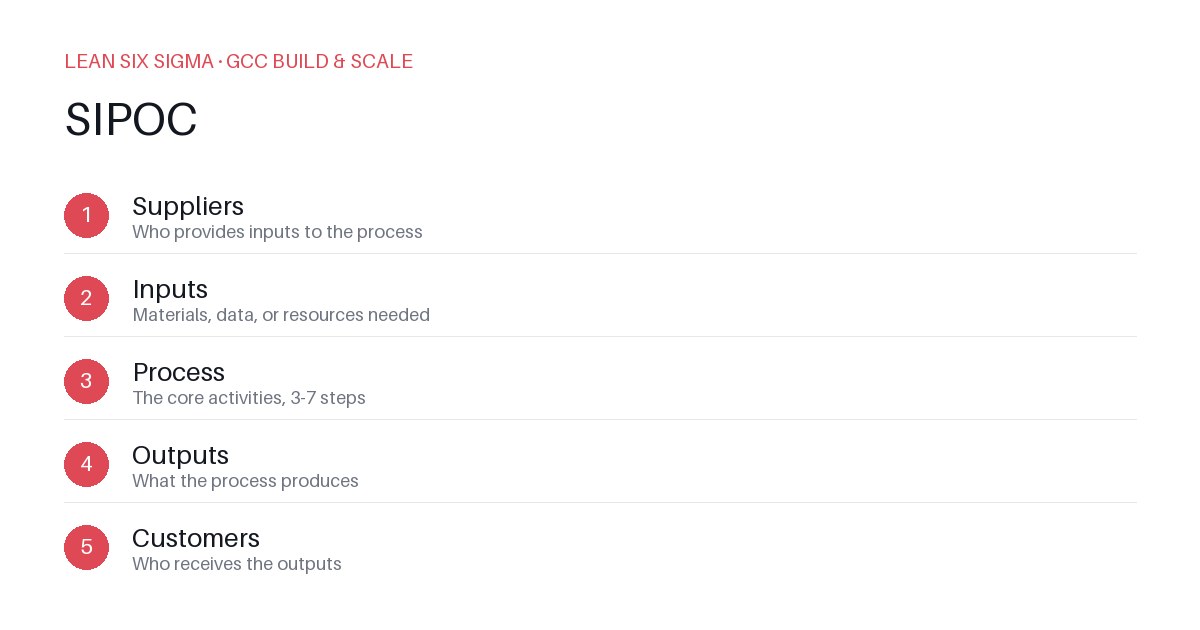
Downloadable templates
Map the SIPOC process before hiring: suppliers, inputs, process steps, outputs, and customers to avoid scope creep and misaligned handoffs.
Define the Function Scope First
A new GCC function often starts as a vague request: “We need better data analytics.” Without a SIPOC (Suppliers, Inputs, Process, Outputs, Customers) map, you’ll hire for the wrong problem, buy tools that don’t integrate, and create handoff gaps that kill delivery speed.
Start by naming the function in one sentence. Example: “Provide automated monthly demand forecasts to supply chain planning teams.” If you can’t say it in one line, you’re not ready to map.
Identify Suppliers and Inputs
Suppliers are anything that feeds your process. Don’t just list people. List systems, data sources, and policies.
- Suppliers: ERP system, CRM data feed, historical sales team, external market research vendor, compliance review group.
- Inputs: Raw transaction data, pricing rules, seasonality factors, approval thresholds, SLA definitions.
If an input isn’t documented, it becomes a bottleneck later. Ask: “What exactly does this input look like? Format, frequency, quality standard?”
Map the Process Steps
Break the function into 3–5 core steps. No sub-processes yet. Use active verbs.
- Collect raw data from ERP and CRM.
- Clean and validate against defined quality rules.
- Model using approved forecasting algorithms.
- Review with subject-matter experts for adjustments.
- Publish final forecasts to planning system.
Number each step. Assign one owner. If a step has more than three sub-actions, you’re overcomplicating. Simplify or delegate.
Define Outputs and Customers
Outputs are what the function delivers. Customers are who consumes them.
- Outputs: Forecast dataset (CSV/API), confidence intervals, anomaly flags, revision log.
- Customers: Supply chain planners, procurement analysts, executive dashboard team.
Specify how each customer receives the output. Email? API? Scheduled report? If the delivery method isn’t defined, adoption fails.
Validate the SIPOC Before Hiring
Use the map to stress-test your plan:
- Gap check: Can any step fail without a fallback? Add contingency inputs.
- Bottleneck scan: Which step takes longest? Can it be parallelized or automated?
- Customer feedback loop: How will you measure if outputs meet customer needs? Define KPIs now.
Example: If “Review” step takes 5 days, customers won’t trust the forecast. Move review to 24 hours with automated anomaly detection.
Implement in Lean Six Sigma Terms
Treat the SIPOC as your value stream map.
- Eliminate: Remove redundant data validation steps.
- Combine: Merge collection and cleaning if possible.
- Reorder: Validate before modeling.
- Reduce: Cut non-essential approval layers.
- Measure: Track cycle time per step.
Document the SIPOC in a shared template. Version it. Review quarterly. When scope changes, update the map before changing headcount or tools.
This isn’t theory. It’s a living blueprint. Build it right, and your GCC function scales without chaos.
Comments
Be the first to comment on this post.
Sign in to leave a comment.