Control Plans for GCC Process Stability
October 15, 2026
Like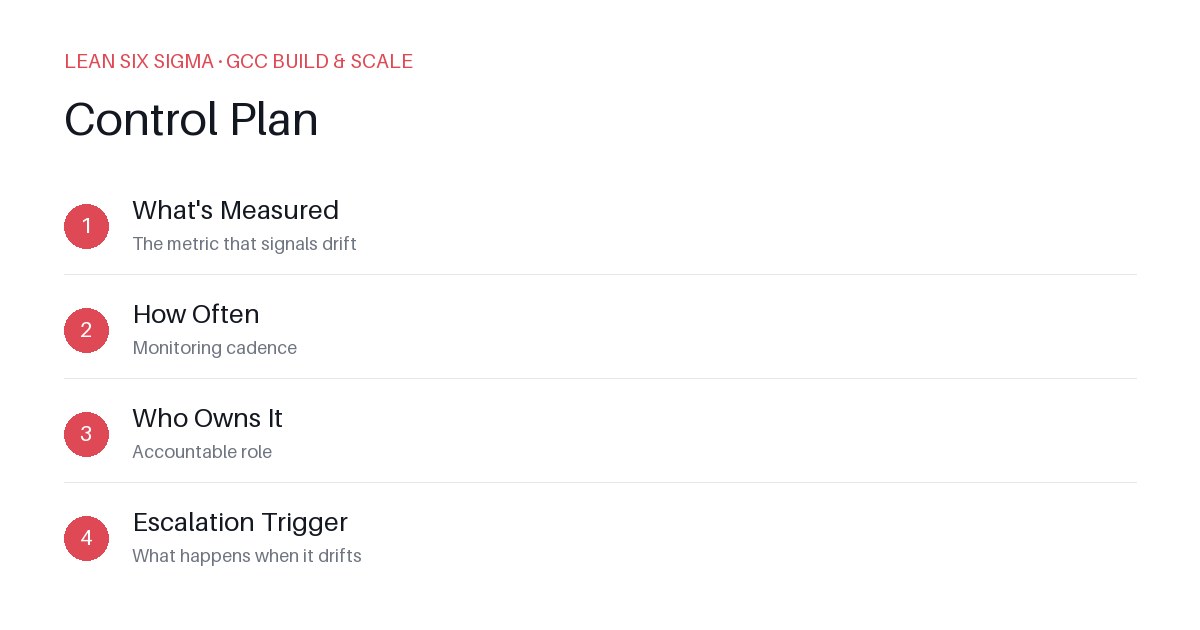
Downloadable templates
A practical guide to building and executing control plans that keep your Global Capability Center processes stable and predictable.
Your GCC is running. The initial chaos has settled, and you’ve hit your first delivery milestones. Now comes the real work: keeping those gains. Without a disciplined control plan, processes drift, defects creep back in, and your team burns out fighting fires instead of building value. A control plan isn’t a document you file away. It’s the operating system for your GCC’s daily rhythm.
Why Most Control Plans Fail
Most teams treat control plans as a compliance exercise. They write them during the project closure phase, sign them off, and forget them. When a defect spikes or a cycle time stretches, there’s no reference point. The result is reactive firefighting.
A working control plan must be:
- Living: Updated weekly based on actual process data, not theoretical targets.
- Specific: Tied to exact process steps, not vague goals like “improve quality.”
- Accessible: Visible to the team running the work, not locked in a shared drive.
Define Your Critical Process Parameters
Start by identifying the 3–5 metrics that directly impact your GCC’s output. For example:
- Cycle time per ticket (not average, but p80 or p95)
- First-pass yield (defects per 100 units processed)
- Rework rate (percentage of work requiring rework)
- Escalation frequency (how often work stalls and needs manager intervention)
Pick one metric per process step. If you’re managing a testing pipeline, track cycle time and defect escape rate. If you’re handling requirements analysis, track clarification loops and rework rate. Don’t track everything. Track what moves the needle.
Set Control Limits, Not Just Targets
Targets are goals. Control limits are boundaries. There’s a difference.
Use historical data to set upper and lower control limits. For example, if your average cycle time is 4 hours with a standard deviation of 1 hour, set a control limit at 6 hours (mean + 2 SD). Anything beyond that triggers investigation, not punishment.
Document these limits clearly:
- Metric: Cycle time for code review
- Target: ≤ 4 hours
- Control Limit: ≤ 6 hours
- Action if breached: Review bottlenecks in QA handoff; adjust workload if needed
Build Simple Monitoring Routines
You don’t need dashboards or complex tools. Start with daily standups and weekly reviews.
In your daily standup:
- Review yesterday’s metric against the control limit.
- Flag any breaches immediately.
- Assign one owner to investigate and report back.
In your weekly review:
- Analyze trends, not just outliers.
- Update the control plan if the process has shifted.
- Celebrate small wins to reinforce stability.
Assign Clear Ownership
A control plan without an owner is a suggestion. Assign a Process Owner for each critical process. Their job isn’t to do the work—it’s to ensure the process stays within control limits.
The Process Owner should:
- Track the metric daily.
- Investigate breaches within 24 hours.
- Report trends to the GCC lead weekly.
- Recommend process adjustments when needed.
Iterate and Refine
Control plans aren’t set and forget. They’re living documents.
Every month, review your control plan:
- Are the limits still accurate?
- Are breaches being addressed?
- Is the process improving or drifting?
Adjust as needed. If a metric consistently breaches the control limit, the limit may be too tight, or the root cause isn’t being addressed. If breaches disappear, consider tightening the limit to drive further improvement.
A control plan isn’t about perfection. It’s about predictability. When your GCC knows what to expect, teams stop guessing and start delivering.
Comments
Be the first to comment on this post.
Sign in to leave a comment.