Lean Control Plans for GCC Process Stability
August 31, 2026
Like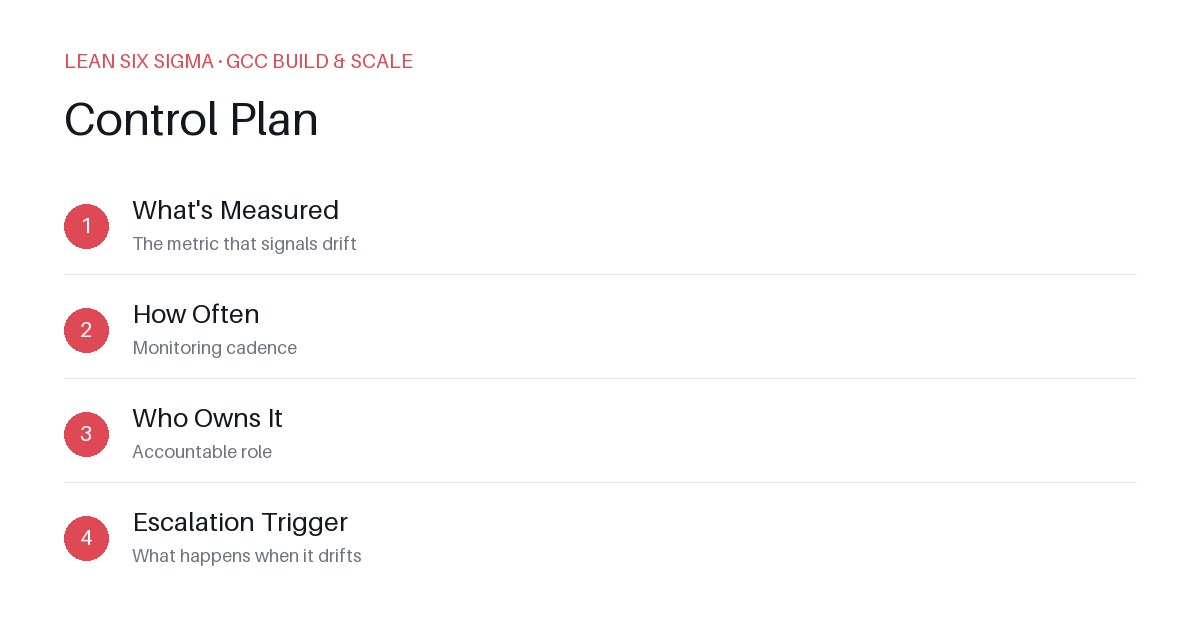
Downloadable templates
Stop guessing when your GCC goes live. Use a structured Control Plan to lock in process stability before scaling headcount.
The Reality of GCC Launches
Most Global Capability Centers fail not because of poor people, but because of poor process handoff. You spend months building the capability, validate it in a pilot, and then dump it into production. Without a formal Control Plan, that pilot is just a memory. Teams revert to ad-hoc work, defects creep back in, and you end up rebuilding the same workflow from scratch.
Why Most Control Plans Fail
A Control Plan isn’t a document. It’s an operating system for your GCC. Most teams treat it as a compliance checklist: define the process, list the steps, and sign off. That’s useless. If your plan doesn’t include decision points, risk triggers, and clear ownership, it’s just a map of where you were, not where you’re going.
Build a Lean Control Plan
Start with the actual work. Don’t abstract. Map the process at the task level, then layer on control points.
- Define the Scope: What’s in and what’s out? If you’re building a GCC for IT Service Management, clarify if you’re handling L1 ticket routing or L2 root cause analysis. Scope creep kills control.
- Map the Flow: Use a value stream map, not a flowchart. Show handoffs, wait times, and where value is added. If you can’t see the bottleneck, you can’t control it.
- Identify Control Points: These are the gates where you verify quality before moving forward. Examples:
- Input validation: Is the request complete and clear?
- Process adherence: Are steps followed in order?
- Output verification: Does the deliverable meet SLA criteria?
- Set Metrics: Tie each control point to a metric. If your metric is vague, your control is useless. Track first-pass yield, rework rate, and cycle time variance. If a metric isn’t measured, it’s not managed.
- Assign Ownership: Every control point needs an owner. Not a team, not a department. A person. If you’re building a GCC for supply chain analytics, who owns the data quality gate? Who owns the model validation gate? Name them.
Implement and Enforce
A Control Plan lives in the work, not in a folder. Embed it into daily operations.
- Integrate into SOPs: Don’t create separate documents. Update your standard operating procedures to include control points. If your SOP doesn’t mention the control, it won’t happen.
- Use Visual Management: Put the Control Plan on a Kanban board or a whiteboard in the GCC workspace. Make it visible. If it’s not seen, it’s not followed.
- Conduct Daily Reviews: Start every day with a 10-minute review of control points. What failed? What’s at risk? Adjust immediately. Control Plans aren’t static; they evolve with the process.
- Audit and Refine: Every two weeks, audit the Control Plan against actual performance. Are control points being skipped? Are metrics drifting? Update the plan based on real data, not assumptions.
Common Pitfalls
- Overcomplicating: Too many control points create friction. Start with three to five critical gates. Add more only if defects spike.
- Ignoring Human Factors: Your GCC is run by people. If the Control Plan doesn’t account for training gaps or skill variations, it will fail. Build in coaching and feedback loops.
- Treating It as a One-Time Event: A Control Plan is a living document. As your GCC scales, the process changes. Update the plan accordingly.
Next Steps
Start small. Pick one process in your GCC. Map it, define your control points, and assign owners. Run it for two weeks. Measure the impact. Then scale. Stability isn’t a destination; it’s a discipline. Build the Control Plan, enforce it, and let your GCC deliver consistently.
Comments
Be the first to comment on this post.
Sign in to leave a comment.