DMAIC to Fix GCC Onboarding Delays
August 20, 2026
Like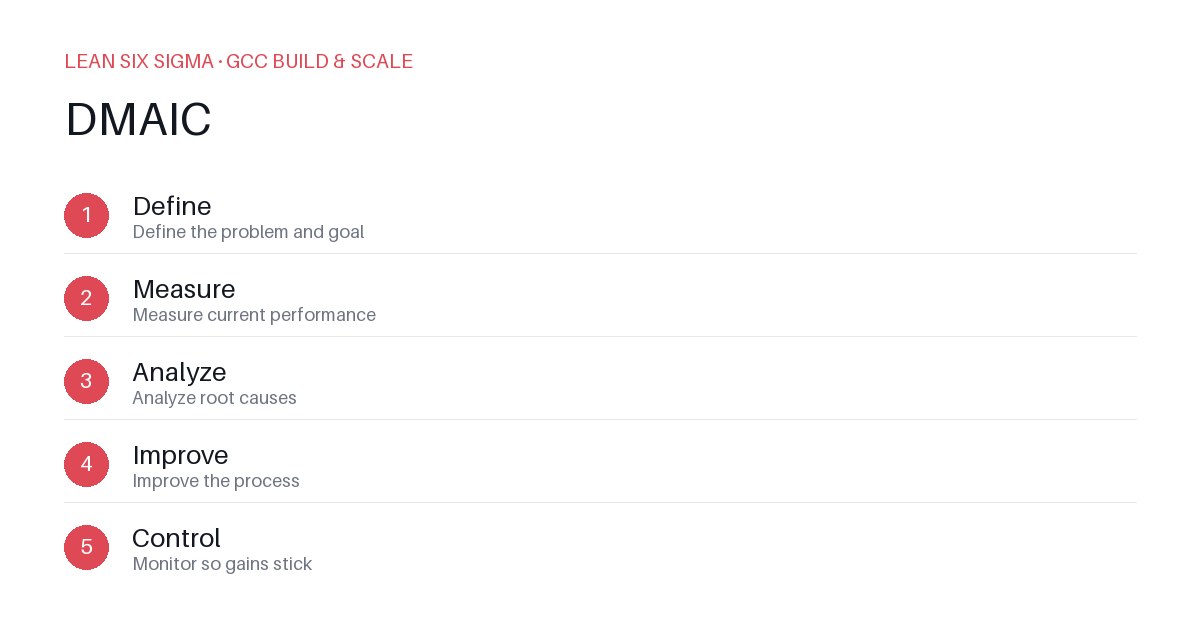
Downloadable templates
Map, measure, and fix onboarding bottlenecks using DMAIC phases to cut time-to-productivity for new GCC hires.
Define the Problem
Onboarding delays in Global Capability Centers (GCCs) usually stem from unclear roles, fragmented handoffs, or missing training resources. Start by interviewing 5–7 recent hires and their managers. Ask: Where did you wait? What information was missing? Who approved what? Document every step from offer acceptance to first task. Create a value stream map showing each handoff, approval, and system setup. Identify the top three delays that impact time-to-productivity.
Measure the Current State
Track onboarding timelines for the last 20 hires. Record days between each milestone: offer accepted, background check cleared, equipment provisioned, system access granted, first training module completed, first task assigned. Use a simple spreadsheet or dashboard. Calculate average and standard deviation for each phase. Flag any step with variance >2 days. Example: if system access averages 5 days with a range of 1–9, that’s a bottleneck. Correlate delays with team size, location, or role type. This data tells you where to intervene first.
Analyze Root Causes
Apply the 5 Whys to each major delay. For system access: Why 5 days? IT queue. Why queue? No priority tagging. Why no tagging? Onboarding form lacks IT priority field. Why? Form was designed by HR, not IT. Root cause: misaligned ownership and missing fields. Use a cause-and-effect diagram to map dependencies. Identify which delays are controllable (e.g., training content gaps) versus external (e.g., visa processing). Focus DMAIC actions on controllable factors. Prioritize fixes by impact on overall time-to-productivity.
Improve the Process
Redesign the onboarding workflow based on root causes. Add an IT priority field to the onboarding form. Create a shared checklist with assigned owners and SLAs for each step. Implement a daily 15-minute standup for onboarding coordinators during peak periods. Develop role-specific microlearning modules instead of one-size-fits-all training. Pilot the new process with the next 10 hires. Assign a process owner to monitor adherence. Build in feedback loops: after each milestone, ask the hire to rate clarity and speed. Adjust based on real-time input.
Control and Sustain
Embed the improved process into your GCC operating model. Track onboarding metrics weekly: average time-to-productivity, % on-time milestone completion, hire satisfaction score. Set control limits: e.g., system access must be ≤2 days. If a step breaches limits, trigger a root cause review within 48 hours. Conduct monthly process audits with cross-functional teams. Update training materials when role requirements change. Celebrate wins: share before/after metrics with leadership. This keeps momentum and prevents regression. Continuous monitoring turns onboarding from a cost center to a competitive advantage.
Comments
Be the first to comment on this post.
Sign in to leave a comment.