Client Interference Kills GCC Deliveries
August 15, 2026
Like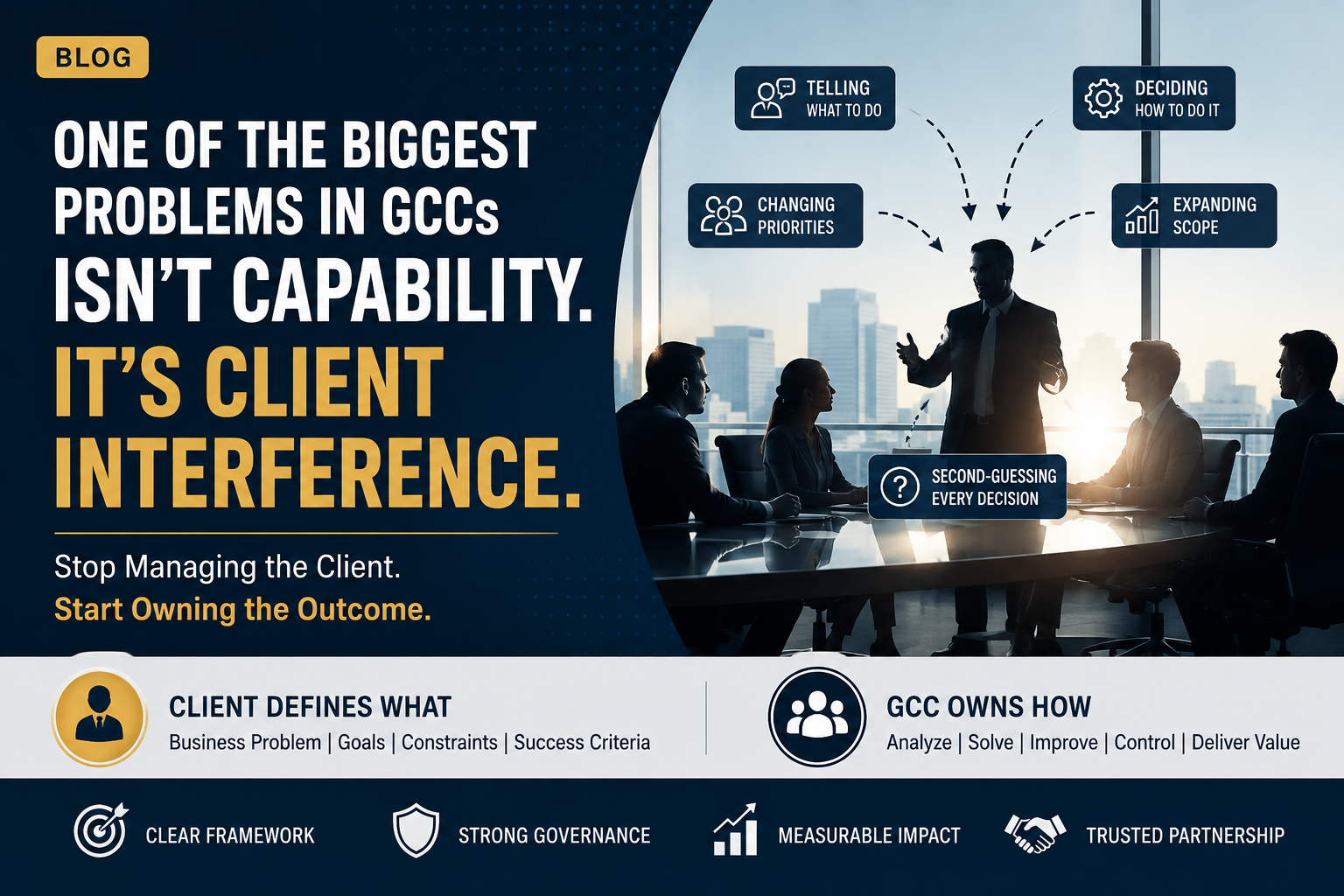
Downloadable templates
When clients shift from governance to interference, GCCs lose focus on outcomes. Discover how client interference kills delivery success.
One of the Biggest Problems in GCCs Isn’t Capability. It’s Client Interference.
A GCC can have the right talent, technology, processes, and leadership—and still lose an engagement.
The problem?
The client starts managing the HOW.
At the beginning, the client defines a clear business problem:
“We need to reduce operational cost.” “We need to improve quality.” “We need to reduce turnaround time.”
That is exactly what the client should do.
But gradually, the conversation changes.
The client starts saying:
- “Use this technology.”
- “Do it this way.”
- “Why don't you try this approach?”
- “We need these additional reports.”
- “Add this process as well.”
- “I think this is the root cause.”
- “Can your team work on this instead?”
Suddenly, the GCC is no longer solving the client's problem.
The GCC is executing the client's instructions.
And that's where the engagement starts becoming dangerous.
The Hidden Cost of Client Interference
Client involvement is important. But there is a massive difference between governance and interference.
Good governance means the client:
- Defines the business outcome
- Provides context and constraints
- Provides data and access
- Makes strategic decisions
- Approves major milestones
- Measures the final business impact
Interference means the client starts:
- Directing individual tasks
- Prescribing solutions before analysis
- Changing priorities continuously
- Expanding scope informally
- Managing individual GCC resources
- Second-guessing every technical decision
The result is predictable.
More meetings. More revisions. More delays. More scope creep. Less ownership. Lower margins.
And eventually, a project that looked successful at the beginning can become a project that the GCC risks losing.
The GCC Should Own the HOW
The solution isn't to keep the client away.
The solution is to create a delivery model where responsibilities are crystal clear.
Client defines WHAT.
The client should tell the GCC:
What problem needs to be solved?
What outcome matters?
What constraints exist?
What does success look like?
GCC owns HOW.
The GCC should determine:
How the problem will be measured.
How the root cause will be identified.
How the solution will be designed.
How technology should be used.
How the improvement will be implemented.
How the results will be measured and controlled.
That's the difference between a GCC acting as a staff augmentation team and a GCC acting as a strategic delivery partner.
This Is Where Lean Six Sigma Fits
A structured Lean Six Sigma approach gives the GCC a framework to take ownership without making the engagement feel arbitrary.
The DMAIC model provides a natural delivery structure:
1. DEFINE
Understand the business problem.
Create the project charter, define the scope, identify stakeholders and establish measurable objectives.
The client provides the business context.
The GCC converts that context into a structured project.
2. MEASURE
Establish the facts.
Collect and validate the relevant data, define KPIs and create the baseline.
Instead of debating opinions, the GCC creates an evidence-based starting point.
3. ANALYZE
Find the real root cause.
Use process analysis, Pareto analysis, statistical techniques and structured root-cause analysis.
This is particularly important when the client already believes they know the answer.
The GCC shouldn't simply implement the client's assumption.
It should validate the assumption against evidence.
4. IMPROVE
Design and prioritize solutions.
Once the root cause is validated, the GCC develops improvement options, evaluates impact and effort, and recommends the best path forward.
The client makes the strategic decision.
The GCC does the analysis that makes that decision easier.
5. CONTROL
Make the improvement sustainable.
Create the control plan, KPI monitoring, ownership model, escalation triggers and executive reporting.
The project shouldn't end with:
“We implemented the solution.”
It should end with:
“The improvement is measurable, controlled and sustainable.”
Move Client Involvement to Decision Gates
One of the simplest ways to reduce interference is to stop making the client part of every activity.
Instead, create clear decision gates.
Gate 1 — Scope
GCC presents the Project Charter.
Client: Approves the problem, objective and scope.
Gate 2 — Baseline
GCC presents the measurement and baseline analysis.
Client: Confirms the baseline.
Gate 3 — Root Cause
GCC presents the validated root causes.
Client: Validates the findings.
Gate 4 — Improvement
GCC presents the recommended solutions and pilot plan.
Client: Approves the direction.
Gate 5 — Control
GCC presents the results, business impact and control plan.
Client: Approves handover.
This changes the relationship completely.
Instead of the client asking:
“What is your team doing today?”
The conversation becomes:
“What decision do you need from us?”
That's a much healthier GCC-client relationship.
What About Scope Creep?
This is where many GCC engagements quietly lose money.
A client asks for something small.
Then another request comes.
Then another.
Each request seems reasonable individually.
But collectively, the project has become something completely different from what was originally sold.
The solution is simple:
Change Control.
Every material change should answer:
- What changed?
- Why is it required?
- What is the impact on scope?
- What is the impact on timeline?
- What is the impact on cost?
- Who approved the change?
This doesn't create friction.
It creates professionalism and transparency.
The Done-for-You GCC Model
The ultimate objective is to create a repeatable delivery model where the customer doesn't have to manage the GCC.
The model becomes:
CLIENT
Business Problem ↓ Business Objective ↓ Data / Access ↓ Strategic Decisions ↓ Approval
GCC
Define ↓ Measure ↓ Analyze ↓ Improve ↓ Control ↓ Report ↓ Handover
The client pays for the engagement.
The GCC owns the delivery.
The client remains involved where their business judgment is required.
The GCC owns the execution where professional expertise is required.
Trust Is the Real Product
The goal isn't to tell the client:
“Don't interfere.”
That's the wrong conversation.
The goal is to build a system that makes the client comfortable saying:
“You own it. Just keep us informed and bring us the decisions.”
That level of trust doesn't come from presentations.
It comes from:
- Clear governance
- Measurable outcomes
- Evidence-based decisions
- Predictable delivery
- Transparent reporting
- Strong change control
- Demonstrable business value
When the GCC consistently demonstrates these capabilities, the client's need to manage the details naturally decreases.
From GCC Execution to GCC Ownership
The evolution looks like this:
Staff Augmentation
“Tell us what to do.”
↓
Managed Delivery
“We'll execute the plan.”
↓
Outcome-Based Delivery
“Tell us the business problem. We'll determine the best way to solve it.”
That final stage is where GCCs create significantly more strategic value.
A mature GCC shouldn't simply provide people.
It should provide ownership.
And ownership requires one fundamental principle:
Client Defines WHAT. GCC Owns HOW.
That is how you move from a client-managed GCC engagement to a trusted, outcome-driven delivery partnership.
Comments
Be the first to comment on this post.
Sign in to leave a comment.