PDCA Loops for GCC Vendor Governance
September 1, 2026
Like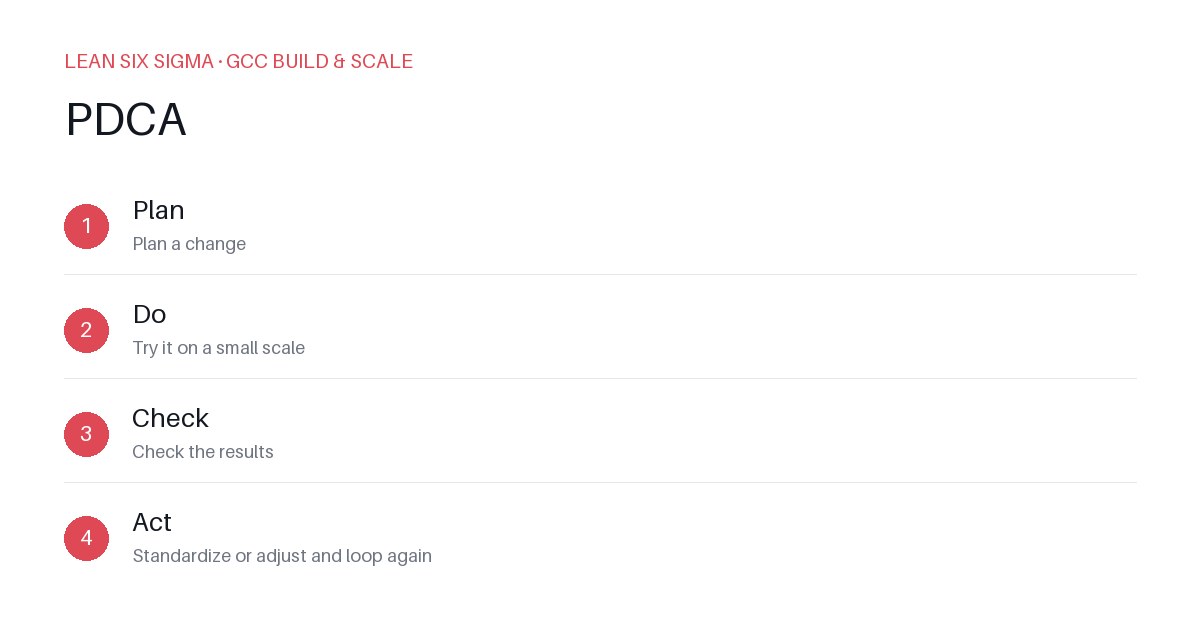
Downloadable templates
Run PDCA cycles to fix vendor drift, cut costs, and keep your GCC aligned with business goals.
Start with a Clear Problem Statement
Most GCCs don’t fail because they lack tools. They fail because vendors deliver what they were told to deliver — not what the business actually needs. That gap is where PDCA begins.
Define your problem in one sentence. Example: "Our vendor-managed test automation suite has a 40% defect escape rate in production, costing $120K/month in rework."
Avoid vague goals like "improve quality." That won’t drive action.
Plan: Map the Vendor’s Actual Work
Don’t assume you know how the vendor operates. Map their actual process:
- Who writes the test cases?
- When are they reviewed?
- How are defects tracked?
- What’s the handoff to QA?
Interview their team. Look at their Jira. Compare it to your internal standards.
Identify two root causes. Common ones:
- No peer review on test design
- Defects closed without root cause analysis
- Vendor SLA doesn’t penalize escape defects
Draft a countermeasure. Example: Add a mandatory peer review step and tie 10% of vendor payment to defect escape rate.
Do: Pilot with One Vendor, One Process
Don’t roll this out globally. Pick one vendor and one process.
Set a 30-day pilot. Track:
- Number of test cases reviewed
- Defect escape rate before and after
- Vendor satisfaction score
Keep it simple. Use a shared dashboard. Update weekly.
Check: Measure, Don’t Guess
At day 30, review the data:
- Did defect escape rate drop?
- Was the vendor resistant or cooperative?
- Did the pilot take longer than planned?
If it worked, document the steps. If it didn’t, adjust the countermeasure.
Common mistake: Checking only the outcome, not the process. You need both.
Act: Scale or Stop
If the pilot improved defect escape rate by >20%, scale it to other vendors.
Update the vendor contract. Add the new review step and payment tie-in.
If it didn’t work, stop. Don’t force a broken process.
Start a new PDCA cycle with a different root cause.
Keep the Loop Running
Vendor governance isn’t a one-time fix. It’s a cycle.
- Monthly: Review vendor performance against new KPIs
- Quarterly: Run PDCA on top 3 issues
- Annually: Renew contracts with updated governance terms
Track your progress in a simple spreadsheet. Share it with leadership.
The goal isn’t perfection. It’s continuous improvement.
Final Note
PDCA works because it forces you to act, measure, and adjust — not just plan and hope.
Start small. Pick one vendor. Fix one problem. Repeat.
Your GCC will thank you.
Comments
Be the first to comment on this post.
Sign in to leave a comment.