PDCA Loops for GCC Vendor Governance
September 10, 2026
Like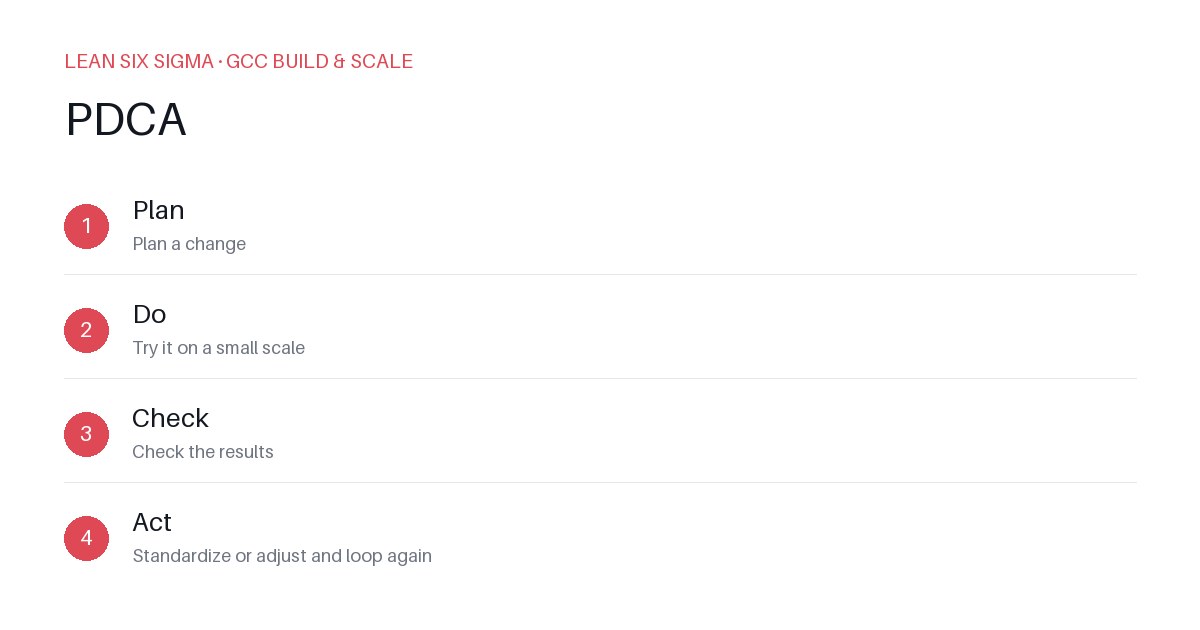
Downloadable templates
Run PDCA cycles on your GCC vendors to cut waste, fix defects, and keep your capability center running lean.
The Problem With Vendor Governance
Most Global Capability Centers (GCCs) treat vendor governance as an annual audit. You send out a questionnaire, get a PDF back, and file it away until next year. That approach fails because vendor performance drifts daily. You don't know if your cloud costs are bloated, your code quality is dropping, or your team is losing institutional knowledge until the quarterly review.
You need a continuous feedback loop. Lean Six Sigma gives you one: the PDCA cycle (Plan, Do, Check, Act). When applied to vendor governance, it turns passive oversight into active process control.
Plan: Define What "Good" Looks Like
Don't start with a audit checklist. Start with your value stream.
Identify the top three risks your vendor introduces. Is it security? Is it delivery velocity? Is it cost variance? Pick one metric to drive the PDCA loop. If you try to fix everything at once, you'll get analysis paralysis.
Set a baseline. What is your current cycle time for bug resolution? What is your current defect rate in delivered artifacts? What is your current cloud spend per FTE? You cannot improve what you do not measure. Define your target state clearly. For example: "Reduce mean time to resolution for critical bugs by 20% in 90 days."
Do: Implement the Change
This is where most GCCs stall. They plan for six months and never execute.
Run a pilot. Don't roll out a new governance framework to all vendors. Pick one team. One vendor. One process.
If your goal is to reduce defect rates, implement a mandatory peer review gate before code merges. If your goal is to cut cloud waste, implement automated shutdown scripts for non-prod environments. If your goal is to improve delivery speed, implement a daily stand-up with the vendor lead.
Keep the change small enough to test in two weeks. You need data, not opinions. Document every change you make.
Check: Measure the Impact
Compare your baseline to your new data. Did the defect rate drop? Did the cycle time improve? Or did things get worse?
Use a simple control chart. Plot the metric over time. Look for trends, not just averages. A single data point is noise. A trend of five points is signal.
If the data shows improvement, you have a winning process. If the data shows no change or degradation, you have a learning opportunity. Both are valuable. The key is that you know the truth, not what the vendor wants you to believe.
Act: Standardize or Adjust
If the pilot worked, standardize it. Update the vendor contract if necessary. Add the new gate to your SLA. Train the rest of the GCC teams on the new process. This is where the real savings happen.
If the pilot failed, adjust. Why did it fail? Was the tool too slow? Was the team resistant? Was the metric the wrong one? Go back to Plan. Refine the hypothesis. Try again.
This is the heart of Lean. You don't get it right the first time. You get it right faster than anyone else by iterating.
Why This Works
Most GCCs are bloated with governance theater. PDCA cuts the fluff. It forces you to focus on one thing at a time. It gives you objective data to discuss with your vendors. It turns governance from a cost center into a value driver.
Start small. Pick one vendor. Pick one metric. Run the loop. Repeat. You will be surprised how quickly your GCC transforms.
Comments
Be the first to comment on this post.
Sign in to leave a comment.