PDCA Loops for GCC Vendor Governance
August 21, 2026
Like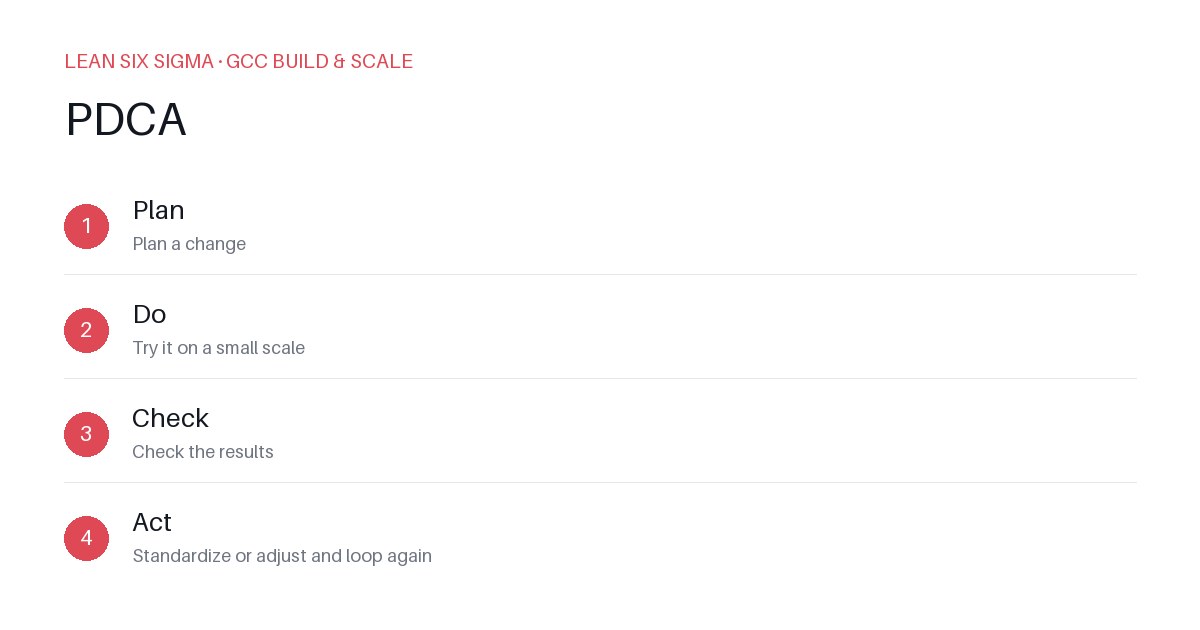
Downloadable templates
Apply PDCA to vendor governance to turn passive contracts into active capability drivers with measurable results.
Most Global Capability Centers (GCCs) treat vendor management as a compliance checkbox. You sign a contract, assign a point of contact, and hope the deliverables align with your roadmap. This approach fails when market conditions shift or when vendors deliver on time but not on quality.
PDCA (Plan-Do-Check-Act) is not just a quality tool for manufacturing. It is the operational framework for turning vendor relationships into strategic assets. Here is how to implement PDCA loops specifically for GCC vendor governance.
Plan: Define Governance Metrics That Matter
Stop measuring vendor performance by hours logged or tickets closed. These are vanity metrics. Plan your governance by defining three concrete outcomes:
- Capability Maturity: How much does this vendor increase your team's skill level? Track via quarterly certification rates or process adoption scores.
- Delivery Predictability: Measure variance against SLAs. Use a simple scorecard: (On-time deliveries / Total deliverables) x 100.
- Cost of Quality: Calculate the cost of rework, bugs, or delays caused by the vendor. This exposes hidden inefficiencies.
Write these metrics into a governance charter. Every vendor review must reference this charter. If a metric is not defined, it is not measured.
Do: Execute with Transparent Workflows
Execution fails when processes are opaque. Implement a shared dashboard that shows real-time progress against the three metrics above. Use RACI matrices to clarify who is Responsible, Accountable, Consulted, and Informed for each deliverable.
- Weekly Syncs: 30-minute standups focused only on blockers and metric deviations. No status updates.
- Sprint Reviews: End-of-sprint demos where the vendor presents work to the GCC business owner, not just the project manager.
- Documentation: All decisions and changes to scope must be logged in a central repository. Ambiguity is the enemy of execution.
Check: Audit Against Reality
The check phase is where most organizations fail. You must compare actual performance against the plan. Do not rely on vendor self-reports.
- Data Validation: Pull data from your Jira, Trello, or equivalent tool. Cross-reference it with the vendor's dashboard.
- Root Cause Analysis: When a metric misses, use the 5 Whys technique. Ask why five times until you find the systemic issue. Is it a skill gap? A tool limitation? A misaligned requirement?
- Feedback Loop: Share the findings with the vendor immediately. Frame it as a collaboration, not a blame game. "Our data shows a 15% delay rate. Let's analyze the root cause together."
Act: Close the Loop and Scale
The act phase is where improvement happens. Based on the check results, make decisive changes.
- Adjust Contracts: If a vendor consistently misses quality targets, renegotiate terms. Add penalty clauses or shift to performance-based pricing.
- Upskill or Replace: If a vendor's team lacks critical skills, require them to invest in training or replace the team. If they cannot adapt, terminate the relationship.
- Standardize Best Practices: If a vendor introduces a process that improves efficiency, document it and roll it out to other vendors. This creates a culture of continuous improvement.
PDCA is not a one-time event. It is a cycle. Repeat it every quarter. Each loop should bring you closer to a vendor partnership that drives capability, not just cost.
Start small. Pick one vendor. Apply PDCA for 90 days. Measure the results. Scale what works.
Comments
Be the first to comment on this post.
Sign in to leave a comment.